When a Brussels Voice Echoes Abuja: The Insecurity Triad reaches the Afro-European policy corridor
There is a particular kind of validation that no press release can manufacture and no institutional affiliation can accelerate.
There is a particular kind of validation that no press release can manufacture and no institutional affiliation can accelerate. It is the kind that arrives from an unexpected geography, carried by a voice with no prior connection to the work — and yet speaks of it with the precision of someone who has studied it carefully.
That validation arrived this week in the pages of BusinessDay, Nigeria’s foremost financial daily, in the form of an opinion piece by Collins Nweke — an International Trade Consultant and Economic Diplomacy researcher writing from Brussels, Belgium.
Nweke’s piece, titled ‘The Insecurity Triad: Why Nigeria’s Crisis is Europe’s Frontline’, does something that no Nigerian commentator had yet done in print: it takes the Insecurity Triad framework — originally developed by this writer as an analytical instrument for understanding Nigeria’s convergent security crisis — and applies it to the Afro-European policy corridor, arguing that what happens in Nigeria’s forests, farmlands, and ideological battlegrounds is not a distant African problem but a direct European security concern.
That argument, made independently from Brussels, marks a threshold moment for the framework.
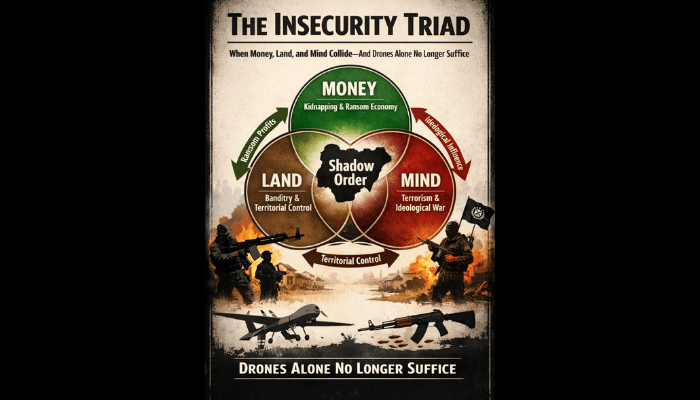
The Insecurity Triad defines Nigeria’s security crisis as a convergent system driven by three mutually reinforcing forces: kidnapping as a ransom economy (Money), banditry as territorial contestation (Land), and terrorism as ideological warfare (Mind). Introduced through this author’s column, The Sunday Stew, and formalised through the Sundiata Post Intelligence Unit’s working paper series — now deposited on Harvard Dataverse and cascading across four additional global scholarly platforms — the framework was designed to move beyond description toward diagnosis.
What Nweke’s piece demonstrates is that it has begun to move beyond Nigeria.
Writing from the capital of the European Union’s institutional architecture, Nweke describes The Insecurity Triad as “more than a local diagnosis” and “a masterclass in thought leadership.”
He argues, with the precision of a practitioner rather than a commentator, that the three arms of the framework map directly onto Europe’s most pressing strategic anxieties about Africa.
His reading is worth examining in full, because it reveals something important: an internationally located policy mind, encountering the framework independently, arrives at conclusions that extend — rather than merely repeat — its analytical logic.
Nweke’s first application of the framework concerns the Land arm — banditry as territorial contestation. In his reading, the systematic destruction of Nigeria’s agricultural heartland by armed bandits is not merely a food security or displacement crisis. It is the primary engine of the irregular migration pipelines that eventually reach the Mediterranean.
When farmers cannot till their land, they move. First internally, then regionally, then across the Sahara and the sea. The camps in Libya, the boats in the central Mediterranean, the arrivals on the shores of Lampedusa — these are not random phenomena. They are the downstream consequence of a territorial crisis that The Insecurity Triad names and maps with precision.
For European policymakers who have spent years treating irregular migration as a border management problem, Nweke’s argument offers a corrective: the border is not in the Mediterranean. It is in the Middle Belt of Nigeria, where the Land arm of The Insecurity Triad is dismantling the conditions that keep people in place.
Nweke’s second application concerns the Money and Mind arms operating, as he puts it, “in the borderless digital realm.” The kidnapping industry, he argues, is increasingly fuelled by global cryptocurrency exchanges. Ideological radicalisation uses the same social media platforms used in Brussels and Berlin.
This is a consequential observation. It means that the Money arm — the financial architecture sustaining Nigeria’s ransom economy — is not confined to Nigerian bank accounts or informal hawala networks. It touches European financial nodes. Ransom flows, crypto transactions, and money laundering networks that originate in Nigeria’s forests pass through financial infrastructure that is partially located in Europe.
Similarly, the Mind arm — terrorism as ideological warfare — does not respect the borders that European intelligence agencies were designed to monitor. The same platforms radicalising young men in Borno and Sokoto are operating in the suburbs of London, Paris, and Amsterdam.
Nweke’s argument, in essence, is that The Insecurity Triad is not a Nigerian problem contained within Nigerian borders. It is a transnational system with European nodes.
The third application is perhaps the most strategically significant for the current moment. As Europe scrambles to diversify its energy and critical mineral supply chains away from Russian dependence, it looks increasingly toward Africa. Nigeria — with its oil, gas, and untapped mineral wealth — sits at the centre of that diversification calculus.
But a Nigeria paralysed by The Insecurity Triad, Nweke argues, is a Nigeria that cannot be the reliable economic partner Europe needs for its green transition. The Land arm disrupts agricultural and territorial stability. The Money arm captures economic surplus that should flow into productive investment. The Mind arm creates the ideological conditions for permanent instability.
Europe’s green transition, in other words, has a Nigerian security precondition. The Insecurity Triad stands between Europe’s climate ambitions and the African resources those ambitions require.
What makes Nweke’s piece analytically interesting beyond its application of the framework is its policy prescription. He argues for what he calls a “recalibration imperative” — a shift from reactive aid to structural engagement — and proposes three strategies anchored in the framework’s three arms.
For the Money arm: integrating Nigeria into European Financial Intelligence networks to track and disrupt ransom flows. For the Land arm: deploying Europe’s Copernicus satellite programme to provide real-time geospatial intelligence for territorial visibility. For the Mind arm: a “Digital Marshall Plan” for rural education as a counter-narrative to ideological radicalisation.
These are Nweke’s own policy proposals — extensions of the framework rather than derivations from it. But their coherence depends entirely on the framework’s analytical architecture. Without The Insecurity Triad’s tripartite structure, there is no logical basis for three distinct policy interventions targeting three distinct systemic forces. The framework is doing the intellectual work that makes the policy argument possible.