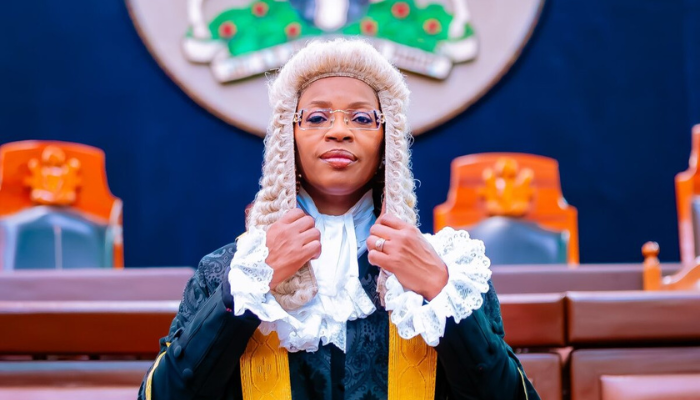
She did not wait to be chosen. She ran. On the seat you claim versus the seat you are handed.
- +Why this first moved me when others have not
- +The seat you are handed, and the seat you claim
- +But claiming is a campaign, not a declaration
- +What my sister-in-law taught a generation of women
There is an argument going on this last week, in WhatsApp groups and across LinkedIn, and it is the wrong argument.
There is an argument going on this last week, in WhatsApp groups and across LinkedIn, and it is the wrong argument.
When the news broke that Oyinkansola Badejo-Okusanya, Senior Advocate of Nigeria, had become President of the Nigerian Bar Association, the headlines called her the first female president. And immediately the correction came. She is not the first, people insisted. She is the second. Dame Priscilla Kuye led the NBA back in 1991. Please do your research. Please read to understand.
Both sides are technically right, and both are missing the point. Because the word that actually matters is not first or second. It is elected.
Dame Kuye was indeed the first woman to hold the office, and she deserves every honour for it. But she did not arrive there by the ballot. She was First Vice President when the sitting president left to become Attorney-General of the Federation, and she stepped up, by succession, to fill the vacant seat. She was handed the office by circumstance, and she carried it with real distinction.
Badejo-Okusanya did something different in kind. She ran. She stood before the entire Bar, contested against two Senior Advocates, and won with almost half the votes cast in a field of thousands. She is the first woman the Nigerian Bar ever elected to lead it. And the difference between being handed a seat and being elected to one is not a technicality. It is the entire story.
Why this first moved me when others have not
I should be honest about something.
I am not usually the one leading the celebrations when another first woman is announced. I have written before, more than once, about how many of these firsts are appointments into ceremonial or constrained roles, seats with a title and a photograph but very little real power, where the applause runs far ahead of any actual shift in who decides things. That is a deliberately contrarian view, and I hold it on purpose.
It is also not the whole picture, and I want to say that clearly and generously. The rounds of celebration that women’s groups and platforms do when a woman reaches a milestone genuinely work. They encourage other women. They widen the sense of what is possible for a girl watching. They matter, and I honour the women who do that work faithfully, even when I am not the loudest voice in the room.
But it explains why this particular first moved me when so many others have not. Because this was not an appointment into a limited seat. This was not a woman being let in and applauded for arriving. This was a woman contesting for real power, in open competition, and winning it outright. And that, to me, is a different thing entirely. It is the difference between representation and ownership. Between being admitted and being chosen by your peers because you stood up and asked to be.
The seat you are handed, and the seat you claim
There is a profound difference between a seat you are given and a seat you take.
The seat you are handed comes through circumstance. Succession, someone else’s departure, the good fortune of being well placed when a gap opens. It is real, and it counts, and there is no shame in it. But it is not the same as the seat you claim. The seat you claim requires you to do the one thing many brilliant women have been quietly taught not to do. To stand up, in public, and say the words out loud. I am the one for this job. I am not waiting to be noticed, or invited, or chosen when it is convenient. I am putting myself forward, and I am asking for the vote.
I have spent years watching capable women hover at the edge of rooms they were more than qualified to lead, waiting to be tapped on the shoulder. Waiting for permission. Waiting for someone to recognise them and offer what they could have stood up and claimed. And I have watched the seat go, again and again, to whoever asked for it first.
Badejo-Okusanya asked. That is why this matters.
But claiming is a campaign, not a declaration
Here is the part that must not be misunderstood, because it is where the real lesson lives.
Claiming a seat is not simply standing up one day and announcing that you want it. If it were that easy, everyone would do it. Claiming is the visible tip of years of invisible work. And I know, in her case, that the work was there, because I watched some of it.
My first encounter with Oyinkansola Badejo-Okusanya was at the Nigerian Bar Association conference dinner, where I had accompanied my sister-in-law, Dr Ngozi Okonjo-Iweala, who delivered the keynote. Even then, Badejo-Okusanya was already in preparation mode. Already positioning, already building, already doing the quiet groundwork of someone who intended to lead. She is a Senior Advocate of Nigeria, which tells you she had already climbed the hardest professional ladder her field offers. But the presidency required something beyond professional distinction. It required years in the trenches of the association itself. Showing up. Building alliances. Strategic planning. Collaboration. Campaigning. Earning the trust of thousands of colleagues long before the ballot ever opened.
That is what claiming actually looks like. Not a bold declaration made in a single brave moment, but a bold declaration standing on a foundation of years of deliberate, unglamorous work. She could say I am the woman for this job because she had spent years making it true, and making it visible, and making the relationships that would carry it. Competence qualified her. The campaign, the alliances, the preparation, all of it, is what allowed the claim to land. Boldness without the work is only noise. Hers was boldness built on a foundation.
What my sister-in-law taught a generation of women
I learned the value of this posture up close, years ago, watching that same sister-in-law campaign for high office.
What struck me then, and stays with me now, was the same combination. Not just the willingness to declare, but the work underneath it. She made her case. She declared her competence, laid out her vision, ran on the conviction that she was the right person, and let the world weigh it. She stood up and said, in effect, I am the woman for this job, and she had done the work that made the sentence true.
That posture became a lesson I built into the Power Woman Africa curriculum, because it is one of the most important things a woman can learn, and one of the least taught. We spend enormous energy preparing women to be excellent, and almost none teaching them to claim what their excellence has earned. We teach competence and forget to teach candidacy. We produce women who are ready for the seat and terrified of asking for it.