Africa’s prosperity hinges on human-centred leadership, World Public Summit says
Africa’s long-term prosperity will depend on leadership that places people, dignity and human capital at the centre of development, speakers at the just concluded World Public Summit in Addis Ababa have said.
Africa’s long-term prosperity will depend on leadership that places people, dignity and human capital at the centre of development, speakers at the just concluded World Public Summit in Addis Ababa have said.
The position was advanced during a high-level plenary session, titled “Humanistic Leadership and Public Initiatives: Investing in People as the Foundation of Africa’s Future,” held at the United Nations headquarters in Addis Ababa.
The session brought together experts from Africa, Europe and Asia to examine humanistic leadership as an approach that combines economic development with ethics, compassion, inclusion and shared responsibility.
Speakers argued that economic growth, infrastructure and technological innovation would have limited impact without leaders capable of empowering citizens, strengthening communities and creating opportunities for people to contribute to national development.
Among the speakers were Yanina Dubeykovskaya, deputy executive director of the World Peoples Assembly and president of the Association of Women Public Figures “Women’s Influence”; Alfred Lasteck Mushi, founder and chairman of the Kili Voices Foundation and journalist with Daily Mail Tanzania; Eric Biegon, trustee of a charitable foundation and journalist with Kenya Broadcasting Corporation; and Mabwuto Tembo Chipata, chief executive officer of the “Her Voice” Foundation in Zambia.
Others included Nina Zelenskaya, director of the Russian Children’s Centre in Cape Town; Kristina Romanenko (Lauti), president of the Tunisian-Russian Chamber of Commerce and Industry; and Anar Izden, executive director of Kazakhstan’s Qorqyt Foundation for International Cooperation and Development.
The speakers said leadership effectiveness should no longer be assessed mainly through economic indicators or political influence, but also by the ability to build trust, promote collaboration, uphold integrity and invest in education, healthcare, youth development and women’s empowerment.
They also identified Africa’s young and growing population as a major opportunity, arguing that greater investment in human capital could help the continent unlock its demographic potential.
The panel also examined the African philosophy of Ubuntu, “I am because we are”, as a framework for people-centred leadership based on empathy, solidarity and collective progress.
Speakers said the philosophy could offer lessons for tackling inequality, improving social cohesion and building resilient communities.
A highlight of the session was the participation of finalists from the African regional stage of the International Contest “Leader of Public Diplomacy”.
Emerging leaders from Ghana, Cameroon, Côte d’Ivoire, Ethiopia, Zambia, The Gambia, Senegal, the Democratic Republic of Congo and Nigeria presented examples of community leadership, social entrepreneurship, public diplomacy and grassroots initiatives aimed at improving lives.
Among them was Jean-Jacques Lukusa of the Democratic Republic of Congo and Christiana Onoja of Nigeria.
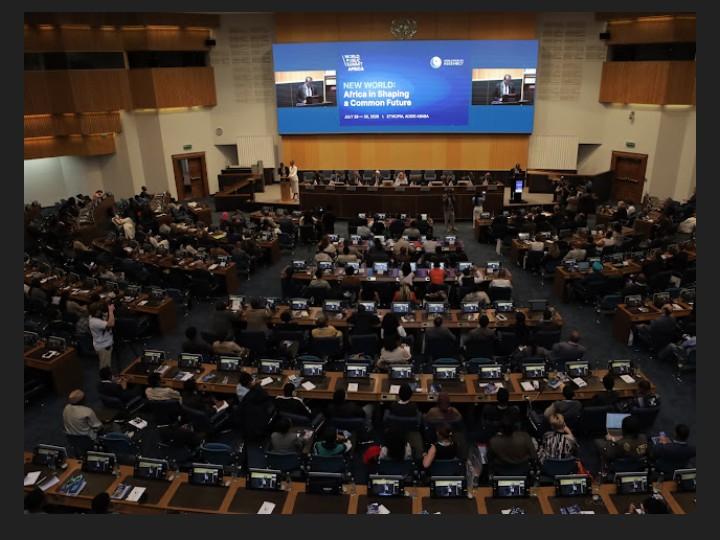
The humanistic leadership session formed part of the World Public Summit, which brought together more than 700 government officials, diplomats, academics, business leaders, journalists, researchers, youth representatives and civil society organisations under the theme, “A New World: Africa in Shaping a Shared Future.”
Andrey Belyaninov, General Secretary of the World Peoples Assembly, said the summit was designed to promote collaboration and shared values among participants.
“The Summit is not just a meeting, it is a space for unity. A space where the values that unite us come to life: respect for people, openness to the world, responsibility for the future and a commitment to creation,” he said.
The summit concluded with the adoption of the African Communiqué, which reaffirmed participants’ commitment to human-centred development, ethical leadership, international cooperation and sustained investment in people.