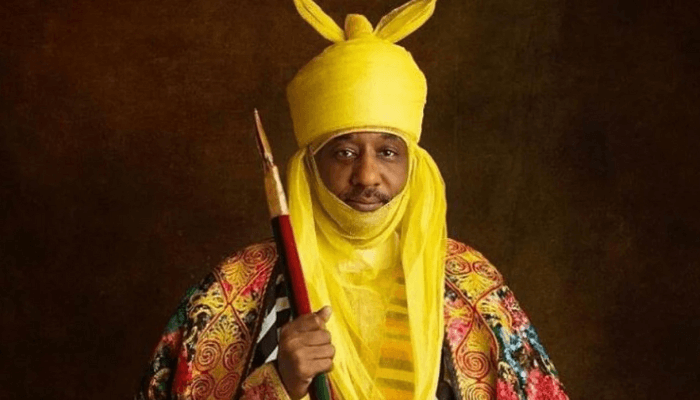
Sanusi defends Kano’s commercial legacy, says Dangote, Rabiu products of ancient city
The Emir of Kano, Muhammadu Sanusi II, on Thursday reaffirmed Kano’s historic position as Nigeria’s foremost commercial hub.
The Emir of Kano, Muhammadu Sanusi II, on Thursday reaffirmed Kano’s historic position as Nigeria’s foremost commercial hub. He insisted that Africa’s richest man, Aliko Dangote, and billionaire industrialist Abdulsamad Rabiu are products of the ancient city, countering recent public assertions suggesting their corporate genesis belongs to Lagos.
Emir Sanusi made these remarks in Kano whilst speaking at the 60th anniversary celebration of the Institute of Chartered Secretaries and Administrators of Nigeria (ICSAN), where he served as the special guest of honour.
The monarch’s comments follow recent public debate sparked by remarks attributed to Vice President Kashim Shettima. The Vice President reportedly highlighted Lagos as the city that “produced” business magnates such as Dangote and Rabiu whilst extolling the state’s pivotal role in Nigeria’s economic development.
Historical entrepreneurial roots versus modern corporate headquarters The Emir argued that although both businessmen built expansive corporate empires with significant operational footprints in Lagos, their roots, upbringing, and foundational entrepreneurial mindsets are firmly embedded in Kano. He described the northern metropolis as boasting over a thousand years of uninterrupted commercial history.
According to Emir Sanusi, Kano’s long-standing reputation as a centre of commerce predates colonial Nigeria and remains one of the strongest pillars of the country’s economic evolution.
“I am happy to be invited to this august gathering holding in Kano, a well-known cultural and business city dating back more than one thousand years,” Emir Sanusi said. “Kano is the most important city in northern Nigeria, and having a presence here is good for your institute.”
He added, “Kano has produced great men. Presently, the first- and second-richest men in Nigeria, Alhaji Aliko Dangote and Alhaji Abdulsamad Rabiu, are from Kano. They were born here, and their business success started here in Kano, although some people are trying to claim them now.”
Expanding corporate governance frameworks across northern Nigeria The monarch noted that the geopolitical debate was not the primary purpose of the event, stressing that his priority was to commend the institute for expanding its professional activities to the state. He praised ICSAN’s leadership for establishing a branch in Kano, describing the move as a strategic recognition of the city’s importance to commerce and professional development in northern Nigeria.
The former Governor of the Central Bank of Nigeria recalled advising the current President of the institute, Funmi Ekundayo, during her inauguration to establish a Kano branch, expressing satisfaction that the recommendation had been implemented.
According to the Emir, the Kano branch is only the second in northern Nigeria after Kaduna and will help deepen professional practice and corporate governance standards across the region. He noted that the decision to host the institute’s diamond jubilee celebration in Kano further demonstrates growing national recognition of the city’s economic relevance and cultural significance.
The structural interplay between traditional and financial capitals Emir Sanusi noted that Kano has for centuries served as a meeting point for merchants from across West Africa, North Africa, and the Middle East, with thriving trade networks that predate modern Nigeria. He maintained that the city’s entrepreneurial culture has continued to nurture generations of successful businessmen and industrialists whose investments now span the continent.
Independent observers note that the debate over whether Lagos or Kano holds greater credit for fostering Nigeria’s leading entrepreneurs reflects the historical interplay between the two cities. Whilst Kano serves as the nation’s traditional commercial heartland, Lagos has evolved into its financial and industrial capital, where many large corporations maintain their headquarters and critical infrastructure.
The anniversary celebration attracted professionals, business leaders, and government officials from across the country, with participants discussing corporate governance, institutional development, and the future of professional administration in Nigeria. Concluding his address, Emir Sanusi urged professional bodies to continue expanding their presence nationwide to promote capacity building, ethical leadership, and improved governance in both public and private institutions.