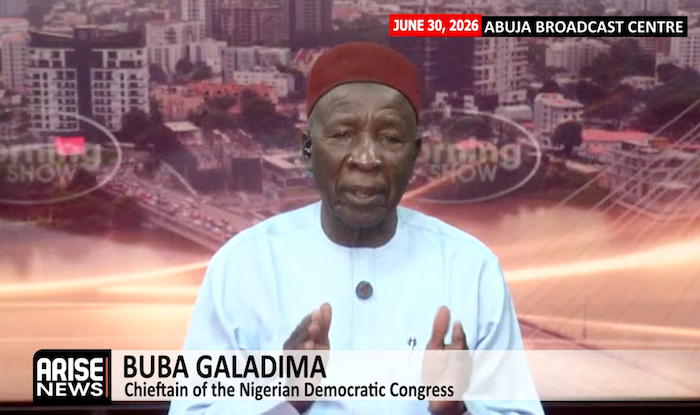
Buba Galadima: Tinubu Wants To Destroy Opposition Parties But Democracy Will Outlive APC
NDC chieftain Buba Galadima says the opposition must unite, warning Nigeria is drifting towards a one-party state.
NDC chieftain Buba Galadima says the opposition must unite, warning Nigeria is drifting towards a one-party state.
A chieftain of the Nigeria Democratic Congress (NDC), Buba Galadima, has condemned the recent Federal High Court judgment affecting the party’s logo, describing it as a calculated attempt to frustrate the party’s participation in the electoral process and warning that Nigeria is gradually sliding towards a one-party state.
Speaking during an interview with ARISE NEWS on Tuesday, Galadima said the party was shocked by the court’s decision but expressed confidence that the ruling would be overturned on appeal.
“It came to us as a rude shock, that judgment on Friday. Not many people in this country have really looked at the situation properly. Friday was June 27, and it was a weekend leading to the period when political parties were supposed to be given the codes through which they would upload their candidates.
“ I thought the judge was very strategic and deliberate in pronouncing that judgment on Friday so that by Monday we would have been barred from accessing the portal through which we were expected to upload our candidates.”
He maintained that the judgment could not withstand judicial scrutiny.
“I think the judiciary needs to do a lot of soul-searching because some bad eggs within the judiciary are tarnishing its image. Certain actions of certain judges must not go unpunished. As a political party, we are taking this calmly, and we believe we will prevail because I don’t think this judgment can stand the test of time or judicial review by a higher court.”
Galadima called on the National Judicial Council (NJC) to discipline judges found to have compromised the integrity of the judiciary.
“I think the NJC, as an institution, should do some soul-searching and really look at some of these judges and deal with them. They should not only punish them but send them to jail because they are destroying this country. In a country where there is no justice, we are all in trouble.”
According to him, the party later received approval to upload its candidates, but insisted that the larger issue of judicial accountability must still be addressed.
“We learnt that they gave us the code yesterday to upload our candidates. But it should go beyond that.”
Galadima said he had deliberately stayed away from the media in recent months because he had become increasingly worried about developments within key democratic institutions.
“I have kept away from both the print and electronic media for quite some time because of the signs I have been seeing coming from INEC and from the judiciary. These are signs we have seen before in the history of this country, and each time they have ended in disastrous situations.”
“When every citizen is complaining, when every citizen feels dissatisfied, alienated and intimidated, something eventually gives way. We are approaching that stage, and I am afraid those who run this country are doing a lot of harm to themselves by bastardising the institutions of government.”
He also criticised the electoral commission over what he described as its treatment of the New Nigeria People’s Party (NNPP).
“Look at what INEC has just done to the NNPP. It has gone largely unnoticed. These are the kinds of actions that should worry every Nigerian.”
Galadima also expressed strong opposition to the proposed establishment of state police, arguing that it would be weaponised by politicians ahead of elections.
“I have fought for state police all my life, from the 1987 Constituent Assembly to the 2014 National Conference. But what is being proposed today is entirely different. It was passed without carefully examining the implications.”
“Most of the people in the National Assembly were not mature enough when the Native Authority Police was used by regional governments. If they knew what happened then, they would never have supported this.”
“I assure the country that those who are supporting this will eventually pay dearly. Some members of the National Assembly may not even have the opportunity to return safely to their states when this law comes into effect.”
He argued that state police was never conceived as a genuine solution to Nigeria’s security challenges.
“If the Nigerian Police and the Nigerian military cannot solve our security challenges, I wonder how state police will do so. All we know is that the President and the governors want state police before the elections so that they can use them as political tools to attack the opposition, disrupt elections and kill democracy.”
Drawing from historical experience, Galadima recalled how the Native Authority Police was allegedly used against political opponents.
“I was old enough to witness what happened. Three months before elections, the Native Authority Police would gather opposition members within their jurisdiction and lock them up. They would accuse them of insulting an emir, a chief or a judge, or even claim they wore shoes in the presence of a traditional ruler.”
“They would detain them throughout the election period. Many Hausa people you see scattered across Nigeria and other African countries today were victims of that abuse. They fled Kano, Katsina and other parts of Northern Nigeria because of the misuse of the Native Authority Police.”
He warned that state police could also threaten national unity.
“It could destroy the unity of this country. Imagine states where only one tribe or one religion dominates the state police. People from other parts of Nigeria may no longer have the freedom to live and conduct their businesses as guaranteed by the Constitution. State police will create more problems, more division and more suspicion.”
Galadima accused President Bola Tinubu and the ruling All Progressives Congress (APC) of prioritising politics over governance since assuming office.
“For the last two years, I have consistently criticised the APC and its government because from the day President Tinubu was inaugurated on May 29, he started politicking instead of delivering democratic dividends to Nigerians.”
“They have continued changing the goalposts, and today nobody knows exactly where Nigeria stands.”
He alleged that the President was determined to weaken opposition parties.
“I have always said that the President does not want to compete with anybody. He wants to destroy all opposition candidates and all opposition political parties, and he is being actively supported by the National Assembly.”
“Now they have dragged the judiciary into it as part of the larger picture the APC government is trying to create.”
Despite his concerns, Galadima expressed confidence that democracy would endure.
“Democracy will survive, whether the APC or President Tinubu is trying to subvert it. It will survive and outlive them.”