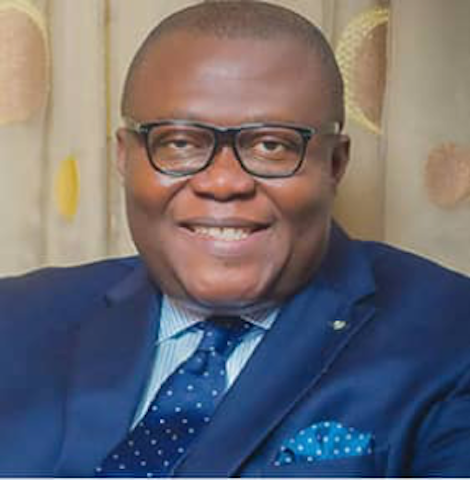
Cardoso’s record aligns closely with the vision he outlined from the beginning: orthodox monetary tightening, FX liberalisation, reserve building, governance reforms, and a banking sector repositioned for ambition rather than crisis management… He has never claimed quick victories or denied the challenges. Instead, he speaks of patience, adaptability, and the long-term view. The true measure of his legacy, he has suggested, will be whether these changes endure beyond his tenure.
- +What Cardoso’s legacy at CBN would look like, By Ehi Braimah
- +The Five Pillars of His Intended Legacy
When Yemi Cardoso, Central Bank of Nigeria (CBN) governor, stepped out to take his seat on the stage for a conversation at The Peninsula, London, on a sunny but cold Tuesday afternoon on 17 March, the room already sensed the weight of the moment.
When Yemi Cardoso, Central Bank of Nigeria (CBN) governor, stepped out to take his seat on the stage for a conversation at The Peninsula, London, on a sunny but cold Tuesday afternoon on 17 March, the room already sensed the weight of the moment.
The Africa Capital Forum, held on the sidelines of President Bola Tinubu’s recent historic state visit to the United Kingdom, had drawn bankers, global investors, diaspora fund managers, and development finance experts.
Jointly hosted by the CBN and UK’s Foreign, Commonwealth and Development Office, in partnership with several Nigerian banks and international financial institutions, the event carried a clear theme: “Moving Nigeria from economic stabilisation to capital mobilisation.”
Cardoso’s mellifluous voice remained calm, and pleasant to the ears, yet it carried across the room a powerful message of assurance. After nearly two-and-a-half years on the saddle as CBN governor, he spoke with the confidence of a man who had steered Nigeria’s monetary policy through turbulent times.
Cardoso sounded confident and surefooted. You could tell that he was not just ticking boxes; he has been methodically building a legacy that would outlast him. On that day in London, Cardoso was joined on the stage for the conversation by Odile Renaud-Basso, a French civil servant who has been serving as president of the European Bank for Reconstruction and Development (EBRD) since 2020.
The theme of the Forum pointed in the direction of wooing investors and attracting capital to Nigeria. Indeed, Cardoso announced during the conversation that 32 Nigerian banks had achieved the recapitalisation threshold.
But just before the Easter weekend, CBN announced that 34 Nigerian banks had raised their capital to ₦4.65 trillion, with 28 per cent of the funds coming from foreign investors, in what has been praised in several quarters as a major consolidation effort in the banking sector.
Cardoso has never declared in a single soundbite, “I want to be remembered for so, so and so,” yet his public statements, from early keynote addresses to the measured updates shared with investors in London, reveal a consistent vision: a transformed Central Bank that prioritises credibility, transparency, and rules-based policy over short-term interventions.
On his watch, CBN has refocused on its core mandates of price stability, financial system integrity, and sustainable growth. Cardoso inherited an institution marked by institutional deficiencies, governance lapses, reduced autonomy, ethical challenges, and a drift from its statutory roles. “I want a level playing field for all players,” he disclosed at the London meeting.
“You do not need to know anyone at CBN or knock on my door to get what you want,” he continued. Cardoso’s clear message was “fairness” – it doesn’t matter who you are, or whether you have access to privileges. That attribute is a key ingredient for excellent reputational management needed to protect the integrity of an organisation.
From the outset, he made it very clear that he would chart a new course. “We will vigorously address institutional deficiencies, restore corporate governance, strengthen regulations, and implement prudent policies,” he stated early on. He positioned the CBN as irrevocably committed to rebuilding public and market trust, shifting away from opacity and quasi-fiscal experiments toward transparency, forward guidance, and accountability.
Analysts have pointed to this philosophical change, from discretionary approaches to rules-based policy, as potentially his most enduring contribution. Cardoso has described his role as “the second hardest job in the world” and a “long-term call,” signalling that he views institutional reset as his central task.
The Five Pillars of His Intended Legacy
First comes restoring credibility and trust. Cardoso has repeatedly described the CBN’s recent past as marred by governance failures and deviation from core mandates. His explicit goal: Rebuild the institution so that markets and citizens view it as reliable once more.
Second is delivering price stability. Inflation control stands as his paramount mission. In his November 2023 CIBN keynote, he announced the adoption of an explicit inflation-targeting framework, developed in coordination with fiscal authorities.
Conventional tools, including liquidity management, policy rate adjustments, and open market operations, have been applied aggressively to repair transmission mechanisms and anchor expectations, but Cardoso prefers to humanise his strategy.
“The economy belongs to everyone,” he said, emphasising that monetary policy must ultimately ease access to food, shelter, healthcare, education, and financial services for ordinary Nigerians. Price stability becomes not merely a technocratic target but a foundation for improved living standards.
Third is building a stable, transparent, and liquid foreign-exchange market. Early actions, such as clearing FX backlogs, unifying exchange windows, introducing a new FX code and Electronic Matching System, and lifting certain import bans, were framed as cleaning up legacy distortions.
The aim: restore market confidence, rebuild reserves through sustainable accretion, and create a predictable environment that supports genuine investment rather than speculation.
Fourth involves strengthening the banking sector to support Nigeria’s ambition of reaching a one trillion-dollar economy. The 2024 to 2026 bank recapitalisation programme highlighted above raised minimum capital requirements so that banks can finance larger-scale projects in a growing economy. Cardoso has directed bank leaders to prepare explicitly for the one trillion-dollar GDP target within the current administration’s horizon.
A sound, well-capitalised financial system, he argues, is essential for private-sector-led growth, MSME financing, and broader financial inclusion.
Fifth, and perhaps most defining in a philosophical sense, is repositioning the CBN as a catalyst for sustainable and inclusive growth, rather than a direct development financier. Large-scale quasi-fiscal interventions, which had previously exceeded ₦10 trillion across sectors such as agriculture and power, have been wound down.
The bank has refocused on its statutory responsibilities: maintaining price and financial stability, managing external reserves, and providing candid advice to government.