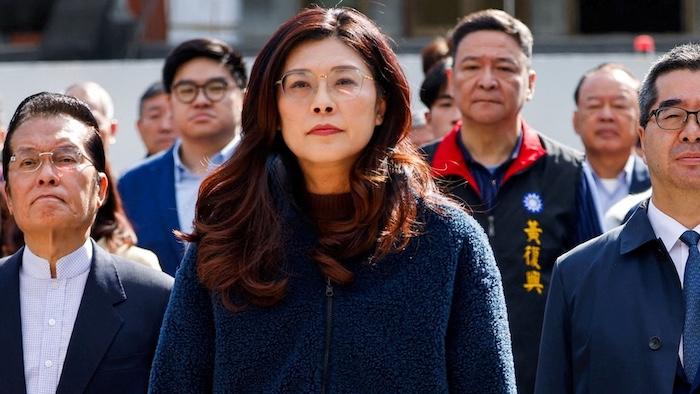
Taiwan Opposition Leader Cheng Heads To China On Rare Peace Mission Amid Tensions
- +China’s ‘reunification’ messaging intensifies
Taiwan opposition leader Cheng Li-wun heads to China on peace mission amid tensions over reunification push.
Taiwan opposition leader Cheng Li-wun heads to China on peace mission amid tensions over reunification push.
Taiwan opposition leader Cheng Li-wun is set to travel to China on Tuesday, where she may meet President Xi Jinping, in what she describes as a peace mission, as Beijing intensifies efforts to encourage support in Taiwan for “reunification.”
Cheng, chairwoman of the Kuomintang (KMT)—Taiwan’s largest opposition party—is making the visit at a time of heightened Chinese military pressure on the island, which Beijing claims as its own territory. The trip also comes as Taiwan’s opposition-led parliament delays approval of a government proposal for $40 billion in additional defence spending.
Ahead of the visit, the KMT and Taiwan’s ruling Democratic Progressive Party (DPP) exchanged sharply worded statements and social media campaigns framing the trip in competing narratives of peace and security.
“Peace is the only foundation for prosperity, and the hope for Taiwan’s future,” the KMT said in a Sunday video message featuring young people relaxing, swimming, and stargazing.
The DPP responded in a Facebook post, accusing the opposition party of aligning with Beijing’s agenda.
It said the KMT was seeking to “cooperate with the Chinese communists’ scheme to weaken Taiwan’s defence capabilities,” pointing to delays in defence spending proposals that have also received backing from the United States.
Cheng, speaking to foreign journalists last month, defended her position that diplomacy must complement military preparedness.
“Peace cannot possibly be achieved through defence capabilities alone,” she said, adding that political engagement was equally essential.
Her visit comes just weeks before a planned summit in Beijing between US President Donald Trump and Chinese President Xi Jinping. While both sides are expected to explore limited agreements on trade and supply chains, including agriculture and aircraft parts, core political disputes—particularly over Taiwan—remain unresolved.
In a February call, Xi told Trump that the United States “must carefully handle arms sales to Taiwan.”
This marks the first visit to China by a KMT leader in a decade, although Beijing has not confirmed whether Xi will meet Cheng, who is scheduled to remain in Beijing from Thursday.
Taiwan’s Mainland Affairs Council urged Cheng ahead of the trip to take a firm stance with Beijing.
It said she should call on China to stop its military threats and “respect the Taiwanese people’s right to choose their own future.”
Beijing has refused to engage with Taiwan President Lai Ching-te, labelling him a “separatist.”
China’s ‘reunification’ messaging intensifies
China has not renounced the use of force to bring Taiwan under its control, though it continues to promote “peaceful reunification” as its preferred approach. In recent weeks, it has intensified outreach efforts aimed at Taiwanese society, which officials in Taipei have rejected.
On Friday, China’s Eastern Theatre Command—responsible for any potential military operation against Taiwan—released a cartoon depicting “Taiwan province” during the Tomb Sweeping Festival, suggesting life under reunification.
The imagery showed people laying flowers at a “Monument for the complete reunification of the motherland,” located in front of a sign referencing Taipei’s Machangding Memorial Park, where accused communist spy Wu Shi was executed by KMT authorities in 1950.
The KMT itself traces its roots to 1949, when its forces retreated to Taiwan after losing the Chinese civil war to Mao Zedong’s communists.
Despite Beijing’s messaging, public opinion surveys in Taiwan have consistently shown limited support for accepting Chinese sovereignty under the “one country, two systems” model.
Asked about “reunification” during a press briefing with foreign reporters, Cheng said the conditions for such a discussion are not yet in place.
“What we need to deal with now is how to create peaceful and stable cross-strait relations,” she said.