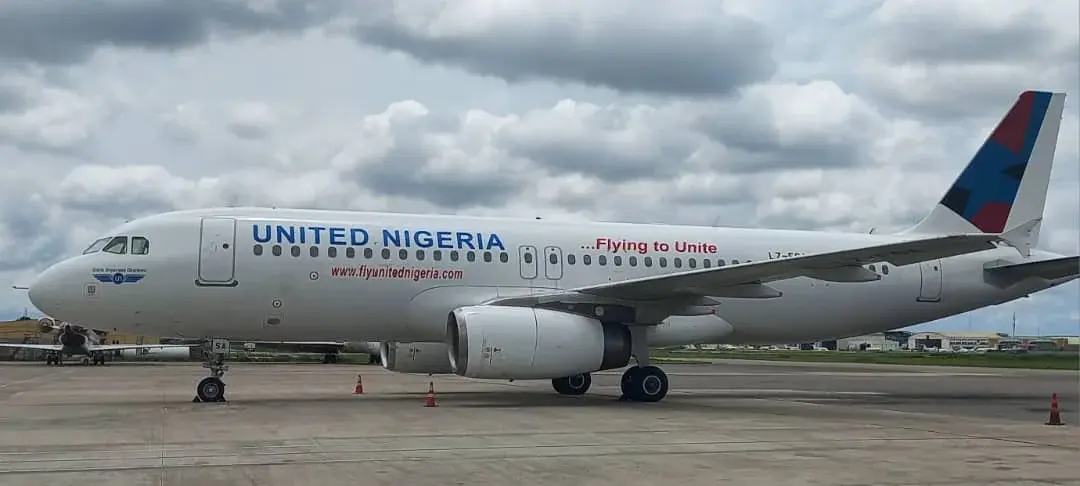
The Chairman of United Nigeria Airlines and spokesperson for the Airline Operators of Nigeria, Prof Obiora Okonkwo, has disclosed that the airline lost about N10bn within three months as a result of disruptions caused by the closure of the Strait of Hormuz amid tensions involving the United States and Iran.
- +United Nigeria Airlines cites N10bn loss amid fuel shock
Okonkwo said the geopolitical crisis triggered a rise in aviation fuel prices, worsening operating conditions for domestic carriers already battling high operating costs and infrastructure challenges.
Okonkwo said the geopolitical crisis triggered a rise in aviation fuel prices, worsening operating conditions for domestic carriers already battling high operating costs and infrastructure challenges.
The Strait of Hormuz, a narrow waterway between Iran and Oman, is regarded as the world’s most critical oil transit route, handling nearly 20 per cent of global petroleum shipments. Its disruption sent shockwaves through global energy markets and significantly impacted Nigeria’s aviation industry.
He spoke during the unveiling of two newly acquired Boeing 737-800 Next Generation aircraft, registered as 5N-CFC and 5N-CFB, by United Nigeria Airlines. The aircraft were named after the Obi of Onitsha, Igwe Nnaemeka Achebe, and the late literary icon Chinua Achebe.
Reflecting on the airline’s recent challenges, Okonkwo acknowledged that reforms introduced by the Minister of Aviation and Aerospace Development, Festus Keyamo, had helped stabilise the sector, but external economic pressures remained severe.
“There are seasons when there are low passengers, but in the last three months, what we have seen is simply too much. We have lost about N10bn, N5bn, N6bn in a space of three months as a result of the closure of the Strait of Hormuz. We have to make up for the losses we have incurred in the last three months,” he said.
Despite the setbacks, the airline chief described the acquisition of the new aircraft as a major milestone and a sign of resilience in the Nigerian aviation sector.
“We have gathered here to celebrate. Two, three, four years ago, it was not clear what the future of aviation would be. There were issues, and in Nigeria, aviation was in total turmoil. But until our minister, Festus Keyamo, stepped in, we had a meeting in his office where he promised he would address the policy issues. Today, the right policies have helped us come this far,” he added.
Speaking on the choice of names for the aircraft, Okonkwo paid tribute to both Chinua Achebe and the Obi of Onitsha.
“Today we have one Achebe that introduced Africa to the whole world. He is from my hometown. Wherever I go around the world, I tell them that Okonkwo in Things Fall Apart is my great-great-grandfather. We have another Achebe who is a living legend and icon. We have here the Obi of Onitsha, Nnaemeka Achebe,” he said.
Providing insight into the airline’s expansion plans, he revealed that the newly acquired aircraft are part of a broader fleet acquisition programme, promising that more aircraft will arrive in the country before the year runs out.
“It is going to be six aircraft in total, and we just have two here. I thank God Almighty for making this possible,” he said.
Okonkwo also commended the Nigerian Civil Aviation Authority for expediting the certification process for the aircraft, describing the regulator’s support as crucial to the airline’s growth.
“We are thankful to the DG of the NCAA who has made our services possible. I had told him I had three aircraft that were arriving. Three of his directors came to our office on a Saturday, prepared all the documents, inspected the aircraft, and issued all the certificates. The process of operating aircraft won’t be easy without ease in certifications,” he said.
The airline chairman further highlighted the operational difficulties airlines face daily, stressing that delays are often caused by factors beyond the control of carriers.
“I know we have passengers in Nigeria that want to get to their destinations. The important thing is to get passengers to their destinations safely and in time. The truth of the matter is that the operator wants to take you there on time.
“That you buy a ticket doesn’t put money in our pockets, because you can demand a refund. Sometimes we meet situations beyond our control. When one aircraft goes bad, we start to work on the schedule so we don’t leave anyone behind. Sometimes it is a bird strike, sometimes it could be because of airport availability,” he explained.
Okonkwo also criticised the financial structure governing aviation agencies, arguing that excessive deductions from the revenues of the NCAA and the Federal Airports Authority of Nigeria were limiting their ability to improve infrastructure and service delivery.
“Minister, we are not happy with the recent report from IATA that Nigeria is the most expensive place to operate. It means it costs operators more to operate. We want a reduction in the charges,” he said.
“The government yanks 70 per cent from the aviation accounts to do other things that are not aviation-related, and this strains the NCAA and FAAN. If we leave these monies in their accounts, they will be encouraged to provide the needed services. The core aspect of the Nigerian economy is driven by aviation. In conclusion, when this is done, the government can also provide a single-digit loan,” he added.
Speaking on behalf of Boeing Commercial Airplanes, Executive Sales Director for Africa, Moore Ibekwe, said recent reforms in Nigeria’s aviation sector have improved access to financing, strengthened regulatory compliance and enhanced safety standards, creating a more attractive environment for aircraft acquisition and industry growth.
According to him, the improvements have enabled Nigerian operators to acquire new-generation aircraft and expand technical capacity.
He noted that Boeing recently launched a training programme in Nigeria, with its engineers providing hands-on training for local professionals. Ibekwe added that the newly acquired Boeing 737 aircraft would create significant opportunities for the country’s aviation industry and broader economy.
“The country needs about 1,200 aircraft. If we get a good percentage of these aircraft, the sky will not be our limit. We have the manpower, capability, and finances. Aviation is global; it creates good-paying jobs, opens up the economy, and positions Nigeria on the world stage in science, technology, finance, fashion, and entertainment,” he said.
Also speaking, the Obi of Onitsha, Igwe Nnaemeka Achebe, expressed gratitude after one of the newly inducted aircraft was named in his honour alongside the late literary icon Chinua Achebe. “I am overwhelmed. I’m lost for words. It is a day of gratitude,” he said.
Also speaking at the event, the Minister of Aviation expressed delight at developments in the country’s aviation industry.