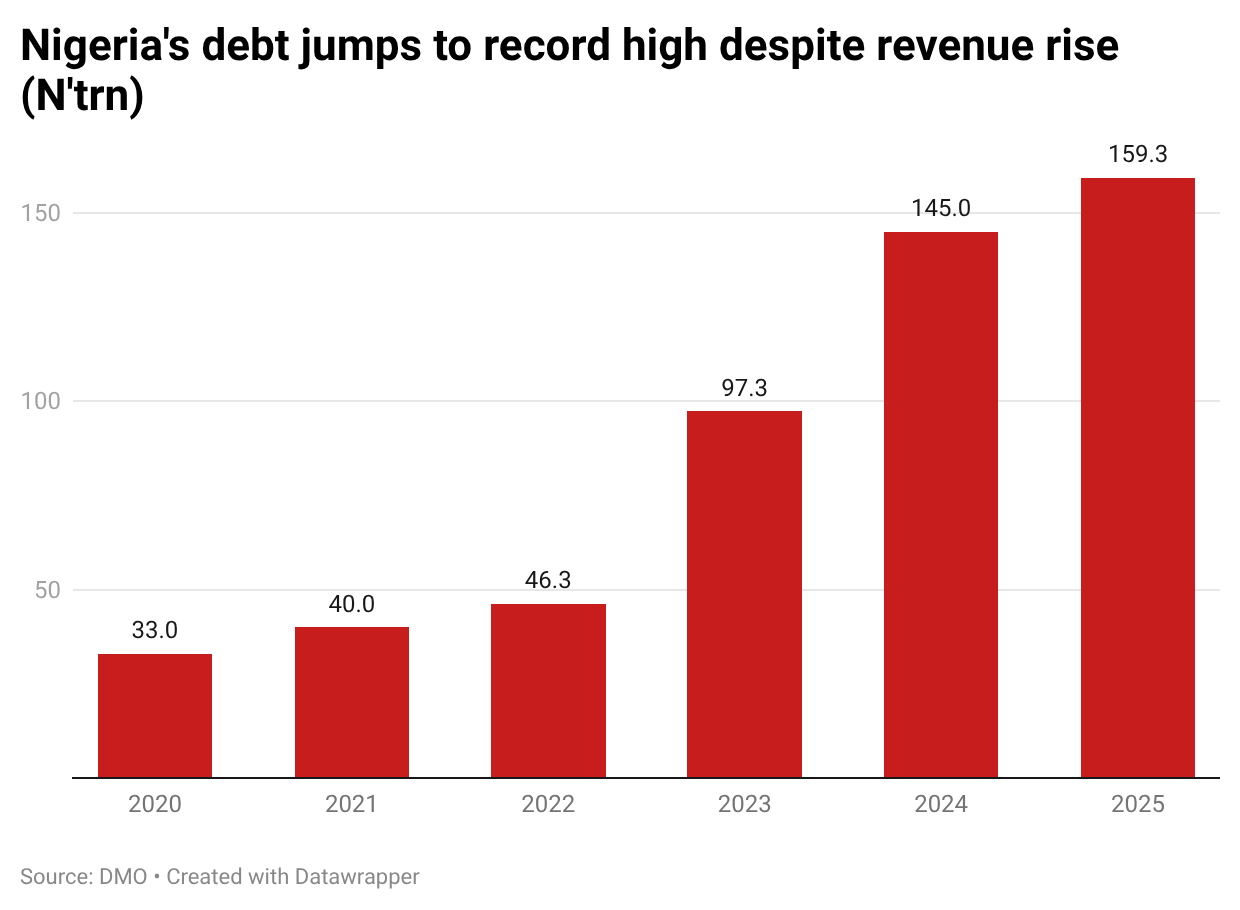
Nigeria’s public debt climbed to a record high in 2025, driven by both domestic and foreign borrowings, even as government revenues improved on the back of stronger collections and reforms.
- +Nigeria’s debt jumps to record high despite revenue rise
Data from the Debt Management Office showed Africa’s most populous nation borrowed N159.27 trillion as at the end of 31st December 2025, compared to N145 trillion in the previous year.
Data from the Debt Management Office showed Africa’s most populous nation borrowed N159.27 trillion as at the end of 31st December 2025, compared to N145 trillion in the previous year.
Nigeria’s debt profile has expanded sharply over the past five years, more than quadrupling from N33 trillion in 2020 to N159.27 trillion in 2025, highlighting the government’s growing reliance on borrowing to bridge fiscal gaps.
The steepest acceleration came after 2022. Debt rose from N46.25 trillion in 2022 to N97.34 trillion in 2023, effectively doubling within a year, before climbing further to N145 trillion in 2024 and N159.27 trillion in 2025. This points to a sustained borrowing cycle even as reforms began to lift government income.
“If you take a closer look at recent trends, you will observe that the pace of growth, while still elevated, is moderating. Between 2023 and 2025, total debt increased by about 63.6 percent (from N97.34 trillion to N159.27 trillion),” Samuel Oyekanmi, research and insight lead at Norrenberger, said.
“This compares with the much sharper 110 percent surge recorded between 2022 and 2023, suggesting that although borrowing remains high, its growth rate is easing slightly.”
The Nigerian government is doubling down on revenue mobilisation while pushing to cut borrowing costs through cheap, lower-cost debt to help finance the country’s budget deficit after a 17 percent increase in planned 2026 spending.
Authorities had announced plans to raise $5 billion through a derivatives transaction with First Abu Dhabi Bank as part of a broader measure to access capital amid a global liquidity squeeze.
Analysts see borrowings rising further this year on the back of an expansionary budget, requiring more capital that may come in the form of debt to bridge.
“The budget has expanded to N68.3 trillion, and the revenue expected to fund most of that would come from borrowings, implying that the debt level is likely to rise further in the coming months,” a senior analyst at a Lagos-based research firm who is not authorised to speak said.
President Bola Tinubu’s administration has embarked on a raft of market-driven policies to boost income and aid growth, including scrapping fuel subsidies, liberalising the foreign exchange market, and, more recently, overhauling the colonial-era tax laws to improve transparency, curb leakages, and strengthen collection.
Those policies have seen Nigeria’s total revenue collection grow from N6.8 trillion five years ago to a record N28.7 trillion by the end of 2025, with the revenue agency targeting an ambitious N40.7 trillion for this year.
Federal allocation also saw a big boost, with disbursements rising from N16.28 trillion in 2023 to N28.78 trillion in 2024, according to an independent think tank, Agora Policy.
But even with the windfall, both the federal government and the subnationals increased their borrowings in the reviewed period.
An analysis of the data revealed that federal government domestic debt rose from N77.81 tn in September 2025 to N80.49 trillion in December 2025, while domestic debt owed by states and the Federal Capital Territory increased from N4 trillion to N4.36 trillion within the same period.
DMO data further showed that both domestic and external borrowings contributed to the increase recorded in the final quarter of 2025. External debt rose from N71.48 trillion in September 2025 to N74.43 trillion in December 2025, indicating an increase of N2.95 trillion, or 4.1 percent.
Similarly, domestic debt grew from N81.82 trillion to N84.85 trillion over the same period, reflecting an increase of N3.03 trillion, or 3.7 percent.
Despite the increases, domestic debt remained the larger component of the country’s debt stock, accounting for 53.27 percent of total public debt as of December 2025, compared to external debt, which stood at 46.73 percent.
In dollar terms, Nigeria’s total public debt rose from $103.94 billion in September 2025 to $110.97 billion in December 2025, reflecting an increase of $7.04 billion within the quarter.
External debt increased from $48.46 billion to $51.86 billion, while domestic debt rose from $55.47 billion to $59.12 billion over the same period.