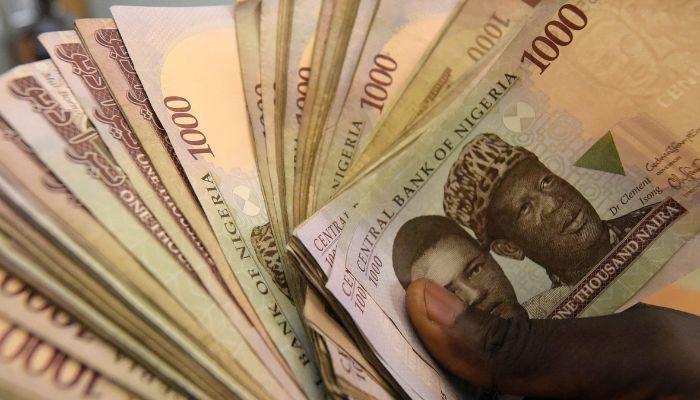
The naira traded largely flat on Wednesday across the official foreign exchange (FX) market as liquidity slowed despite rising external reserves, while the International Monetary Fund (IMF) endorsed Nigeria’s plan to remove the remaining foreign exchange restrictions.
- +Naira steady as IMF backs Nigeria’s plan to remove remaining FX restrictions
Data published by the Central Bank of Nigeria (CBN) showed that the naira depreciated marginally by N2.89, with the dollar quoted at N1,360.07 on Wednesday, representing a 0.21 percent loss compared with N1,357.18 quoted on Tuesday at the Nigerian Foreign Exchange Market (NFEM).
Data published by the Central Bank of Nigeria (CBN) showed that the naira depreciated marginally by N2.89, with the dollar quoted at N1,360.07 on Wednesday, representing a 0.21 percent loss compared with N1,357.18 quoted on Tuesday at the Nigerian Foreign Exchange Market (NFEM).
Activity weakened across key market segments. At the interbank FX market, the number of deals declined by 40.8 percent to 74 on Wednesday from 125 on Tuesday. Total interbank turnover also fell sharply to $54.29 million from $125.69 million recorded the previous day.
At the NFEM window, the number of deals dropped by 29.98 percent to 306 on Tuesday from 437 on Monday. Total turnover declined by 44.78 percent to $544.22 million from $985.56 million over the same period, according to CBN available data. The figures for Wednesday were not available.
In the parallel market, also known as the black market, the naira remained relatively stable, trading between N1,395 and N1,400 per dollar on Wednesday. The gap between the official and parallel market rates widened slightly to about N40 per dollar from N39 on the previous day.
Nigeria’s external reserves, which provide the CBN with ammunition to support the naira, continued their upward trajectory, rising to a 17-year high of $50.88 billion as of June 16, 2026, compared with $37.82 billion a year earlier, representing an increase of 34.53 percent.
The IMF, in its latest Article IV Consultation report, endorsed Nigeria’s plan to dismantle the remaining foreign exchange restrictions as market conditions improve, describing the move as an important step toward restoring normal market functioning and strengthening investor confidence.
The Fund welcomed the CBN’s decision to remove one of the country’s capital flow management measures earlier this year and encouraged authorities to continue the gradual elimination of the remaining restrictions as foreign exchange pressures ease.
“Staff welcomes that, in March 2026, the capital flow management measure on the requirement for International Oil Companies to hold 50 percent of repatriated export proceeds in Nigeria for 90 days before transferring offshore has been eliminated,” the IMF said.
The endorsement comes as Nigeria’s foreign exchange market continues to stabilise following a series of reforms introduced since 2023, including the transition toward a more market-determined exchange rate regime.
According to the IMF, Nigeria’s external position strengthened significantly in 2025, supported by higher oil and gas exports, lower imports of refined petroleum products and stronger diaspora remittance inflows.
The Fund noted that improved foreign exchange inflows and more stable market conditions have created an opportunity for authorities to unwind measures that were introduced during periods of severe FX pressure and volatility.
The CBN has indicated its intention to phase out three remaining capital flow management measures. These include the prohibition on purchasing foreign exchange in Nigeria for investment in foreign currency-denominated securities abroad, limits on overseas transactions using naira-denominated debit and credit cards, and the net open position requirement that restricts banks’ foreign exchange exposure.
According to the IMF, these measures should be removed as macroeconomic and financial conditions continue to improve.
“In line with the Fund’s Institutional View, these capital flow management measures should be phased out as foreign exchange pressures abate and macroeconomic and financial stability is restored,” the report said.
The Fund’s support reflects growing confidence in Nigeria’s foreign exchange reforms, which have helped improve external balances and attract capital inflows.
Nigeria’s external position in 2025 was assessed by the IMF as stronger than implied by economic fundamentals and desirable policy settings. The improvement was largely driven by a stronger trade balance, supported by rising oil and gas exports and declining imports of refined petroleum products as supplies from the Dangote Refinery increased.
Diaspora remittances also strengthened following foreign exchange reforms and the shift toward a more market-based exchange rate system.
Despite these gains, the IMF said further reforms are needed to deepen foreign exchange market efficiency and improve transparency.
The Fund noted that the Real Effective Exchange Rate (REER) remains undervalued by about 25.6 percent according to its EBA-lite model, suggesting that the naira remains weaker than implied by economic fundamentals.
To close that gap, the IMF recommended slowing the pace of reserve accumulation when appropriate, allowing greater two-way movement in the exchange rate and continuing fiscal and structural reforms.
The report also called on the CBN to publish the broad principles guiding its foreign exchange intervention framework to strengthen market confidence and improve transparency.
The IMF acknowledged that FX interventions may be justified during periods of market stress, particularly given the relative shallowness of Nigeria’s foreign exchange market and the economy’s exposure to volatile capital flows. However, it stressed that interventions should not substitute for necessary macroeconomic adjustments.
The report also highlighted concerns about exchange-rate practices that the IMF considers inconsistent with its framework.
According to the Fund, official actions taken by Nigerian authorities over the past year have resulted in two Multiple Currency Practices (MCPs), relating to exchange rates used by the CBN for certain transactions involving government agencies and oil companies.
The CBN, however, disagreed with the classification, arguing that the measures represent cost-recovery mechanisms and standard market-making practices rather than multiple exchange rates.
While noting the disagreement, the IMF encouraged authorities to review the arrangements and take the necessary steps to eliminate them.
The Fund’s backing for the removal of the remaining foreign exchange restrictions is likely to be viewed positively by investors, as it signals continued progress toward a more transparent and market-driven foreign exchange regime after years of controls and administrative interventions.