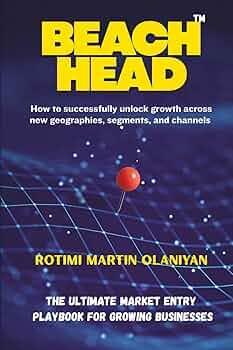
Nigerian companies don’t fail because they lack ambition. They fail because they enter new markets with confidence, not clarity. That was the crux of the discussions when Rotimi Olaniyan launched his new book, “BeachHead”, at the inaugural gathering of his Leadership and Strategy Salon for business leaders recently in Lagos.
- +New Book ‘BeachHead’ exposes why Nigerian businesses lose in new markets
- +…Points pathway to market entry and growth
The gathering was not a random one but an exclusive gathering of industry leaders, regulators, academics, and marketing professionals, all of whom carry significant responsibility for growth, jobs, investment, institutions, and reputations that linger after the numbers have been reported.
…Points pathway to market entry and growth
The gathering was not a random one but an exclusive gathering of industry leaders, regulators, academics, and marketing professionals, all of whom carry significant responsibility for growth, jobs, investment, institutions, and reputations that linger after the numbers have been reported.
Among the attendees were Bolajoko Bayo-Ajayi, President, National Institute of Marketing of Nigeria; Deepak Singhal, Executive Director & MD Consumer Business, Tolaram; Girish Sharma, MD/CEO Guinness Nigeria; Ike Chioke, CEO Afrinvest; Lekan Fadolapo, DG Advertising Regulatory Council of Nigeria; Peter Bamkole, Deputy Vice Chancellor, Pan Atlantic University; and Tunji Oyebanji, President Chartered Institute of Directors. Olaniyan is not a newcomer to the industry, so one might argue that this book is long overdue. He is a strategist, educator, and entrepreneur working at the intersection of strategy, marketing, business growth, digital transformation, and innovation. With a career spanning academia, executive education, industry and commercial advisory, he helps leaders, founders, and organisations navigate growth with clarity and discipline, especially in market entry, marketing effectiveness, customer engagement, and business transformation. And so, he stressed that the event was not about launching a book. Rather, it was about promoting a disciplined way of marketing thinking – one he has used, researched, refined, and tested.
The event also served as an experiment in fostering executive reflective practice and knowledge exchanges, which he learnt having spent close to a decade in executive education, in one of the UK’s leading business schools.
“The book is called Beachhead: How to Successfully Unlock Growth Across New Geographies, Segments and Channels,” he said, according to a statement.
“And the simplest way to explain why I wrote it is this: Growth rarely fails because leaders lack ambition. Growth fails because leaders underestimate entry and overestimate their internal capabilities.”
The statement said in his study of 47 high-potential growth British companies, he found that the significant majority underestimate the friction of moving into a new geography, misjudge the cost of winning a new customer segment, and underrate what happens when a new channel is not just a route-to-market, but a new set of behaviours, incentives, and power dynamics.
Noting that BeachHead is a practical antidote, a playbook for leaders who want growth that is repeatable, not just inspirational, he explained that BeachHead is not the full invasion.
“It is the first secure foothold. It is where you land, stabilise, learn, supply, and then expand. In business terms, the BeachHead is the smallest winnable entry position from which you can scale,” he said.
Explaining further, he said that when growth fails, it often fails because organisations attempt expansion the way people do wishful thinking: they try to win everywhere at once, with the same playbook, and they call it “strategy”. But a BeachHead approach forces discipline. It asks: Where can we win first?
He cautioned that many business leaders who treat expansion like a campaign rather than an operating system, a new geography like a bigger version of the old one, a new segment like a demographic label rather than a lived reality, and a new channel as a distribution pipe rather than a whole ecosystem, may end up shocked because “markets don’t cooperate; markets respond.”
The BeachHead method is built on a simple triad, which he calls the “Market Cell”. It repeats across three contexts: geography, segment, and channel.
“In every case, the question is not whether an organisation can sell. It is whether it can win a first pocket decisively.”
One of the core lessons of the book, he noted, is that you don’t scale excellence; you scale repeatability. In practice, the BeachHead is a deliberate first position: a geography you can supply and understand, a segment you can delight and retain, and a channel you can dominate and optimise.
“If I could summarise the deepest idea behind BeachHead in one line, it would be that growth is not what you do once. Growth is what you can do again and on demand. And that is why the real destination of a BeachHead is not market entry. The real destination is repeatability.”
“A well-funded launch can win once, a heroic team can win once, and a brilliant campaign can win once. But only a disciplined organisation can win again,” Olaniyan concluded.
The statement said the Leadership and Strategy Salon will continue quarterly as a space for reflective practice, strategic thinking, and honest conversations about business growth.