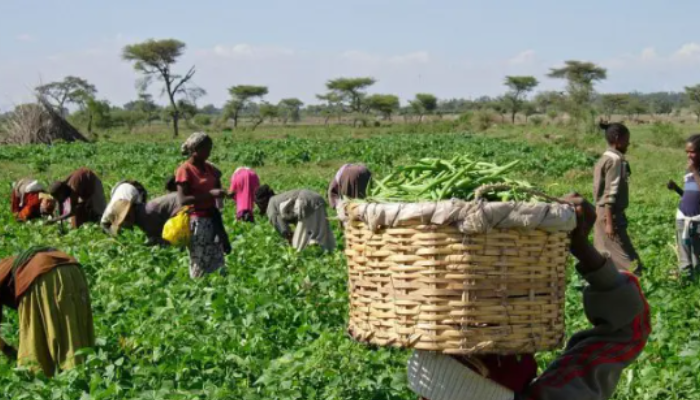
Women make up 70% of Nigeria’s agricultural workforce. They’re responsible for 80% of food production. Yet when I started working in commercial agriculture, I was taken aback by how gendered trade really is. Women are the bedrock of many households, but in rural communities, there are few economic opportunities beyond petty trade. Maybe one cupful at a time. Maybe two. Every market day, if she’s lucky.
- +Why women’s crops matter more than you think
In these circumstances, the only way to improve a family’s livelihood is for the father, husband, or brother to earn more money or for women to rely on their benevolence for any semblance of financial autonomy.
In these circumstances, the only way to improve a family’s livelihood is for the father, husband, or brother to earn more money or for women to rely on their benevolence for any semblance of financial autonomy.
That’s the reality for many households across rural Nigeria. And it’s exactly why the conversation about “women’s crops” matters more than most development programmes want to admit.
What we talk about when we talk about women’s crops In agriculture, a “woman’s crop” refers to subsistence crops or those commonly viewed as lower-value, typically grown and managed by women, such as shea nuts, cocoyam, and fonio in present-day West Africa. Women’s crops are typically those that don’t show up in large volumes in export statistics. These are crops women grow because traditional gender divisions, limited access to land and credit, and household food security roles have left them with little else.
Notice I didn’t say women choose these crops. They stick to them because of barriers, not preference.
Women farmers produce 30% less per hectare than their male counterparts, largely because they tend to farm less valuable crops. They are 38 percentage points more likely to farm roots and tuber crops, which are often lower in value, while they are 19 percentage points less likely than men to cultivate higher-value cereals. The whole infrastructure of commercial agriculture is set up to exclude them. And then we act surprised when their yields are lower.
The smallest gender gaps in agricultural participation are found among the least valuable crops, such as white yam. High-value “cash crops” like cocoa, cotton, and rice have the lowest female participation, with gender gaps in participation ranging from 64 to 88 percentage points. With equal access to resources, women farmers could boost yields by 20–30%. But those resources rarely arrive.
At Aké Collective, we focus on women’s crops for a reason that has nothing to do with romanticising subsistence farming. We focus on them because they give women the freedom to lead and to earn on their own terms. These crops may not be traded in large volumes, but they hold real power. They change how women work and how they’re seen.
Here’s what I mean. Because fonio isn’t something men typically grow in large volumes, the trade of fonio allows new women to enter the market in new ways. When we started working with women farmers, I had to navigate village politics carefully. A village head might say, “Oh well, they’re dealing with a crop that women do anyway, so feel free.” That casual dismissal is actually an opening. These crops act as a Trojan horse for economic entry. Women can build businesses without immediately triggering male resistance.
The threat of a woman’s bank alert Working with women farmers at Aké Collective was challenging at first. Their partners, whether husbands, brothers, or uncles, sometimes felt threatened. I learned quickly that you have to use soft power. If you go in all guns blazing, they will not let their wives work with you.
We had situations where we would open a bank account for a woman, and she would ask a lot of questions. “Can my husband see my bank alert?” What we like to say is, ‘I have to pay the person who did the work.’ But that simple act, paying a woman directly, can upend household dynamics in ways development agencies do not prepare you for.
Today, some cultural norms persist that place women in subordinate positions. A woman’s economic rise can be seen as a challenge to male authority. Success in the field requires avoiding confrontation, not because it is philosophically right, but because it is the only approach that works. Diplomacy is not optional when you are trying to integrate women into an economy that has actively kept them out.
The 2025 Revised National Gender Policy finally, explicitly, addresses gender-based violence within agrifood systems as a structural barrier to be eliminated. That is progress. But policy on paper does not change the fact that a woman might not be allowed to keep her own earnings if her husband decides otherwise.
Empowerment means cash While development agencies talk about theoretical goals, for rural women, empowerment means cash. Financial independence is the only way to improve household livelihoods when commercial trade remains so gendered.
I see a new kind of confidence in the women we work with because they are earning their own money, independent of anyone else. They no longer have to wait for market day to sell one or two cupfuls at a time. Financial autonomy is freedom. It is the freedom to make your own choices when you want to, for the people who matter most to you.
Women currently hold less than 20% of agricultural assets. The Women Agro Value Expansion programme and the Nigeria for Women Programme Scale-Up target millions of women with ₦12 billion in credit facilities. That is real money. Whether it reaches the women who need it most is another question entirely.
The profitability problem Here’s the uncomfortable truth about “women’s crops”: profitability shifts control. When markets grow, men often move into crops that were once dismissed as women’s work. We’ve seen it with shea in Burkina Faso and Ghana. What was once called “women’s gold” becomes another export commodity dominated by men as soon as serious money is involved.
The label “women’s crop”, then, isn’t permanent. It lasts only as long as the crop remains low-value enough that men do not bother. That is why investors, policymakers, and trade practitioners should not rush to invest in underserved value chains and assume this will automatically lead to women’s economic empowerment. Without careful attention to why certain crops are relegated to women’s work and deemed unworthy of wider interest, these investments can push rural women further to the margins of commercial trade.
What policy can and cannot do The 2025–2030 Revised National Gender Policy in Agriculture framework aims to shift women from “beneficiaries” to “essential partners”. It introduces mandatory participation quotas, requiring women and youth to make up 70% of participants in certain agricultural programmes.
Some policies, such as the Kaduna State Gender Policy 2025–2023, target the Land Use Act and customary laws to ensure women have documented ownership and secure tenure. This is the foundation for long-term investment. Without land rights, nothing else matters.