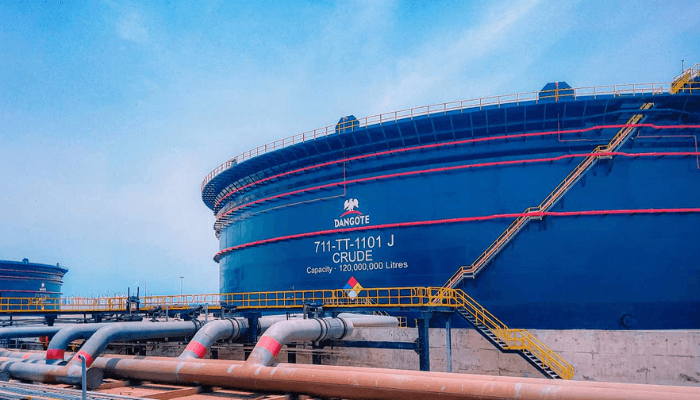
Dangote Petroleum Refinery and Petrochemicals has raised its ex-depot price for Premium Motor Spirit to N1,275 per litre and Automotive Gas Oil to N1,950 per litre, according to a new pricing template issued to fuel marketers and depot operators, the latest in a relentless series of upward revisions that have made Nigerian motorists and industry operators brace for further pain at the pump.
- +Dangote Refinery lifts petrol price to N1,275, diesel to N1,950
Petrol climbed N75 per litre to N1,275, a 5.02 percent increase from last month’s N1,200, while diesel surged N200 per litre to N1,950, up sharply from N1,750, according to a senior refinery official who confirmed the adjustment late Tuesday.
Petrol climbed N75 per litre to N1,275, a 5.02 percent increase from last month’s N1,200, while diesel surged N200 per litre to N1,950, up sharply from N1,750, according to a senior refinery official who confirmed the adjustment late Tuesday. Market data from Petroleumprice.ng corroborated the new pricing.
The revision puts diesel within striking distance of the psychologically significant N2,000-per-litre mark, a threshold that, if breached, would send fresh shockwaves through logistics, manufacturing, and agriculture, sectors that remain almost entirely dependent on diesel-powered generators and haulage trucks in a country where grid electricity remains unreliable.
“The adjustment is in line with global market trends,” the official said, citing ongoing tensions in the Middle East as a key driver of international crude benchmarks. “These are external factors that directly influence refined product pricing.”
The price hike arrives at a particularly sensitive moment. Nigeria, Africa’s most populous nation and largest economy, has been navigating the downstream consequences of a fuel subsidy removal that took effect in mid-2023 under President Bola Tinubu.
Since then, pump prices have lurched repeatedly upward, eroding purchasing power and lifting transport costs to levels that ripple through nearly every consumer good.
Dangote’s 650,000-barrel-per-day refinery, the largest single-train refinery in the world, was widely expected to stabilise domestic fuel supply and moderate prices by reducing Nigeria’s dependence on imported refined products. While the facility has delivered on supply diversification, its pricing has remained tethered to international benchmarks, offering limited insulation from global crude market volatility.
For logistics operators, the diesel increase is particularly consequential. Long-haul freight companies and cold-chain operators, already running on thin margins, are expected to pass the added costs directly to consumers, potentially adding another layer to food price inflation that the National Bureau of Statistics has struggled to bring under control.
Small business owners, particularly in Lagos and Kano where generator dependency is near-universal, face an immediate and blunt impact. A N200-per-litre increase on diesel translates directly into higher operating costs for bakeries, printing shops, and market traders who run generators for eight to twelve hours daily.
Analysts note that without a meaningful improvement in grid power supply or an offsetting monetary policy response, successive fuel price adjustments risk entrenching inflation expectations and suppressing consumer demand further.