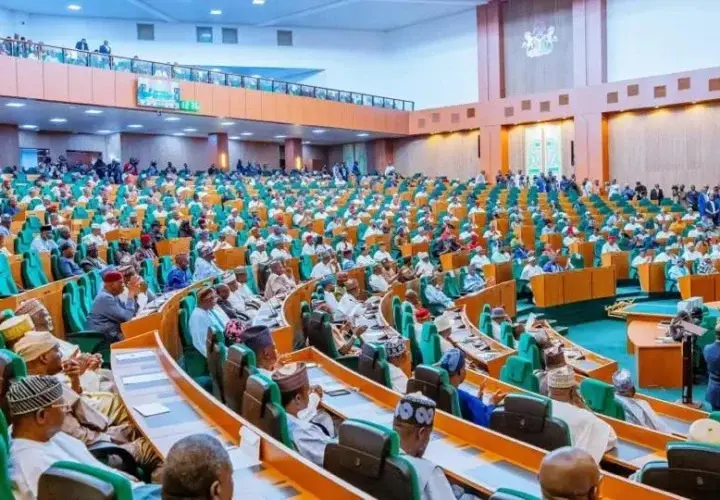
The House of Representatives has commenced moves to address mounting concerns in Nigeria’s downstream petroleum sector, opposing the continued imposition of US dollar-denominated charges on locally refined petroleum products and announcing plans to investigate alleged irregularities in the allocation of fuel import licences.
- +Lawmakers oppose dollar billing for local petrol sales
The House Committee on Petroleum Resources (Downstream) disclosed this on Tuesday during an interactive session with key industry stakeholders, including the Independent Petroleum Marketers Association of Nigeria, the Depot and Petroleum Products Marketers Association of Nigeria, and the Major Energies Marketers Association of Nigeria.
The House Committee on Petroleum Resources (Downstream) disclosed this on Tuesday during an interactive session with key industry stakeholders, including the Independent Petroleum Marketers Association of Nigeria, the Depot and Petroleum Products Marketers Association of Nigeria, and the Major Energies Marketers Association of Nigeria.
The engagement forms part of the committee’s ongoing consultations on proposed amendments to the Petroleum Industry Act and broader reforms aimed at strengthening domestic refining, guaranteeing national energy security and ensuring a competitive downstream petroleum market.
The Chairman of the committee, Ikenga Ugochinyere, said the lawmakers would invite the Nigerian Midstream and Downstream Petroleum Regulatory Authority, the Nigerian Upstream Petroleum Regulatory Commission, the Nigerian Ports Authority, the Central Bank of Nigeria, refiners and other relevant agencies to respond to issues raised by industry operators.
“We’ll be meeting with the NMDPRA, NUPRC, the refiners—both modular refinery owners and the large refinery operators—as well as the NPA, the CBN and other relevant agencies on the issues that have been raised. These will form part of our downstream reforms, including proposed amendments to the Petroleum Industry Act and legislative motions to correct identified gaps,” Ugochinyere said.
The lawmaker expressed concern over the continued charging of port fees in U.S. dollars for petroleum products refined and transported within Nigeria, describing the practice as detrimental to the economy.
Ugochinyere also pledged to investigate allegations that fuel import licences for the first three quarters of 2026 were issued to the same group of marketers.
“We have also taken note of what you said about the lopsidedness in the issuance of import licences, where allocations for the first, second and third quarters went to the same set of operators. We will raise these questions when the NMDPRA appears before the committee to explain the criteria used in issuing those licences,” he added.
The committee chairman stressed the need to strike a balance between protecting Nigeria’s expanding domestic refining capacity and preserving the investments of marketers who have built storage and distribution infrastructure over several decades.
“How do we encourage and protect owners of domestic refineries while also protecting the investments of marketers? We cannot continue importing the same volume of petroleum products as before, given that more refineries are coming on stream. At the same time, we must guarantee national energy security in case local refineries experience disruptions.
“We need a balanced framework that supports domestic refining, preserves healthy competition and ensures the country always has a reliable fuel supply. That is the direction this committee is pursuing,” he said.
Presenting DAPPMAN’s memorandum, the association’s Executive Secretary, Mr Olufemi Adewole, urged lawmakers to address what he described as structural distortions affecting petroleum marketers and depot operators.
According to him, at least 72 of Nigeria’s 154 licensed petroleum depots recorded little or no trading activity over the past year because of what he described as an uneven operating environment.
“From the records of the NMDPRA, not fewer than 72 of the 154 depots nationwide had no regular or consistent trading activity in the last one year. They are merely paying salaries without engaging in meaningful business. This is largely due to an uneven playing field, persistent trading losses and the inability to access alternative sources of supply,” he said.
While welcoming the commencement of operations at the Dangote Refinery, Adewole warned against what he described as a near-monopoly in the supply of PMS.
“Our experience has been one of mixed feelings, bordering on an almost total monopoly in the supply of PMS by the mega refinery. Although the Petroleum Industry Act provides for a fully deregulated market where prices are determined by market forces, that has not been our experience,” he said.
The association also accused the NMDPRA of allocating import permits repeatedly to the same group of marketers. “The same set of marketers received import allocations in the first, second and third quarters of 2026, as though other qualified operators do not exist. This is unacceptable, and we urge this committee to ensure greater transparency and fairness in future allocations,” Adewole said.
DAPPMAN argued that retaining the option of fuel imports remains necessary to prevent shortages during refinery maintenance, operational disruptions or logistics challenges.
“In order to avoid the return of fuel queues, the import option provided under the Petroleum Industry Act must remain available as a regulated contingency mechanism whenever domestic supply is insufficient,” he said.
The association also decried what it described as duplicated port charges and the continued billing of domestic petroleum transactions in foreign currency.
“Marketers are invoiced at the loading point and again at the discharge port for products moved entirely within Nigeria. More critically, certain charges are still imposed in US dollars despite the purely domestic nature of these transactions. This practice persists despite a presidential directive suspending foreign currency-denominated billing for local operations. We urge the committee to ensure compliance,” Adewole added.
DAPPMAN further called for accelerated dredging of major waterways, rehabilitation of pipelines and depots, improved rail transportation for petroleum products and the creation of a national downstream logistics master plan.
IPMAN National President, Abubakar Shettima, commended the Federal Government for encouraging private investment in refining but said marketers continue to grapple with high financing costs, multiple taxation, foreign exchange volatility, inadequate storage infrastructure and limited access to refinery products.
He called for policies that would support domestic refining while preserving competition. “We support strengthening domestic refining, but we also need equitable access to locally refined petroleum products, affordable financing and reduced regulatory costs that ultimately increase pump prices,” he said.