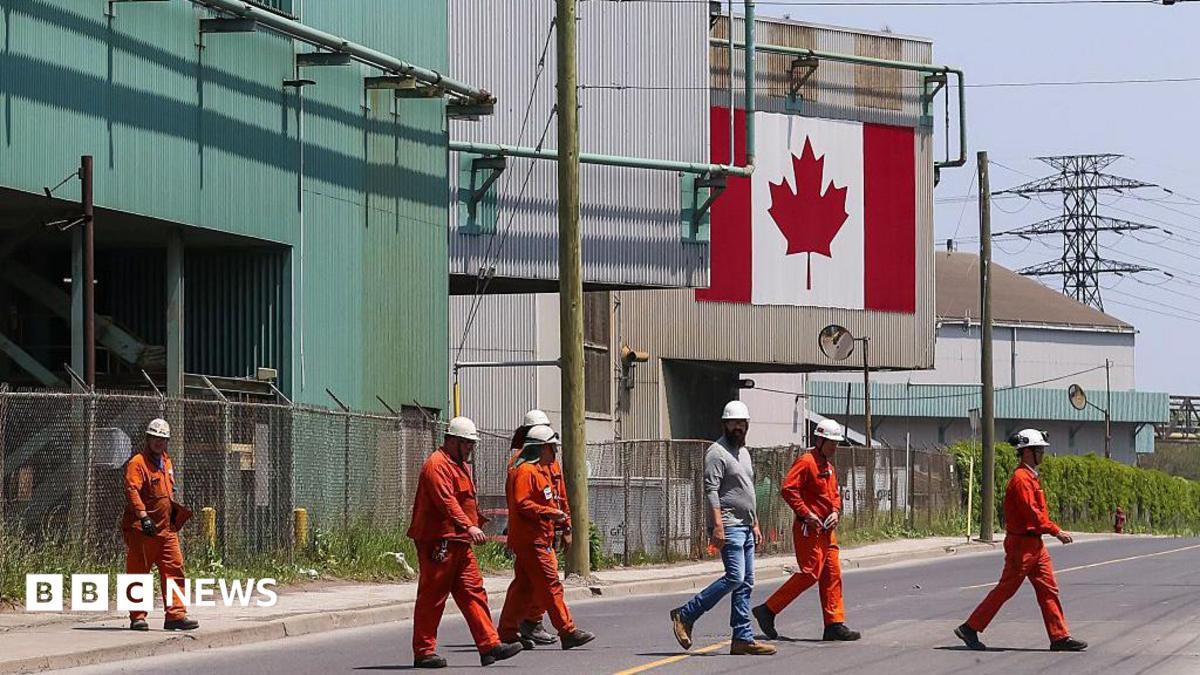
Prime Minister Mark Carney has promised to reboot Canada's economy, building it into the "strongest in the G7".
- +Just how much trouble is Canada's economy in?
- +Why the US economy keeps defying the odds
- +When trade soured, this American liquor maker moved to Canada
- +A year on: Four ways Trump's tariffs have changed the global economy
He has spent weeks travelling overseas in the last year seeking to drum up business interest in Canada as an investment destination.
He has spent weeks travelling overseas in the last year seeking to drum up business interest in Canada as an investment destination.
But there is no doubt the country's economy is struggling, and from tariffs on certain industries to younger Canadians struggling to find work or buy a home, some Canadians are feeling the pain more than others.
Five charts help illustrate the state of Canada's economy - and how it's performing compared to other wealthy nations.
Economic growth in Canada this year is forecast to be 1.6%, according to the International Monetary Fund (IMF). That's behind the US but ahead of European G7 partners.
As the country's economy recovers from the slowdown triggered by US tariffs, the Organisation of Economic Co-operation and Development (OECD), an influential global policy group, projects a modest improvement in gross domestic product (GDP) - growth of 1.7% - in 2027.
Earlier this month, the country's statistics agency said Canada had slipped into a technical recession - two consecutive quarters of GDP decline, in late 2025 and early 2026. Economists cautioned against panic, saying the country is likely to avoid a prolonged downturn.
"Whether one chooses to divine the fact that we're in a recession or not really does miss the point," said Jeremy Kronick, president of the CD Howe Institute, a non-partisan economic think tank.
"I mean, it, the economy is weak, right?"
For many Canadians, the cost of living is a major worry.
Some 61% of respondents told the non-profit Angus Reid Institute research firm in a recent poll that it was their top concern, ahead of housing affordability, crime and US tariffs.
Inflation in May was 3.2%, up from 2.8% in April, driven by higher energy prices, notably gasoline prices due to the fallout from the Iran war. That's still down from the post-pandemic highs of 7% or 8% in the summer of 2022.
It's a pattern repeated across most other wealthy nations, with Canada's inflation rate similar to those in major European economies but still lower than in the US.
"It is clear that inflation does cause hurt for a range of people, and that the majority of us see that inflation as we go to a grocery store, we see our energy prices inflate," said Paul Kershaw, founder of the generational fairness advocacy group Generation Squeeze, and a professor at the University of British Columbia.
Kershaw called rising housing costs a "third kind of inflation" - one which has led to a boom in equity for current homeowners but has left many, mostly younger people, out of the market.
Kershaw said there are "Canadians who are doing just fine, who've actually probably gained wealth over some of these harder years... and who are managing the frustrations that come with higher food costs and higher energy costs."
Canadian households now carry the largest debt burden among G7 nations. Much of it is driven by mortgage debt, which analysts argue helps increase net worth, while the rest is consumer credit and other loans.
The recent Angus Reid survey indicates that seven-in-10 Canadians describe their current household finances as "good" or "very good", while the 27% who say they are in poor financial shape are also more pessimistic overall about their financial future.
A separate survey from the firm suggests more than a third of Canadians say the financial aspect of their current living situation is tough or very difficult. That rises to 45% among renters. People who have secured a home and a mortgage whose households make less than C$100,000 (£53,400) are also under financial pressure.
Canada's unemployment stood at 6.6% in May, while youth unemployment is at 13.4% - the first decline since January but still stubbornly higher than pre-pandemic averages of about 10%.
Kershaw added: "We are at a moment where the economy disproportionately isn't working for younger people, and some newcomers of any age."
He argues that Carney's plans to make the economy more productive and resilient, which comes with significant investments in infrastructure projects and defence spending, won't help the many Canadians just trying to make ends meet now.
Carney has acknowledged affordability challenges, most recently offering a one-time grocery benefits payment to eligible Canadians.
But the prime minister has repeatedly urged patience.
"This government's been in the process of laying the foundations for a stronger, more resilient, more independent Canadian economy," Carney said earlier this month.
Why the US economy keeps defying the odds
When trade soured, this American liquor maker moved to Canada
A year on: Four ways Trump's tariffs have changed the global economy
"That process is settling in during that time as the major investments, major changes to how the government operates, how we do major projects, how we have new trade agreements with other countries."
His Liberal government has plans to, among other actions, double Canada's non-US exports over the next decade by expanding trade relationships across Europe and Asia, and to fast track major infrastructure projects.
Dave McKay, CEO of the Royal Bank of Canada, the country's largest bank, cautioned during a talk hosted by Bloomberg earlier this month that the clock is ticking.
"We have to see tangible progress on a couple of these big ideas," he said. "The capital is impatient, and it will move where it thinks they can get the most sure and fastest return."
Kronick, of the CD Howe Institute, said uncertainty with Canada's largest trading partner, the US, is another headwind.
For James White, the US-Canada trade war has had a major impact on his family-owned company, Wellmaster.
The Ontario-based firm manufactures products for drillers, and White, the firm's president and CEO, said 60% of its profitability is reliant on access to the US market.
But since the tit-for-tat tariffs began last year between the two trading partners, sales are down by 20%. His business has been affected by US levies on steel derivatives - and Canada's similar retaliatory tariffs.
"I'm being pulled down in my ability to make investments in my people and my technology and my equipment. That's not happening with my competitors," he said.
US tariffs hit Canada slightly differently compared with other nations, as the country shares a border with the largest economy in the world. More than 70% of Canadian exports head to the US, and the economies are deeply integrated.
While the majority of products are exempt from US tariffs under the current free trade agreement between the US, Canada and Mexico - the USMCA - the White House has imposed tariffs on specific sectors, including 15% to 50% tariffs on steel, aluminum, and copper - the ones proving challenging to White - and 25% tariffs on vehicles.