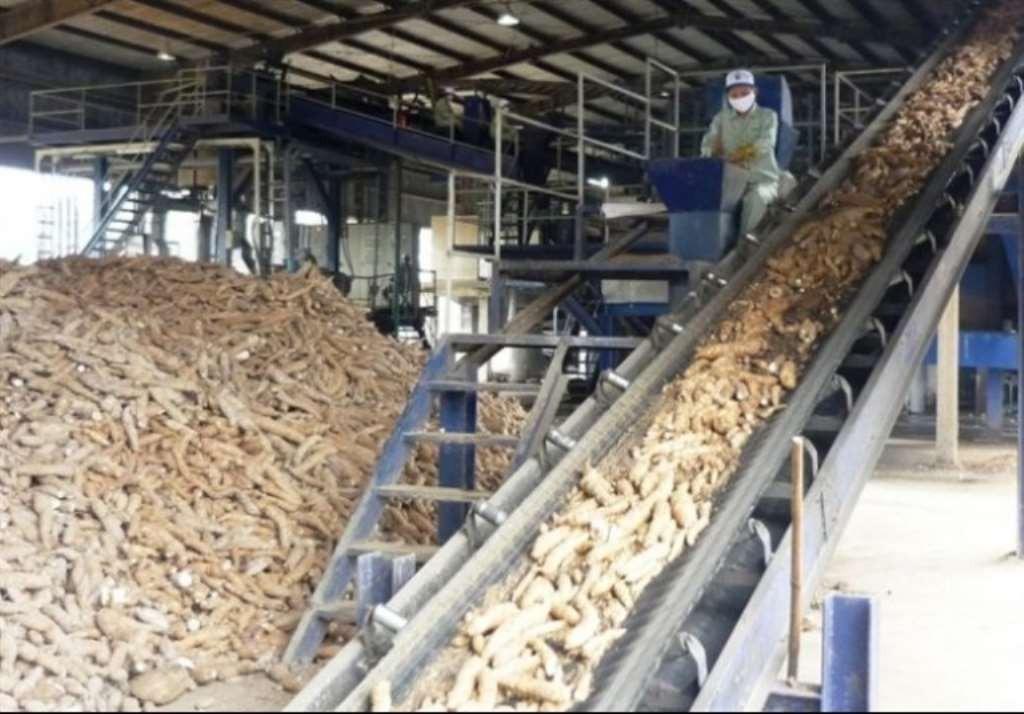
Nigeria’s cassava processing industry is facing a critical setback as factories struggle to secure sufficient raw materials, hampering the production of starch, flour, and other by-products.
- +Nigeria’s cassava factories struggle with feedstock shortages
- +Farmer networks are not optional
In recent years, the industry has seen massive investments as high-capacity processing plants sprang up, bolstered by policies aimed at driving industrial starch, flour, and ethanol production.
In recent years, the industry has seen massive investments as high-capacity processing plants sprang up, bolstered by policies aimed at driving industrial starch, flour, and ethanol production.
On paper, the sector gained momentum; however, a monitoring and evaluation of these plants exposes a different picture.
Research by the Nigeria Cassava Investment Accelerator (NCIA) showed that most cassava processing facilities in the country operate at between 30 and 40 percent of their installed capacity due to irregular supply of fresh tubers.
According to the research, as investments continue to target the industrialisation of the sector, an equally important challenge is quietly compounding – the question of feedstock reliability remains unresolved, and without it, the returns on processing investments will continue to disappoint.
Reliable feedstock supply is not a secondary concern; it is the variable that determines whether the plant performs as intended, and farmer networks are the infrastructure that either delivers or destroys that reliability.
The impact of unreliable cassava supplies extends beyond the farm, with plants operating at 40 percent capacity incurring full costs while generating only a fraction of potential revenue.
Unit economics crumble, debt servicing bites, and operators get trapped in a vicious cycle: poor feedstock supply erodes their finances, curbing investment in farmer relationships that could boost supply.
The fallout isn’t limited to upstream operations; downstream businesses are also feeling the pinch. A plant that cannot run consistently cannot serve buyers reliably, which translates to lost contracts and a diminished commercial standing.
At the market level, the effect is volatility – ample supplies weigh on prices, and this in turn squeezes farmers’ income. When supply tightens, factories battle high input costs. Neither condition supports planning, and both erode confidence across the cassava value chain.
According to NCIA, for investors, unreliable feedstock is the primary execution risk that makes cassava projects difficult to back. “A well-structured processing asset with a credible offtake can still be an unattractive investment if feedstock supply is not demonstrably reliable.”
Farmer networks are not optional
The planning of several operators venturing into the cassava value chain is to minimise dependence on external farmers; to own land, plant directly, and control supply from the ground up.
However, findings from NCIA showed that even the most vertically integrated plants still rely on smallholders for 60 and 70 percent of their supply. Their findings revealed that a mid-sized plant requires roughly 3,000 farmers delivering consistently to stay viable.
Farmer networks take different structural forms — aggregator-led models, out-grower schemes, agent or cluster-based coordination. The model matters less than how it is managed.
Managing farmer networks is challenging – the logistics are complex, the coordination demands are relentless, and the systems required to make networks perform reliably take real investment to build. That operational difficulty is precisely where most farmer supply networks break down.
Since 2014, IDH (the Sustainable Trade Initiative) has been testing a “Block Farming Model” that treats farmer management as a rigorous science rather than an afterthought.
The centrepiece of IDH’s technical approach is the block farming model. The model structures smallholders into managed production blocks with a focal farm at the centre, supported by defined delivery schedules aligned to processor intake requirements, and access to inputs and finance on credit.
According to the NCIA, IDH’s engagement has delivered tangible results: block farmers saw yields rise 57 percent above the national average, boosting their incomes by 81 percent, while surrounding community farmers recorded a 15 percent rise in income.
The model also introduces phased cropping schemes, smoothing supply flows to the factory gate rather than delivering in seasonal surges.
Dayo Ogundijo, IDH’s director of programs, explained that the IDH block farming model works because production is tightly organised, land is contiguous, planting is synchronized, inputs are controlled, and harvesting is supervised.
“Scaling nationally introduces pressure in five main areas: land consolidation at scale, sustained pre-financing capacity, management bandwidth, logistics and perishability risks and trust architecture,” he said.
To curb side-selling of feedstocks, a major threat to processor stability, Ogundijo suggests faster payments and innovative loyalty mechanisms can bridge the trust gap. “Farmers need to feel genuinely valued,” he said.
“Beyond faster payments, building loyalty requires strengthening trust and making farmers feel genuinely valued in the relationship,” he explained.
To get things right, he listed major factors to consider: bundled service dependency, transparent and predictable pricing frameworks, end-of-season performance incentives, input-credit recovery through structured deduction, and group-based accountability models.
The economics of cassava processing hinge on scale – moving from 40 to 80 percent capacity can be the difference between loss and viability.
Reliable farmer networks hold the key to unlocking this utilisation gap. For investors, a project with a solid feedstock supply is a different risk profile.
Fixing farmer networks is a faster, more controllable solution than tech innovation or policy reform. This infrastructure supports multiple industrial applications, from garri to bioethanol. To turn Nigeria’s cassava sector into a powerhouse, focus must shift from the factory to the farm.