Art on trial - a sculptor's arrest highlights new extremes for censorship in China
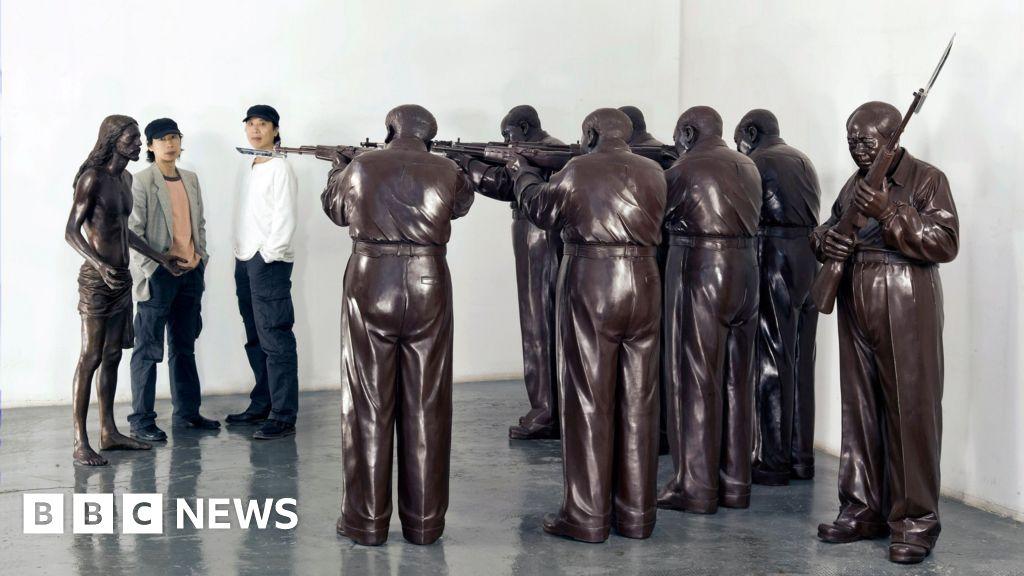
Jesus Christ stands at gunpoint, palms upturned, seven figures in a firing squad around him.
Jesus Christ stands at gunpoint, palms upturned, seven figures in a firing squad around him. The bronze riflemen are unmistakable in their likeness. They are Mao Zedong, the long-deceased dictator who founded the People's Republic of China, and presided over some of the most traumatic chapters in China's recent history.
The "Execution of Christ" was exhibited in 2009. So too was "Mao's Guilt": a life-sized replica of the so-called supreme leader kneeling in a pose of solemn contrition.
But it was only 15 years later that such works, satirising one of China's most contentious idols, cost Gao Zhen his freedom.
The 69-year-old, who emigrated to the United States in 2022, was arrested at his studio on the outskirts of Beijing in mid-2024 while visiting with his family. Authorities seized his artworks and barred his wife and seven-year-old son from leaving the country.
Then, last month, Gao faced a secretive trial on suspicion of "insulting revolutionary heroes and martyrs" - a charge that could see him jailed for up to three years.
The trial has received limited coverage in China, with most local reporting focusing on the circumstances of his arrest. At that time, some local media described him as a "so-called 'artist' who caters to Western political agendas through pseudo-art that vilifies and insults revered figures".
But still, said Gao Qiang, the younger of the brothers, the trial's "message is clear".
"Even if a work was made 15 years ago, it can still be turned into a crime if today's political climate changes," he told the BBC.
Qiang says there has "clearly" been a hardening of Beijing's backlash against perceived dissidence of late – stretching across visual arts, film, music, literature and online writing as part of "a wider pattern of tightening control".
The Chinese government has not commented on the trial.
But China-watchers say this pattern is revealing of a CCP that is becoming increasingly extreme in both grasp and reach – policing its citizens transnationally and retroactively.
Ian Johnson, a Pulitzer Prize-winning journalist who has long reported on China's persecutory practices, says we are witnessing "probably the darkest period of time in decades" for freedom of expression under the CCP.
"In the half-century since the Cultural Revolution ended in 1976, this is the most prolonged crackdown that we've seen – far eclipsing the period after the Tiananmen massacre in 1989," Johnson says. "The Party is now less willing than ever to countenance criticism of its leaders."
Others suggest that sliding democratic norms around the world have led Beijing to believe it can crack down more aggressively, without fear of rebuke from nations which appear to have abandoned the moral high ground.
On Wednesday, the United Nations human rights office joined a growing chorus of international advocacy groups to call for Gao's immediate release, saying his case "raises concerns with regard to retroactive application of criminal law and use of criminal sanctions to punish artistic expression".
There are also concerns for his health.
Gao suffers from chronic lumbar spine disease, arthritis, eye problems and chronic urticaria – a skin condition that causes itchy red welts. He has met his lawyer in a wheelchair on multiple occasions, in some cases struggling to get out of bed, and has reportedly shown signs of malnutrition, according to Qiang. Repeated applications for medical bail have been denied.
The risks are "grave", Qiang says. "His physical condition remains deeply concerning."
The Gao brothers gained prominence in the Chinese art scene during the 1990s and early 2000s, a quarter of a century after Mao's death. But the long shadow of his reign still loomed over their lives.
Mao founded Communist China in 1949 and led it through a tumultuous and devastating period in the 1960s and 1970s, when an attempt at rapid industrialisation triggered a famine, killing tens of millions. Then came the Cultural Revolution: a violent purge of anyone seen as a threat to Communism, including many Chinese intellectuals, landowners and artists.
Among the millions of victims was the Gao brothers' father, who was labelled a class enemy and taken to a place that Gao Zhen described, in a 2009 interview with the New York Times, as "not a prison, not a police station, but something else".
It should come as little surprise, then, that Mao is a recurring muse in the Gao brothers' oeuvre. But while for most of their careers they had been able to escape serious punishment, in 2012, with the rise to power of current leader Xi Jinping, the space for creative expression in China contracted.
Gao left China for New York, where he has permanent residency, shortly after Xi oversaw an amendment to China's criminal code in 2021, which strengthened laws against insulting the country's "heroes and martyrs".
Among this pantheon, Mao is especially sacrosanct. But he is also a complicated figure within the state-sanctioned narrative. While eager to imbue him with reverential status, the Party is simultaneously wary that almost any discussion of Mao's legacy could rake up uncomfortable memories.
To undermine Mao's legacy, though, is to challenge the CCP's legitimacy. And in the eyes of the state, this crosses the line from free speech into slander.
It has long been up to the Chinese authorities to determine where that line rests, and a range of artists, writers and activists have fallen afoul of it.
One of the most famous is Ai Weiwei, an artist who was arrested for "economic crimes" in 2011 after expressing support for pro-democracy protests. Another is Liu Xiaobo, a literary critic and human rights activist, who authored a manifesto calling for democratic reform in China and was arrested in 2008. Liu was awarded the Nobel Peace Prize in 2010, but could not receive it. He died in prison in 2017.
Chinese authorities have spent decades hunting down and rooting out those deemed to have challenged state-sanctioned narratives. But in recent years the dragnet has become increasingly elastic.
"Artists and writers have long been in the Chinese government's crosshairs - but the authorities are now extending that reach beyond physical borders," says Sophie Richardson, a spokesperson for the Network of Chinese Human Rights Defenders advocacy group.
This is done not just through "brutal tactics" like exit bans, Richardson explains, but also by pressuring foreign art institutions to adopt political rhetoric that aligns with that of the CCP.
"It's a global effort to limit free speech and artistic expression," she says.
Still, Gao Zhen's case is remarkable – not only because he is seemingly being punished retroactively, but also because, as Johnson points out, Zhen "did not directly criticise the Communist Party, let alone Xi Jinping".