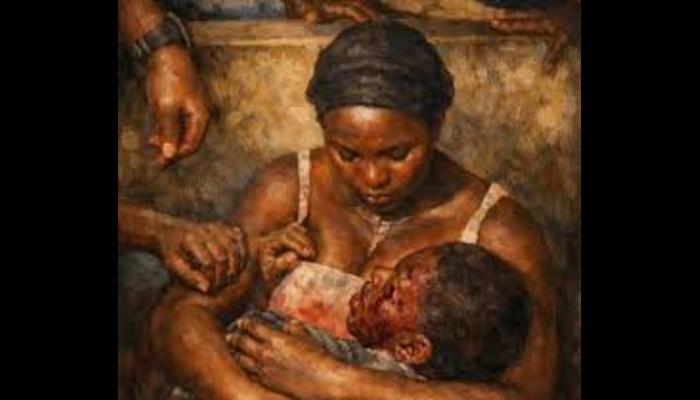
“Baby, today is my birthday. And am grateful. Baby, you don’t want to see me in tears and I won’t cry for you. Baby I’m begging you, since Sunday I haven’t eaten, you didn’t give me food to eat but from today I promise you I will eat. Baby, I have a gift to give you, I trust you, I gave you the name Promise Gideon Ayuba. Gideon in the Bible is the prince that went to war and he was victorious. Baby avenge your death, if you want me to forget, avenge your death. Baby I have a gift to give you. Baby avenge for me. I had you in my stomach for 9 months Baby, you suckled my breast Baby. I beg you to avenge for me, avenge for me. Where ever they are Baby, avenge for me.” (Mrs Favour Ayuba).
- +Promise Ayuba and the cutlass of justice
The Sociology of death and dying is a rich sub-field in sociology that enables us to dissect and analyse how human beings make sense of death, the dead and how they react to the perceived causes (natural or man-made or mysterious) of the death.
The Sociology of death and dying is a rich sub-field in sociology that enables us to dissect and analyse how human beings make sense of death, the dead and how they react to the perceived causes (natural or man-made or mysterious) of the death. In many cultures in Nigeria, the circumstances surrounding death are important in shaping the responses it generates. Framed within socio-cultural, interpersonal and individual perspectives, humans then decide the appropriate rites and rituals to perform as they grief and mourn the passing of their loved one(s). Death can be described as ‘good death’ if the deceased attained the ripe age before dying. If a person dies ‘peacefully’ without any ailment or disease, it is framed as peaceful and considered a glorious exit. It is accompanied by celebrations and big colourful social event. If the death was occasioned by sickness and prolonged pain, the ‘Significant Others’ would say the deceased has gone to rest.
The other side of it is ‘untimely death’. When death is framed as ‘untimely’ or ‘gone too soon’, the dead’s life is assumed to have been cut shot. No parent ever prays to bury their children. Yoruba parents would say ‘eléye ò ní saájú’, meaning their children who are to celebrate their passing should not die ahead of them. Ikú-oró (horrific death) speaks to the ‘how’ of a death. Society mourns when a toddler, an adolescent or young adult is cut down in their prime – when they are murdered in cold blood. Such is the case of citizen Promise Gideon Ayuba who was among the 28 persons brutally murdered in Angwa Rukuba Jos North Local Government area on March 29, 2026 (Palm Sunday) when terrorists invaded the community. Promise’s mother’s reaction to her son’s death became the face of the victimized people of Angwa Rukuba. Her conversation with the corpse of her son was against normative expectations. In this piece, I analyze how the ‘cutlass of justice’ which Mrs Favour Ayuba gave her late son to avenge his death represents how victims of insecurity in Nigeria pursue justice through self-help when the State fails to get them justice.
Mrs Favour Ayuba is strong-willed and demonstrated the bond she shared with her late son. Her actions challenged the traditional norm, by clutching to the remains of her son as if she was saying we failed you, son. She presented a bold face but buried her tears within. Her words affected the mood in the place. Sympathizers cried. Through the mother, we know the type of son that Gideon was – a son who never wanted to see his mother cry.
It was therefore, a traumatic experience for her because her son was killed on the Palm Sunday. And he had to be buried on her own birthday. Her refusal to eat was part of ritual of mourning. She recognised his gap in her world, when she said, “since Sunday I haven’t eaten, you didn’t give me food to eat but from today I promise you I will eat”. This showed the caring role which late Gideon performed for her mother. Promise was presented to us as a caring son who prepared food for her mother. With his demise, the gap has become obvious.
It was on the basis of the pain that Mrs Ayuba invoked her spiritual authority over her son and connected it to her faith and later, to traditional mechanism. The Bible documents the role of mothers in teaching and guiding their children (Proverbs 1:8-9); in the responsibility of raising children (Psalm 127: 3-5) and saddled them with the necessity of discipline in child rearing (Proverb 22:6). She knew the battle was now beyond her but that of Gideon hence, the task to send him to battle his killers – “I have a gift to give you, I trust you, I gave you the name Promise Gideon Ayuba, Gideon in the Bible is the prince that went to war and he was victorious. Baby avenge your death, if you want me to forget, avenge your death”. Mrs Ayuba had to switch to traditional mechanism due to her knowledge that the Bible admonishes believers to forgive and not seek vengeance which is of the Lord. She appealed to her son’s spirit to go after his killers and avenge his death, empowering him with a weapon of justice – a cutlass. This traditional approach is also deployed among the Yoruba and more common among the initiates where the spirit of the dead is called upon to unravel the mystery surrounding his/her death.
To the victim, punishment must be swift, certain and severe to guarantee trust in the criminal justice system. But, the victims of insecurity (and by extension bad governance) have observed a pattern of unkept promises beyond condemnation of attacks and killings. They rarely hear about the arrest nor the punishment of perpetrators who inflicted eternity wounds on them and their communities. The 10-minute Airport meeting that President Bola Ahmed Tinubu had with some victims and their political/opinion leaders yielded a promised humanitarian assistance and installation of close circuit cameras. However, the leaders rather than the victims made most of the presentations. That is the problem with our interventions. Victim’s voices are often silenced yet they are needed to offer critical insights into the nature of conflicts and solutions. The leaders spoke like politicians, not as victims. They could not have. Some of them had governed the state before with no end to the crisis. One of the former governors even requested that the leaders should be invited to Abuja for a closed-door meeting where all of them will say the truth about the conflict. When they get to that Abuja, they will trade with their people and the cycle of victimisation will continue.