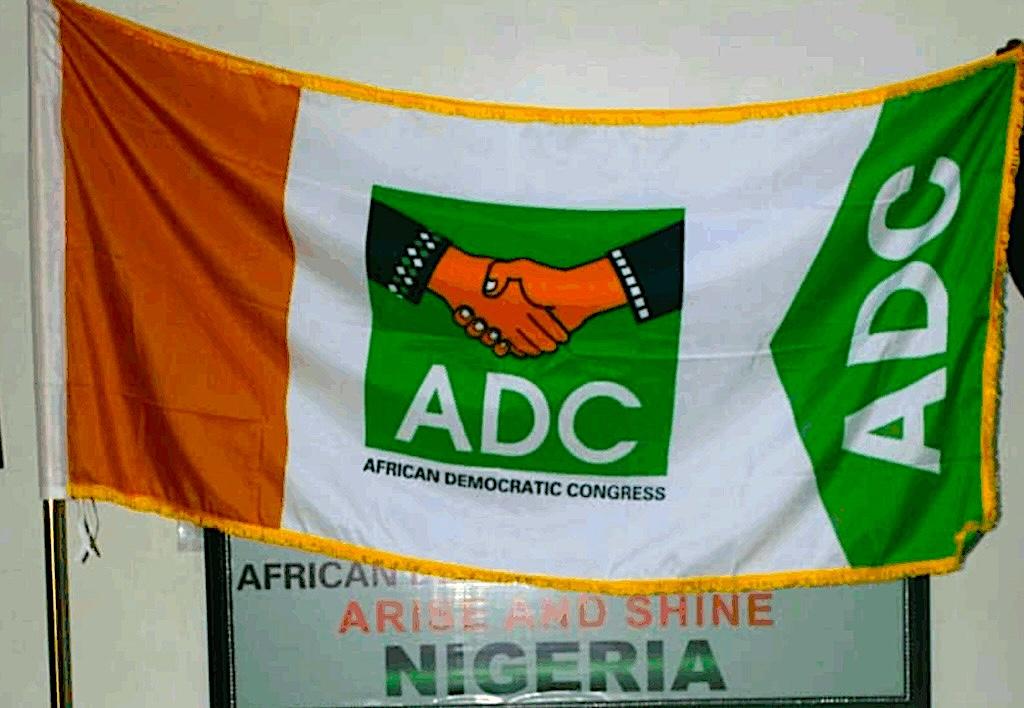
A fresh leadership crisis has erupted in the All Democratic Congress (ADC) as a bloc of state chairmen announced a takeover of the party’s structure.
- +ADC crisis deepens as new faction emerges, back INEC’s stance
The state chairmen unveiled an interim national leadership and endorsed the Independent National Electoral Commission’s (INEC) recent action against a rival faction.
The state chairmen unveiled an interim national leadership and endorsed the Independent National Electoral Commission’s (INEC) recent action against a rival faction.
At a press briefing in Abuja on Tuesday, Don Obinna, alongside 24 state chairmen and representatives from across the country, declared that they had assumed control of the party following what they described as a leadership vacuum created by INEC’s suspension of the David Mark-led National Working Committee (NWC).
The group also disowned both the David Mark-led leadership and the faction linked to Nafiu Bala Gombe, insisting that the ADC has no factions and remains a single entity under the authority of its state chairmen.
The state chairmen claimed that Mr Bala never held a recognised position within the party, insisting his emergence was part of unconstitutional arrangements.
“We dissociate the ADC from Nafiu Gombe and firmly and unequivocally state that he has never held the position of deputy chairman of the ADC,” Mr Obinna said.
He added that the decision followed what he described as persistent constitutional violations, including the failure to convene mandatory National Executive Committee (NEC) meetings and attempts to sideline elected state executives.
“Since the emergence of David Mark’s NWC, we’ve never held an NEC meeting. They contravened the party’s constitution. NEC doesn’t even know if a congress is supposed to have been held. There’s a case in court on that,” Mr Obinna explained.
The state chairmen subsequently announced the constitution of an interim National Executive Committee to manage the party’s affairs and organise a national convention.
The committee is led by Temitope Ogga (Kogi) as chairman and Odion Kennedy (Edo) as secretary. Other members include Muhammad Jidda (Borno), deputy chairman; Kabiru Hussaini (Jigawa), assistant secretary; Charles Omidiji (Osun), national organising secretary; Johnny Derek (Bayelsa), deputy organising secretary; Stella Chukwu (Enugu), treasurer; and Mr Obinna, publicity secretary.
The group also threw its weight behind INEC’s position on the disputed leadership, describing the commission’s action as a necessary step to restore order within the party.
Speaking further, Mr Ogga questioned the eligibility of members of the David Mark-led coalition, citing provisions of the party’s constitution that require at least two years of membership before contesting for elective positions.
The latest move by the bloc of state chairmen comes amid a sharp escalation in tensions between the ADC and INEC over the party’s leadership crisis.
The dispute worsened last Thursday when the ADC, at a world press conference, demanded the immediate resignation of INEC chairman, Joash Amupitan, accusing the electoral body of undermining democracy and interfering in the internal affairs of political parties.
At the briefing, Mr Mark, the factional national chairman, warned of what he described as a shrinking democratic space under President Bola Tinubu’s administration.
He argued that INEC’s decision to freeze recognition of the party’s leadership raised serious questions about the commission’s neutrality and independence.
Mr Mark, a former Senate president, maintained that the party would proceed with its internal processes regardless of INEC’s stance, insisting that the law does not mandate the commission’s presence at party congresses or conventions.
Reinforcing that position, the party, in a statement on Friday signed by its National Organising Secretary, Chinedu Idigo, and National Publicity Secretary, Bolaji Abdullahi, said it would go ahead with its planned congresses and national convention despite INEC’s warning.
The party said it had fulfilled all statutory obligations, including formally notifying the electoral body of its activities, and described INEC’s actions as unlawful.
At the heart of the crisis is INEC’s decision to suspend recognition of the leadership of any faction, in line with a Court of Appeal ruling directing parties to maintain the status quo pending the determination of a substantive suit before the Federal High Court.
The suit was filed by Mr Bala, a former national vice chairman of the ADC, who is challenging Mr Mark’s emergence as national chairman following the resignation of the former chairman, Ralph Nwosu.
Mr Bala is asking the court to declare him the legitimate national chairman in accordance with the party’s constitution. The case is still pending.
In the course of the dispute, Mr Mark’s faction had approached the Court of Appeal with an interlocutory appeal ahead of proceedings at the Federal High Court. However, the appellate court dismissed the appeal and ordered all parties to maintain the status quo.
Following that ruling, INEC announced that it would not recognise any faction of the ADC leadership until the court delivers a final judgment in the matter.
Mr Mark, however, faulted the commission’s interpretation of the ruling, arguing that there was no legal basis for the de-recognition of his leadership of the party. He said INEC ought to have sought judicial clarification if there was any ambiguity in the court’s directive.
He also accused the ruling All Progressives Congress (APC) of being behind the crisis, alleging that Mr Bala was being used to destabilise the ADC as part of a broader political strategy to weaken opposition forces ahead of future elections.
In response, INEC chairman, Mr Amupitan, warned the party against proceeding with its planned congresses without the commission’s supervision, citing the ongoing court proceedings.
Speaking on Arise Television, he said a motion related to the dispute had yet to be determined and cautioned that any action taken in defiance of the court order could attract “grave legal consequences.”
He pointed to precedents in Zamfara and Plateau states, where failure to comply with court orders led to the nullification of electoral victories, with candidates who initially came second eventually declared winners.