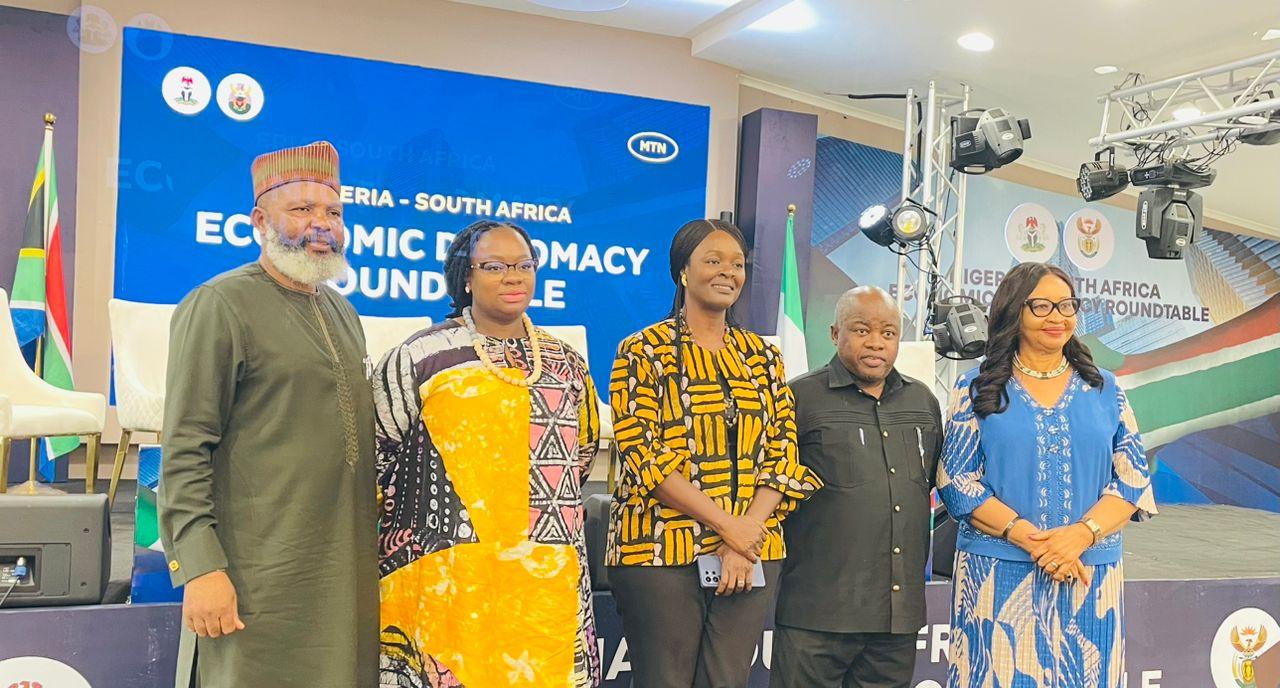
The strategic importance of deepening economic ties between Nigeria and South Africa has been described as critical drivers of Africa’s growth and integration agenda.
- +Nigeria–South Africa partnership critical to Africa’s integration agenda
The submissions were made by stakeholders at the second edition of the Economic Diplomacy Roundtable jointly convened by the South African High Commission in Nigeria and MTN, who brought together government officials, business leaders, and diplomats to advance conversations around trade, investment, and cross-border collaboration.
The submissions were made by stakeholders at the second edition of the Economic Diplomacy Roundtable jointly convened by the South African High Commission in Nigeria and MTN, who brought together government officials, business leaders, and diplomats to advance conversations around trade, investment, and cross-border collaboration.
Stakeholders agreed that while challenges remain, stronger collaboration between Nigeria and South Africa could set the pace for broader continental integration and shared prosperity.
Speaking on behalf of MTN Nigeria’s leadership, Onyinye Emeka, chief marketing officer, said the roundtable reflects the telecom giant’s broader commitment to shaping Africa’s economic future beyond corporate interests.
Quoting the company’s CEO, Karl Toriola, Emeka noted that the initiative “is not a corporate event in our calendar, but speaks to the very essence of why MTN exists on this continent.”
She added that MTN is positioning itself not merely as a participant but as a co-author of the African future, leveraging its infrastructure and decades-long presence across the continent.
Emeka highlighted MTN’s footprint, noting that the company serves over 307 million subscribers, has deployed more than 175,000 kilometres of fibre infrastructure, and continues to invest heavily in digital and financial systems that support intra-African trade.
She said initiatives such as cross-border payment platforms are already enabling more seamless transactions, particularly between major economic hubs like Lagos and Johannesburg.
“Trade does not thrive on promises; it thrives on systems that work,” she said, emphasising the need for functional payment rails and regulatory alignment to unlock economic potential.
Stakeholders also acknowledged the role of both governments in strengthening bilateral relations. Reference was made to the 11th Nigeria-South Africa Binational Commission held in Cape Town in December 2024, where both countries reaffirmed commitments to deepening cooperation through over 30 bilateral agreements and memoranda of understanding.
Emeka noted that policy frameworks such as Nigeria’s Presidential Enabling Business Environment Council (PEBEC) and South Africa’s Operation Vulindlela are helping to create a more conducive environment for investment and trade.
She further stressed that Nigeria and South Africa, as Africa’s two largest economies, must move beyond competition to collaboration.
“Nigeria and South Africa are not the destination; they are the engine,” she said. “If both countries build a seamless and trusted economic corridor, it will serve as a template for the rest of the continent.”
Dominic Khumalo, senior business manager/ group chairman, MTN, said the company’s 30-year presence across Africa has provided critical insights into the continent’s economic realities and opportunities.
According to him, MTN’s operations across countries such as Ghana, Uganda, Cameroon, and South Africa have demonstrated that connectivity, digital inclusion, and institutional trust are central to development.
“Our true calling is not just to provide digital and financial services, but to enable dignity, hope, and opportunity for millions of Africans,” he said.
Khumalo added that Nigeria and South Africa together account for nearly half of sub-Saharan Africa’s GDP, making their partnership essential to the success of the African Continental Free Trade Area (AfCFTA).
“When these economies trade freely, the AfCFTA becomes real. When payment systems between Lagos and Johannesburg work, financial inclusion accelerates across the continent,” he said.
Ije Jidenma, chairperson of the Nigeria-South Africa Chamber of Commerce, stressed the importance of economic diplomacy in advancing mutual interests.
She described economic diplomacy as the intersection of foreign policy and economic strategy, noting that it plays a critical role in driving exports, attracting investment, and strengthening geopolitical influence.
Jidenma called for stronger collaboration between businesses in both countries, urging stakeholders to prioritise trust-based partnerships, joint ventures, and sustainable investments.
“We would like to see South African businesses grow in Nigeria and Nigerian businesses thrive in South Africa on a win-win basis,” she said.
Jidenma stated that the enhanced cooperation in key sectors such as energy, infrastructure, logistics, housing, and digital connectivity could unlock significant economic opportunities and job creation across the African continent.