Crude oil is flowing in our bloodstream, rural Niger Delta women tell female environmental activists
- +“If you eat shrimps and other seafood, you have been eating crude oil.”
…Consumption of seafoods soaked in oil is rampant, makes case for cleanup of oil region
…Consumption of seafoods soaked in oil is rampant, makes case for cleanup of oil region
Rural women in the oil region have cried out, saying what is flowing right now in their bloodstream is crude oil. The women said seafoods and other plants are soaked in crude oil, which is passed to humans.
This claim is supported by findings of a women-focused non-governmental organisation (NGO) known as Kebetkache Women Development Centre (KWDC), led by Emem Okon.
Okon disclosed what happened in some of the communities they visited for research in the oil region. She told of places in Ogoni where women are mostly below 50 years, who say their mothers died long ago.
She told stories of women with lung diseases and others suffering different breathing defects, saying most of the food they eat is poisoned with carcinogens.
The activist further painted a grim picture of the human impact of pollution on women and local communities, recounting testimony from a woman in Otuabagi community.
“One of the women in Otuabagi (Oloibiri area) said if you cut my waist, you will not see blood, you will see crude oil,” Okon said.
She pleaded with the media to expose hidden clauses in the Petroleum Industry Act (PIA) and the Niger Delta pollution.
Okon, who is the Executive Director of Kebetkache, charged journalists to intensify investigations into environmental degradation in the Niger Delta.
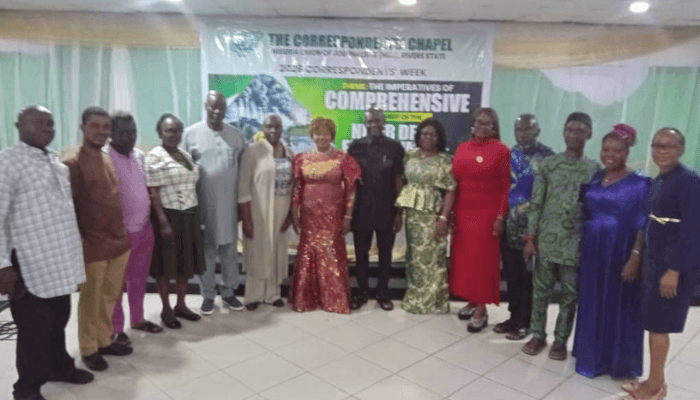
Okon spoke during the keynote address at the Dinner Night of the Correspondents’ Week organised by the Correspondents’ Chapel of the Nigeria Union of Journalists (NUJ) in Port Harcourt, with support from Renaissance Africa Energy Company, Nigeria LNG and Kebetkache Women Development Centre.
The 2026 Correspondents’ Week has the theme, ‘The imperatives of comprehensive cleanup of the Niger Delta Environment: Role of the Media.’
She said the media must move beyond routine reporting and begin to interrogate environmental policies, oil industry practices and government actions affecting communities in the Niger Delta.
“Environmental degradation in the Niger Delta demands urgent action,” she said.
“The media should take up the PIA and expose the hidden clauses, investigate, and interrogate these things.”
Okon urged journalists to help drive public awareness around environmental justice and push the government to extend the ongoing Ogoni cleanup to other polluted parts of the Niger Delta.
“The media needs to make the government realise that we need to extend the Ogoni cleanup to the entire Niger Delta. We must begin now.”
She noted that the United Nations Environment Programme (UNEP) had estimated that full environmental restoration of Ogoniland could take up to 30 years, warning that waiting for completion before addressing pollution in the larger Niger Delta would worsen ecological damage.
She also criticised what she described as misplaced priorities in government intervention efforts, particularly plans to establish a museum in polluted communities without addressing environmental devastation.
“We are told the federal government is now building a museum in Oloibiri, which to me is another level of deception,” she said.
“Communities will begin to think the museum is going to bring something good for them, and then they will sit and expect, and nothing reasonable will come out.”
Okon tasked journalists to simplify technical environmental reports and laws for ordinary citizens, saying many communities remain unaware of policies that directly affect them.
According to her, independent reporting is essential in exposing the gap between environmental policies and realities on ground.
“Communities most affected are often defeated. Some of them don’t even know that they can speak out.”
“They abstain because they know that if they speak up, they are speaking against very powerful forces — the corporations, the government. They have the power, they have the authority, they have the money.”
Okon commended the Correspondents’ Chapel for sustaining conversations around environmental justice in the Niger Delta and expressed hope that collective action would restore the region for future generations.
Her position was supported by Constance Meju, a chief and a renowned environmental and gender rights advocate, who warned that decades of oil pollution in the Niger Delta have gone beyond environmental degradation to direct human consumption of crude oil through contaminated seafood and water sources.
Meju also spoke at the Dinner Night and said oil spill response efforts in the Niger Delta remained grossly inadequate compared to international standards, leaving communities exposed to long-term health risks.
“In the Niger Delta, there is no oil spill site that has been cleaned properly,” she said.
She compared Nigeria’s oil spill response system with international best practices, arguing that weak enforcement and poor remediation culture have worsened environmental injustice in the region.
“When oil spill occurred in the US, after the site was cleaned up, President Barack Obama visited the site and was dissatisfied. He told the operator to go back and clean the place,” she said.
“But here in the Niger Delta, oil spill sites are shabbily cleaned and most of them not cleaned at all.”
Meju issued a stark warning on food safety, insisting that pollution has already entered the food chain in oil-producing communities.
“If you eat fresh fish in the oil region, I want to tell you that you’re eating oil,” she said.
“If you eat shrimps and other seafood, you have been eating crude oil.”
She warned that continued exposure to polluted waterways has altered marine life and posed serious long-term health risks to residents who depend on fishing for survival.
The activist also linked environmental destruction to rising youth unemployment and dependency in the Niger Delta, saying traditional livelihoods have collapsed due to pollution.
“In the time past, as kids, when we needed money, we used to go and fish, but since the devastation, our youth are no longer working. There’s an entitlement,” she said.
She warned that the loss of productive livelihoods has created a dependency mindset among young people struggling to survive in polluted communities.
“There’s a dangerous mentality for you to believe that people have to work for you,” she added.
Meju called on journalists to intensify investigative reporting on oil pollution and play a stronger role in holding multinational companies accountable.
“This is the best position to do the necessary advocacy,” she said.
“Because we are the ones they listen to. Anybody who is the most powerful in this country, he respects journalists. He fears journalists.”
She urged the media to use its influence to ensure oil companies comply with environmental laws and fully rehabilitate impacted sites.