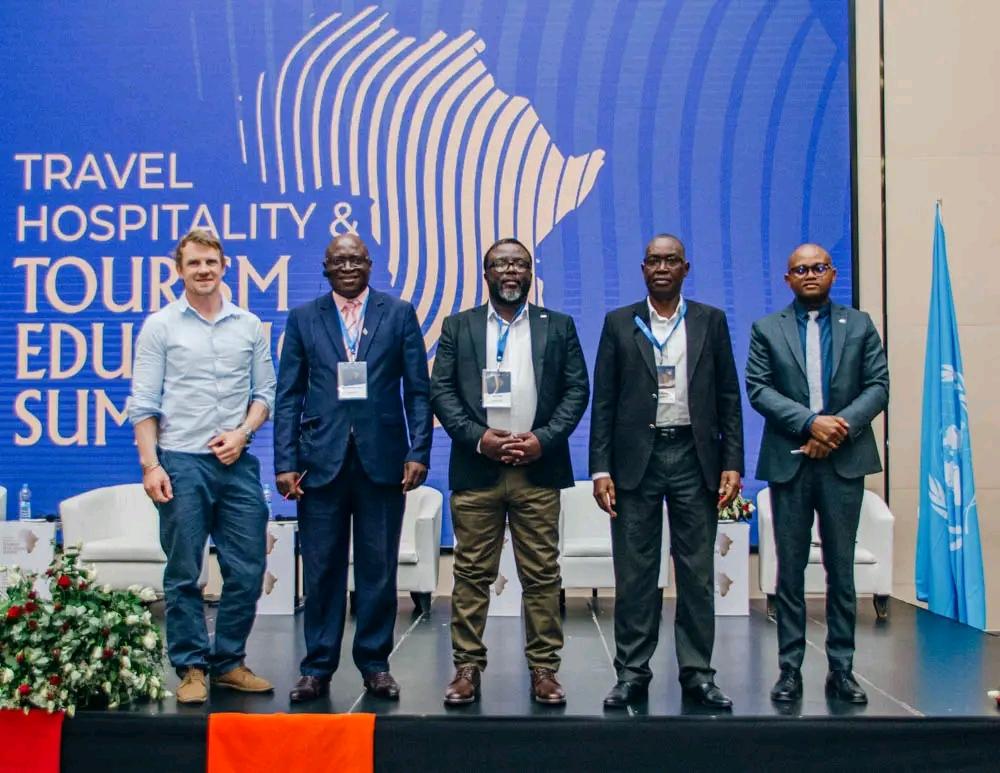
Tourism, education summit closes in Lusaka, tasks sectors on reforms, implementation
One again, the Zambia Institute for Tourism and Hospitality Studies (ZITHS) has pulled through another successful edition of the annual Travel, Hospitality and Tourism Education Summit (THTES).
One again, the Zambia Institute for Tourism and Hospitality Studies (ZITHS) has pulled through another successful edition of the annual Travel, Hospitality and Tourism Education Summit (THTES).
This year, which is the fourth edition closed in Lusaka with a decisive shift from dialogue to delivery, setting in motion a structured, multi-sector framework to reform tourism education and workforce development across Africa.
Tagged (THTES 2026), the summit, which held from April 14-16, 2026 at the Mulungushi International Conference Centre and convened by ZITHS, moved beyond policy rhetoric, producing concrete commitments, institutional alignment, and measurable pathways anchored in its theme: Education as a Catalyst for Tourism Transformation.
Bringing together ministers responsible for tourism, education, labour and commerce, alongside UN Tourism leadership, academia and industry operators, THTES 2026 positioned itself as one of the continent’s most coordinated interventions on tourism human capital development to date.
At the centre of the summit’s outcomes was the adoption of the Lusaka Communiqué on Tourism and Human Capital Development, formalizing, for the first time, a coordinated inter-ministerial approach to tourism workforce development. The communiqué, signed by Zambia’s Ministers of Tourism, Labour, Commerce and Education, establishes a unified governance model built around three pillars: expanded apprenticeship systems, curriculum alignment with labour market demand, and enforceable monitoring frameworks.
Brenda Tambatamba, Labour and Social Security Minister, positioned the Skills Advisory Committee as the operational anchor of this alignment, confirming that labour market intelligence studies are already informing implementation. A pilot apprenticeship programme targeting 1,000 young people across tourism and other key sectors is now underway, supported by the International Labour Organization and the European Union.
Chipoka Mulenga, Commerce, Trade and Industry Minister, reinforced tourism’s positioning as an investment sector, disclosing ongoing reforms to eliminate fragmented licensing regimes. The planned single licensing framework is expected to significantly reduce entry barriers and improve ease of doing business.
Douglas Syakalima, Education Minister, underscored structural reform within the education system, confirming that tourism has been embedded as a standalone subject within the Zambia Education Curriculum Framework (2023–2033), introducing industry awareness at primary level.
Meanwhile, Rodney Sikumba, Tourism Minister, linked the reforms to broader legislative gaps, calling for policy coherence to sustain implementation momentum.
A defining thread across THTES 2026 was the deliberate dismantling of the long-standing disconnect between academic certification and workplace competence.
Technical sessions on vocational training systems, apprenticeships and workforce readiness moved discussions firmly into implementation territory.
Mark Rachuonyo Ogendi, chief executive officer, Utalii College Kenya, presented a model anchored on 70 percent practical training and 30 percent theory, delivered through a fully operational training hotel environment. The approach integrates mandatory foreign language training, positioning graduates for global competitiveness. The Bank of Zambia demonstrated how structured institutional learning can complement academic training, outlining internship programmes of one to six months supported by supervision frameworks and targeted learning outcomes.
The International Labour Organization reinforced global standards through Recommendation 208 on Quality Apprenticeships (2023), emphasising legally defined contracts, dual learning systems, and measurable competency outcomes.
Private sector participation further sharpened the implementation lens. InterContinental Lusaka reported improved intern performance following the introduction of stipends—an intervention that also contributed to stronger female participation within training cohorts.
From a global perspective, UN Tourism highlighted Spain’s compulsory internship model as a benchmark, underpinned by tripartite collaboration between government, academia and industry, with shared financial responsibility for training. By the final day, the summit had moved beyond workforce discussions into redefining tourism itself as a structured, data-driven and interdisciplinary field.
The certification of trainers and tutors signaled a deliberate investment in teaching capacity, while an educator masterclass led by UN Tourism introduced STEM-based approaches to tourism instruction. Revenue management, destination systems and digital platforms were reframed through mathematics, science and technology, embedding analytical rigor into tourism education. Plenary discussions reinforced this repositioning. Under the theme ‘The Science of Tourism’, stakeholders called for stronger integration of research, data interpretation and policy alignment in tourism development.
In parallel, conversations on MICE (Meetings, Incentives, Conferences and Exhibitions) education elevated the segment from an operational niche to a strategic economic driver. Contributions from academia and industry emphasized the need for Convention Bureau structures to institutionalize MICE development, drawing on Rwanda’s model as a reference point.
A conference paper presented by Event Architect Group further framed MICE as a high-value ecosystem requiring coordinated governance across tourism, aviation, trade and foreign affairs. Beyond policy frameworks, THTES 2026 delivered concrete infrastructure and capacity-building commitments.
Minister Sikumba confirmed that 160 hectares of land have been secured for the development of the ZITH International Academy for Tourism and Hospitality Studies, a flagship institution to be established in partnership with UN Tourism and positioned as a continental centre of excellence.
The minister also reaffirmed tourism’s economic weight, noting that the sector currently supports over 159,000 direct jobs.
On capacity development, UN Tourism announced the allocation of 100 scholarships through its Online Academy, targeting educators and professionals across Africa.
Elcia Grandcourt, Regional Director for Africa, UN Tourism, placed these interventions within a broader demographic context, noting that while Africa faces youth unemployment exceeding 72 million, women—who account for 69 percent of the tourism workforce—remain underrepresented in leadership roles.
She identified Zambia’s early integration of tourism into formal education as a model aligned with global education guidelines.
THTES 2026 closed with a clear and unified position: Africa’s tourism competitiveness will be determined not by ambition, but by execution.