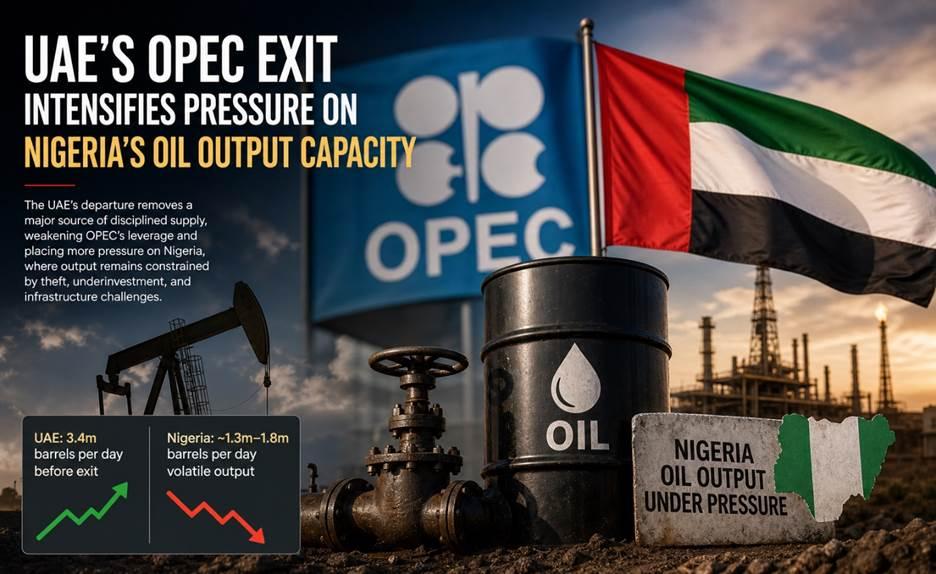
The departure of Abu Dhabi ends more than five decades of membership and removes one of OPEC’s most capacity-rich producers. For oil-dependent economies unable to expand output, the implications are structural rather than temporary.
- +UAE’s OPEC exit intensifies pressure on Nigeria’s oil output capacity
- +Nigeria’s structural constraint
- +The strategic shift in oil markets
In global oil markets, influence is defined less by membership than by the ability to produce and withhold barrels.
In global oil markets, influence is defined less by membership than by the ability to produce and withhold barrels. That distinction now sits at the centre of a shift within the Organization of the Petroleum Exporting Countries (OPEC).
The exit of the United Arab Emirates removes a key source of disciplined supply and exposes the extent to which OPEC’s pricing power depends on a small group of high-capacity producers.
For Nigeria, the adjustment is indirect but material.
Before its exit, the UAE produced about 3.4 million barrels per day, placing it among OPEC’s top-tier producers alongside Saudi Arabia and Iraq.
OPEC accounts for just over a third of global crude supply, with the UAE contributing roughly 12 percent of OPEC output and about 3 to 3.5 percent of global production. While not dominant individually, its role formed part of the cartel’s core balancing capacity.
The significance lies in discipline rather than volume alone. OPEC’s effectiveness depends on coordinated supply management. When a member exits, its production does not disappear; it re-enters the market outside quota constraints.
According to Dan Pickering of Pickering Energy Partners, the UAE’s exit could reduce OPEC’s share of global supply from about 30 percent to 26 percent. The immediate effect is a shift of flexible capacity from coordinated control to independent production.
The decision reflects a structural misalignment between production capacity, OPEC governance, and the UAE’s long-term energy strategy.
Abu Dhabi National Oil Company has invested heavily to raise output capacity toward 5 million barrels per day by 2027, supported by an estimated $150 billion upstream programme. Yet OPEC quotas limited production to around 3.2 million barrels per day, leaving a substantial share of capacity unused.
Analysts at the Observer Research Foundation estimate this gap at more than 1.5 million barrels per day, reflecting foregone revenue against sustained capital investment.
Robin Mills, chief executive of Qamar Energy, noted that the UAE had long viewed its quota position as inconsistent with its production potential. The exit also reflects a broader strategic recalibration shaped by economic constraints under OPEC allocation rules, evolving regional dynamics that limited alignment with Saudi-led coordination, and a desire to prioritise autonomy in output decisions.
Beyond quota rigidity, three additional factors reinforced the decision:
First, structural dissatisfaction with OPEC’s quota-setting framework, which UAE policymakers have argued does not adequately reflect capacity expansion among newer producers. This has been evident in repeated negotiations over baseline adjustments within OPEC.
Second, a strategic shift in ADNOC’s investment horizon, as upstream expansion and downstream integration require higher utilisation certainty. Persistent underuse of capacity increasingly conflicted with capital efficiency objectives.
Third, a transition in global energy planning, where the UAE is positioning itself as a long-horizon supplier seeking to optimise reserve monetisation ahead of potential demand plateau risks, in line with national diversification strategies.
The UAE’s exit contrasts sharply with Angola’s departure in 2023, which stemmed from inability to meet quotas rather than excess capacity. One reflects constraint. The other reflects expansion.
In the short term, OPEC’s market influence remains intact, supported more by geopolitical risk than production discipline. Brent crude has traded above $117 per barrel amid disruptions linked to tensions around key shipping routes.
However, structural cohesion is weakening. Priya Walia of Rystad Energy estimates OPEC output at 27.68 million barrels per day against a quota of 36.73 million, underscoring persistent compliance gaps.
OPEC’s historical strength has depended on a small group of producers with spare capacity and willingness to adjust output. The UAE combined both. Its exit reduces the cartel’s flexibility and narrows the pool of producers capable of stabilising supply.
This shift also alters incentives among remaining members, particularly those with a history of exceeding quotas, including Iraq and Kazakhstan.
Michael Tamvakis of Bayes Business School notes that the UAE’s timing reflects a strategy to maximise market share during periods of constrained global supply. Once logistical disruptions ease, additional UAE output is expected to return to the market, further exposing reduced OPEC coordination capacity.
Nigeria’s structural constraint
For Nigeria, the implications are centred on production capability rather than cartel dynamics.
Crude output has averaged about 1.7 million barrels per day between 2025 and 2026, with peaks approaching 1.8 million barrels per day. However, performance remains volatile.
Industry estimates suggest losses of around 400,000 barrels per day due to theft and pipeline disruptions. Output has also dipped to around 1.3 million barrels per day in weaker periods, below quota expectations and budget assumptions.
These fluctuations reflect operational constraints rather than market strategy. While improvements have been recorded, they remain marginal relative to structural limitations.
According to Olugbenga Olaoye, Nigeria’s gains reflect short-term efficiency improvements rather than a durable expansion in capacity. He notes that the country remains unable to adjust output meaningfully in response to price movements.
This creates a fiscal constraint. Revenue projections are repeatedly anchored to production levels that are not consistently achieved, increasing reliance on borrowing and monetary adjustments to close budget gaps.
Nigeria therefore operates as a price-dependent producer with limited volume flexibility. It benefits from high prices but lacks the capacity to respond through increased output when conditions change.
The strategic shift in oil markets
OPEC’s share of global production has declined over time as non-member producers, including the United States and Norway, expanded output. The UAE’s exit accelerates this structural trend.
While OPEC retains significant reserves, reserves without production flexibility carry limited short-term pricing influence. Market power is increasingly determined by the ability to deliver barrels consistently and at scale.
For Nigeria, the broader implication is that influence in the oil market is shifting away from quota management toward production efficiency and operational reliability.