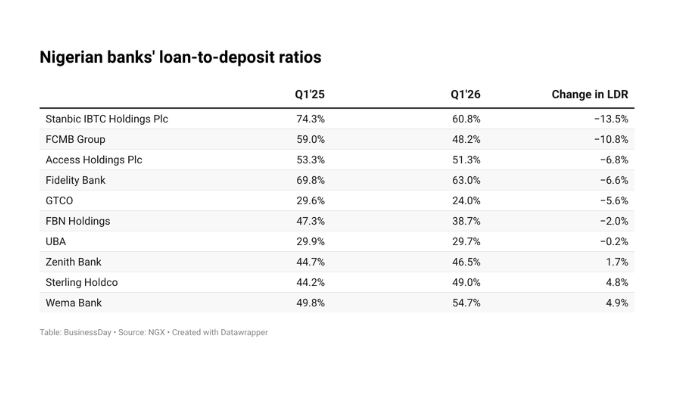
Nigerian banks became more cautious in deploying customer deposits into loans in the first half of 2026 (Q1), with Stanbic IBTC Holdings, FCMB Group, and Access Holdings recording the sharpest declines in lending appetite as deposit growth outpaced credit expansion across the sector.
- +Stanbic, FCMB, Access drive decline in Nigerian banks’ lending appetite
An analysis of first-quarter 2026 financial statements of 10 listed banks shows that the industry’s average loan-to-deposit ratio (LDR) fell to 46.6 percent from 48.2 percent a year earlier, signalling a growing preference for liquidity preservation amid a high-interest-rate environment and persistent macroeconomic uncertainties.
An analysis of first-quarter 2026 financial statements of 10 listed banks shows that the industry’s average loan-to-deposit ratio (LDR) fell to 46.6 percent from 48.2 percent a year earlier, signalling a growing preference for liquidity preservation amid a high-interest-rate environment and persistent macroeconomic uncertainties.
The loan-to-deposit ratio, a key measure of how aggressively banks convert deposits into loans, compares a bank’s total loan book with customer deposits. A declining ratio generally indicates that deposits are growing faster than lending, reflecting a more conservative credit stance.
Stanbic IBTC recorded the steepest decline in lending appetite among the banks reviewed, with its LDR falling by 13.5 percentage points to 60.8 percent in the first quarter of 2026 from 74.3 percent a year earlier. Although the bank’s loan portfolio expanded to N2.48 trillion from N2.26 trillion, deposits grew much faster, rising to N4.08 trillion from N3.04 trillion.
FCMB Group followed with a 10.8 percentage-point decline in its LDR to 48.2 percent from 59.0 percent. The lender’s gross loans fell to N2.25 trillion from N2.43 trillion, even as customer deposits increased to N4.67 trillion from N4.12 trillion.
Access Holdings, Nigeria’s largest bank by assets, posted the third-largest decline. Its LDR dropped by 8.6 percentage points to 38.7 percent from 47.3 percent, reflecting the rapid growth in customer deposits relative to lending activities. Deposits surged to N34.9 trillion from N23.03 trillion, while loans increased to N13.5 trillion from N10.9 trillion.
The trend was not limited to these banks. Fidelity Bank’s LDR declined by 6.8 percentage points to 63.0 percent, while GTCO’s ratio dropped by 5.6 percentage points to 24.0 percent. FBN Holdings recorded a smaller decline of 2.0 percentage points to 51.3 percent, while UBA’s ratio remained broadly stable at 29.7 percent.
Among the major lenders, Fidelity Bank and Stanbic IBTC maintained the highest LDRs in the industry at 63.0 percent and 60.8 percent respectively, suggesting that despite the declines, both institutions continued to deploy a larger proportion of customer deposits into loans than their peers.
By contrast, GTCO remained the most conservative lender among the banks analysed, with an LDR of just 24.0 percent. UBA followed at 29.7 percent, while Access Holdings reported 38.7 percent.
Only three banks recorded an increase in lending appetite during the period. Wema Bank posted the largest improvement, with its LDR rising by 4.9 percentage points to 54.7 percent. Sterling Holdco followed with a 4.8 percentage-point increase to 49.0 percent, while Zenith Bank recorded a modest increase of 1.7 percentage points to 46.4 percent.
Credit growth remains positive despite falling lending ratios The decline in lending appetite comes as Nigerian banks continue to operate in one of the highest interest-rate environments in recent history. Elevated yields on government securities, tighter monetary conditions and heightened credit risks have encouraged lenders to maintain stronger liquidity positions even as deposits continue to flow into the banking system.
The Central Bank of Nigeria’s Monetary Policy Committee has maintained the benchmark interest rate at 26.5 percent, reflecting its commitment to keeping inflationary pressures under control.
Despite the decline in LDRs, banking sector credit continues to expand in absolute terms. According to the latest figures from the regulatory authority, lending to the domestic economy rose from N109.42 trillion in January to N111.39 trillion in February 2026, representing a 1.8 percent increase.
The figure marks the highest level of credit to the domestic economy since November 2024, when total credit stood at N115.57 trillion. On a year-on-year basis, net domestic credit increased by 7.8 percent from N103.36 trillion recorded in February 2025.
However, credit growth has not been evenly distributed. Credit to the private sector declined marginally by 0.8 percent year-on-year to N75.64 trillion from N76.25 trillion a year earlier, raising concerns about the availability of financing to businesses and productive sectors of the economy.
Analysts say the trend reflects a banking sector that is prioritising balance-sheet resilience over aggressive loan growth. While credit creation remains positive across much of the industry, the pace of deposit mobilisation is increasingly outstripping loan expansion, resulting in lower loan-to-deposit ratios across many of the country’s largest lenders.
High CRR continues to constrain lending capacity Beyond high interest rates, analysts argue that the Central Bank of Nigeria’s Cash Reserve Ratio (CRR) policy remains one of the biggest constraints on banks’ ability to expand lending.
According to a recent report by Chapel Hill Denham titled *The Nigerian Banking Paradox: High Returns, Deep Discounts*, Nigerian banks may be losing as much as N2.5 trillion annually in earnings because of the high reserve requirement imposed by the apex bank.
The investment banking firm noted that banks continue to generate some of the strongest returns on equity in Africa, yet remain undervalued due to regulatory constraints and macroeconomic risks.
The report estimates that for every N100 deposited by customers, banks are required to set aside as much as N50 in non-interest-bearing reserves while continuing to pay interest on those deposits. Applying a 15 percent net interest margin implies an annual earnings drag of approximately N2.5 trillion across the industry.
Chapel Hill Denham argued that the policy, while originally designed to strengthen financial stability and manage liquidity, has increasingly limited banks’ capacity to support economic growth through lending.
The concern is particularly acute for small businesses. Muda Yusuf, chief executive officer of the Centre for the Promotion of Private Enterprise (CPPE), recently noted that credit to Small and Medium-sized Enterprises accounts for only about one percent of total banking sector credit, far below the sub-Saharan African average of around five percent.
According to Yusuf, the issue highlights one of the biggest weaknesses in Nigeria’s financial architecture.
“Priority must shift from capital adequacy to economic impact. Nigeria needs not just stronger banks, but banks that work for the economy,” he said.