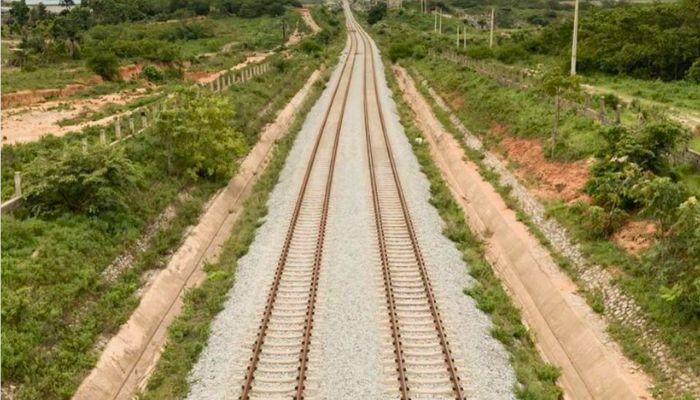
The federal government has insisted that the $1.9bn Abuja-Kano-Maradi rail project will be ready by December this year. The project is expected to strengthen intra-African trade and serve as a major revenue earner along the northern corridor.
- +FG pledges December completion for $1.9bn Abuja-Kano-Maradi rail project
- +…Says project now at about 70% completion
- +Relieving pressure on road infrastructure
- +Integration of national rail networks
Federal Ministry of Transportation director of rail transport services Finbarr Zirra, speaking on the achievements of the President Bola Tinubu administration, said the project would revolutionise economic activities across the country, especially in the northern region, upon completion.
…Says project now at about 70% completion
Federal Ministry of Transportation director of rail transport services Finbarr Zirra, speaking on the achievements of the President Bola Tinubu administration, said the project would revolutionise economic activities across the country, especially in the northern region, upon completion.
Relieving pressure on road infrastructure
Covering a distance of about 400km, the Kano-Maradi standard gauge line connects Kano in Nigeria to Maradi in Niger. The project includes 15 stations passing through cities such as Dambatta, Kazaure, Daura, Mashi, Katsina, and Jibiya.
The line extends to Maradi, situated 40km from the Nigerien border. Zirra described the project as critical infrastructure needed to enhance the country’s economic development. He revealed that Kano would serve as a primary hub for the project, which is currently about 70% complete.
The rail project, initiated by the late former president Muhammadu Buhari, aims to reduce pressure on road networks that currently carry about 90% of goods via trailers. Zirra noted that heavy haulage significantly shortens road lifespans, regardless of repairs.
”Mindful of that in the 1980s, the government felt we had to retrace our steps to ensure we revive this sector,” Zirra said. He stated the railway is designed to last at least 100 years and will provide a futuristic solution for the North West region.
Integration of national rail networks
The project is part of an integrated programme designed to run from Lagos through Ibadan, Ilorin, and Minna to Abuja, eventually reaching Kano. While the Abuja-Kaduna and Lagos-Ibadan sectors are already in service, substantial progress has been made on the Kaduna-to-Kano section.
The section from Makarfi to Kano is complete, and the ministry expects the Kaduna-to-Abuja link to be joined by the end of the year. Reports indicate that while Chinese firms are handling the Abuja-Kaduna section, Portuguese contractors are managing the line from Kano to Maradi.
Apart from infrastructure, the government says it is focusing on rolling stock—the trains themselves—to service these routes. Zirra emphasised that a single loaded train from Lagos to the North could remove approximately 30 trucks from the roads.
The design includes dry ports, such as the Dala dry port in Kano, to facilitate efficient cargo evacuation. As a historic commercial centre, Kano’s role as a hub linking Katsina, Maradi, Kaduna, and Dutse is expected to lower material costs and create enormous multiplier effects across other sectors.