Few words stir public anxiety in Nigeria quite like “debt.” Each new bulletin from the Debt Management Office (DMO) sets off a familiar ripple: headlines blare the latest figures, social media buzzes with outrage, and citizens are reminded of how much each Nigerian supposedly “owes.” Yet this framing misses the deeper reality. The real issue is not simply the size of the debt but the fragile fiscal foundation on which it rests.
- +Nigeria’s fiscal bind: Revenue weakness or debt overhang?
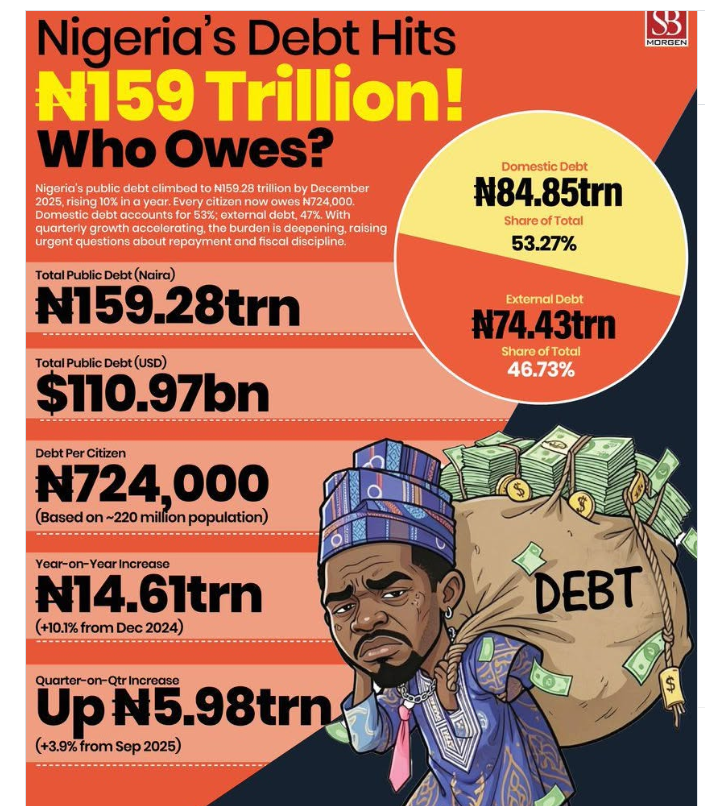
According to the Debt Management Office (DMO), Nigeria’s total public debt—covering the federal government, 36 states, and the FCT- stood at ₦159.28 trillion (about US$110.97 billion) as of December 31, 2025.
According to the Debt Management Office (DMO), Nigeria’s total public debt—covering the federal government, 36 states, and the FCT- stood at ₦159.28 trillion (about US$110.97 billion) as of December 31, 2025. This marked a sharp rise from ₦144.67 trillion (US$94.23 billion) at the end of 2024, representing a year-on-year increase of ₦14.61 trillion, or 10.1%. When spread across a population of roughly 220 million people, the figure translates to about ₦720,000 per citizen.
In 2024, Nigeria devoted an extraordinary 96% of its revenue to debt servicing, leaving barely any fiscal room for infrastructure, education, or healthcare. At the same time, the country’s tax-to-GDP ratio remains stuck at between 6-8%, one of the lowest globally, compared to an African average of 18%. This mismatch between weak revenue mobilization and ballooning debt obligations has created what economists describe as a fiscal trap: borrowing to plug deficits, then spending most of the revenue to repay those loans.
The consequences are predictable yet devastating- shrinking fiscal space, stalled reforms, and constrained growth. Policymakers are caught in a dilemma: should the priority be raising more revenue through tax reforms and ceaseless borrowing, or tackling the debt overhang that crowds out investment? The poser is stark: Is Nigeria’s fiscal crisis fundamentally a revenue problem, a debt problem—or both, intertwined in a trap that demands urgent escape?
Nigeria’s fiscal challenge is best captured in the paradox of its revenue mobilization deficit.
Nigeria’s borrowing spree is driven by simple arithmetic. The 2026 federal budget projected spending of ₦58.18 trillion against expected revenue of ₦34.33 trillion, leaving a deficit of ₦23.85 trillion (4.28% of GDP). After adjustments by the National Assembly, spending rose to ₦68.32 trillion, with borrowing plans climbing to ₦29.2 trillion. When government expects ₦34–37 trillion in revenue but commits to spending nearly double, the gap must be financed- and overwhelmingly, that financing is debt.
Despite being one of Africa’s largest economy, the country’s tax-to-GDP ratio has stubbornly remained at 6–7%, far below the continental average of 15–18% and the OECD benchmark of 30–35%.
Yet beneath the arithmetic lies a deeper structural weakness: weak tax-to-GDP equivalence and chronic revenue under collection. A government that collects so little either spends little-untenable in a country with vast infrastructure and human development deficits- or borrows heavily. The new National Tax Acts (2025) and ongoing revenue reforms aim to broaden the base, but until they deliver, deficits and borrowing will persist, reinforcing the country’s fiscal trap.
This weak revenue base leaves the government perpetually short of funds, forcing it to borrow heavily to meet recurrent obligations. The consequence is stark: in 2022, debt service consumed 97% of retained revenue, leaving almost nothing for capital expenditure. Even with modest improvements, debt service still accounted for 69% of revenue in 2023 and 61% in 2024, far above the prudential threshold of 30–40% recommended for developing economies.
Meanwhile, Nigeria’s public debt has ballooned from N49.85 trillion in 2023 to N159.3 trillion by December 2025, translating to N720,000 per citizen. Projections suggest it could reach N187.79 trillion by end-2026. This rapid escalation underscores the mismatch between borrowing and revenue generation. Structural weaknesses- such as leakages in oil earnings, a narrow tax base, and poor enforcement of fiscal responsibility laws—compound the problem.
The reality is clear: Nigeria’s fiscal crisis is not simply about the size of its debt, but about the inadequacy of its revenue. Without decisive reforms to broaden the tax base and strengthen collection, the country risks remaining trapped in a cycle of borrowing to pay debt.
Nigeria’s debt sustainability challenge has become the defining constraint on its fiscal future.
The imbalances underscores how borrowing has outpaced revenue growth, creating a cycle where new loans are used to pay old ones.
For example, Between 2015 and 2023, theFG’s overdrafts from the CBN, the Ways and Means advances that were supposed to be temporary, capped and repaid within the year, accumulated far beyond the statutory limits, reaching over N22.7 trillion before being securitised into long term FGN debt with National Assembly approval. This hidden monetary financing is widely seen as one driver of Nigeria’s inflationary surge, which saw headline inflation peak above 34 per cent in 2024 before moderating to 14.45 per cent by November 2025 as the CBN halted deficit monetisation and tightened policy. The episode is perhaps the clearest illustration that the problem is not the instrument itself but its misuse beyond lawful and prudent bounds with limited transparency.
This debt overhang is not merely a numbers game—it erodes investor confidence, limits policy flexibility, and traps the economy in low growth. The central question is whether Nigeria can restructure its fiscal priorities to escape this bind. Without decisive reforms in revenue mobilisation, expenditure efficiency, and debt management, the shrinking fiscal space will continue to undermine development ambitions.
Nigeria’s fiscal trap is a vicious cycle where weak revenue mobilization and rising debt mutually reinforce each other, steadily eroding the country’s fiscal space. With a tax-to-GDP ratio of just 6–7%, far below Africa’s average of 15–18%, Nigeria struggles to generate sufficient income to fund its budget. This chronic revenue shortfall forces the government to borrow heavily, yet the borrowed funds are increasingly consumed by debt servicing rather than productive investment.
This dynamic creates a fiscal trap: weak revenue necessitates borrowing, while rising debt service crowds out the very revenues needed to escape dependence on loans. The result is a shrinking fiscal room for development, where essential spending on infrastructure, education, and healthcare is sacrificed to meet debt obligations. Without decisive reforms in revenue mobilization, debt management, and expenditure efficiency, Nigeria risks remaining locked in a cycle of borrowing to pay debt, undermining growth and long-term sustainability.