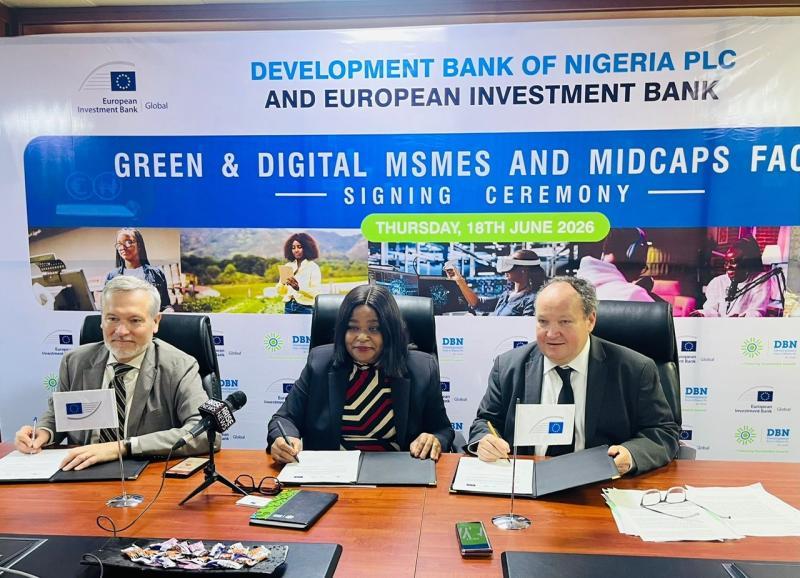
Nigeria has secured a €200 million financing facility from the European Investment Bank’s development arm, EIB Global, through a partnership with the Development Bank of Nigeria to expand access to credit for small businesses and support investments in the country’s green and digital economy.
- +European Investment Bank approves €200 million loan for Nigerian SMEs
The funding agreement was announced in a statement issued by EIB Global on Thursday following a signing ceremony held at the Development Bank of Nigeria’s Lagos office in the presence of the EIB Vice-President, Ambroise Fayolle.
The funding agreement was announced in a statement issued by EIB Global on Thursday following a signing ceremony held at the Development Bank of Nigeria’s Lagos office in the presence of the EIB Vice-President, Ambroise Fayolle.
According to the statement, the facility will be deployed through local financial institutions to support micro, small and medium-sized enterprises as well as mid-sized companies operating in agriculture, renewable energy, digitalisation and innovation.
The development comes as Nigerian businesses continue to face challenges accessing long-term financing amid elevated interest rates and persistent funding gaps that have constrained private sector growth.
The statement read, “The European Investment Bank Group’s development arm, EIB Global and the Development Bank of Nigeria announced a €200 million financial partnership to support the development of small-scale investments of Nigerian enterprises contributing to Nigeria’s green and digital economy.”
According to the statement, the agriculture component is expected to improve productivity, strengthen local supply chains and enhance food security, while funding for renewable energy businesses will help expand access to clean energy, reduce carbon emissions and improve climate resilience in underserved communities.
Commenting on the partnership, Fayolle said the initiative would strengthen the competitiveness of Nigeria’s private sector while advancing inclusive growth objectives.
The statement added that the financing aligns with EIB Global’s strategy of supporting sustainable, inclusive and resilient economic growth in Nigeria under the European Union’s Global Gateway Initiative.
The Managing Director and Chief Executive Officer of the Development Bank of Nigeria, Dr Tony Okpanachi, described the facility as a major milestone in efforts to support entrepreneurship and sustainable economic development.
He noted that the partnership would support businesses across critical sectors of the economy while helping to accelerate Nigeria’s transition towards a digitally enabled and innovation-driven economy.
Analysts have consistently identified access to finance as one of the biggest constraints facing Nigerian MSMEs, many of which struggle to obtain affordable long-term funding from commercial lenders despite accounting for a significant share of employment and economic activity.
EIB Global stated that it has invested nearly €500 million in Nigeria’s private sector over the years, supporting sustainable business growth through long-term financing initiatives.
The institution also disclosed that its cumulative investments in Nigeria have reached approximately €2.3 billion since it began operations in the country in 1978.
According to the statement, those investments have supported projects in sustainable urban transport, climate adaptation, agribusiness logistics, digitalisation and financing for SMEs and mid-sized companies.
Nairametrics earlier reported that the Development Bank of Nigeria (DBN) Plc disbursed more than N1 trillion to over one million Micro, Small and Medium Enterprises (MSMEs), supporting the creation of more than 1.6 million jobs since it commenced operations.
Licensed in 2017, the Development Bank of Nigeria was created to address financing constraints facing Nigeria’s MSME sector by providing long-term funding, credit guarantees and capacity-building support through participating financial institutions.
The bank’s core mandate is to improve access to finance for micro, small and medium enterprises, which are widely regarded as the backbone of the Nigerian economy.