Dangote proposes Nigeria-scale refinery in East Africa, seeks partnership with regional leaders to deliver project within 4 years.
- +Dangote Seeks Ruto, Museveni Backing For Nigeria-Scale Refinery In East Africa
- +Dangote: No Investor Will Come to Africa Without Local Leadership
Aliko Dangote, Africa’s richest man, on Thursday pushed to expand his refining footprint beyond Nigeria, unveiling plans to build a refinery of comparable scale in East Africa in partnership with governments in the sub-region.
Aliko Dangote, Africa’s richest man, on Thursday pushed to expand his refining footprint beyond Nigeria, unveiling plans to build a refinery of comparable scale in East Africa in partnership with governments in the sub-region.
The proposed project is expected to be completed within four years, especially if East Africa’s regional leaders cooperate, Dangote stressed, kicking against Africa’s long-term practice of exporting raw materials abroad.
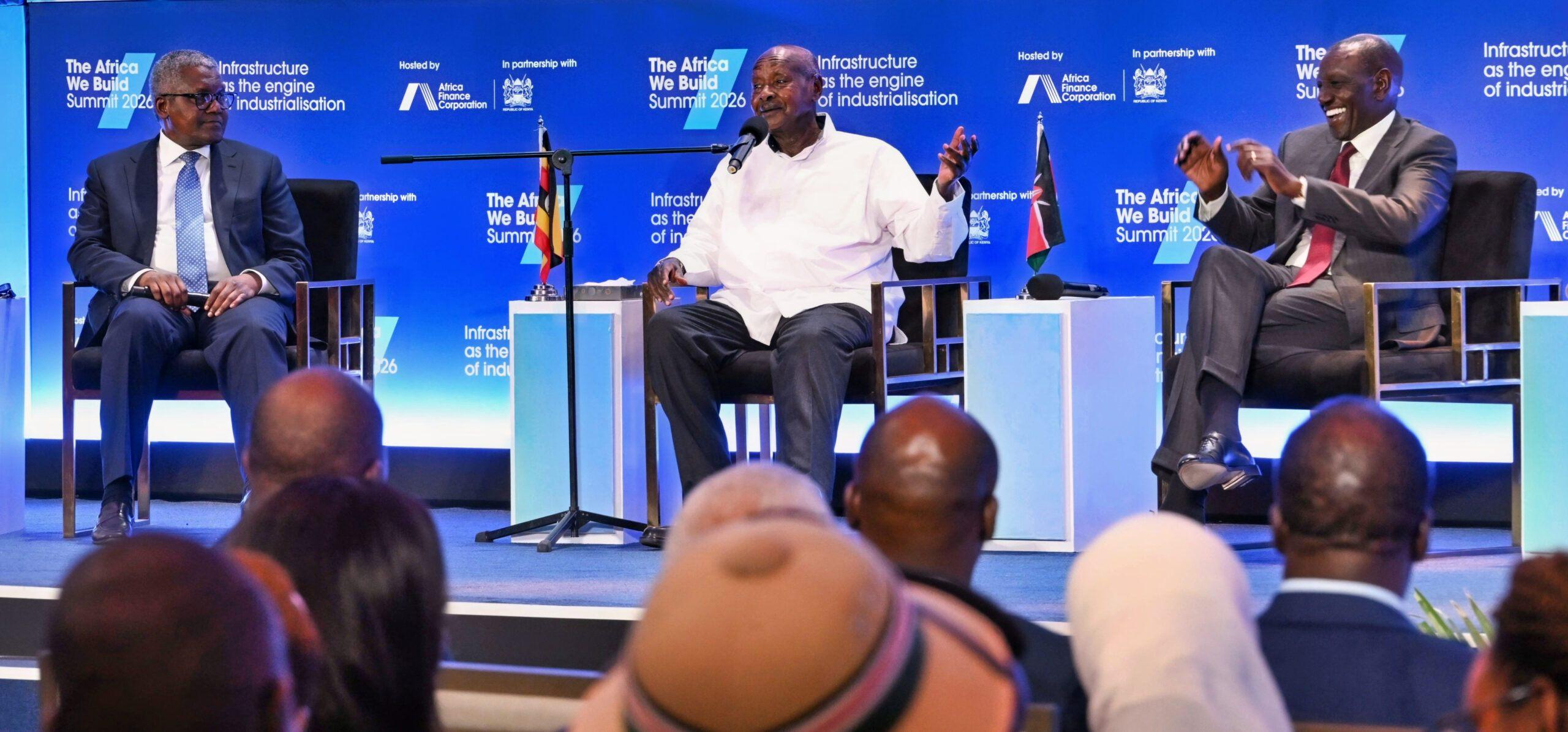
Speaking at a presidential panel at the “Africa We Build” summit in Nairobi, alongside Kenyan President, William Ruto, as well as Ugandan President, Yoweri Museveni, Dangote said his group was ready to build in East Africa a refinery comparable to the 650,000 barrels-per-day facility in Nigeria, provided there was strong policy backing and alignment from governments across the sub-region.
The move comes amid rising intra-African energy trade, with Dangote’s refinery already exporting about 1.1 billion litres of aviation fuel to Europe.
Meanwhile, strong oil import demand lifted South Africa–Nigeria trade volumes to $2.16 billion. This was revealed in a new data released at the fourth edition of the South Africa Week held in Lagos.
The event was hosted by the South African Consulate General in Lagos, in partnership with Brand South Africa and Development Bank of Southern Africa (DBSA)
Dangote stated that by exporting raw materials and importing finished products, Africa was further impoverishing its population of over 1.4 billion people. As part of efforts to reverse the trend, he planned the new move, which could reshape fuel supply, deepen regional integration, and accelerate the continent’s push towards industrial self-sufficiency,
Dangote stated, “I can give commitment to the two presidents (Ruto and Museveni) that are here. If they will support the refinery, we’ll build the identical one that we have in Nigeria, 650,000 barrels. It will (work). There’s nothing that can stop it. We have done the one in Nigeria, and that’s why we’re taking the bold move, which we have started already.
“Piling has started. We’re building that one to a scale. 1.4 million barrels a day will be the largest refinery in the world. That’s number one. Number two, we’ll have 10 per cent of the entire United States of America’s refining capacity. And this is coming with a lot of petrochemicals.”
When completed, the joint refinery is expected to serve Tanzania, Kenya, Uganda, South Sudan, and the Democratic Republic of Congo. The facility is expected to process crude from across the region, supported by shared pipeline infrastructure to improve efficiency and reduce costs.
According to Dangote, consistency in government policy and strong institutional support would be critical to unlocking such large-scale investments. He stressed that uncertainty and reversals in policy had over the years discouraged long-term capital deployment across Africa.
He said Dangote Group planned to invest $40 billion across sectors, including refining, petrochemicals, fertiliser, and manufacturing, by 2030.
Dangote said, “I want to just go into the market, and where I stand, that all Africans should invest (in the Dangote refinery). And we’ll be paying dividends in dollars. But my commitment today here is that if we agree with the three, four governments here about the refinery, we will lead and we’ll make sure that that refinery is built within the next four or five years.”
He also reiterated his position on free movement across Africa, urging leaders across the continent to accelerate visa-free movements, and explaining that the current heavily restricted system hinders trade.
He stated, “Today, with a foreign, with a European passport, you can move faster in Africa than being an African, which I think we must really stop.
“Why can’t we allow visa-free for all Africans? Please, we need to do that, because if we don’t really do that, it will be difficult to trade with somebody that you cannot get in and out easily.”
Kenyan President, Ruto, said Africa could no longer afford to export raw materials while importing finished products, describing the practice as a drain on jobs and long-term prosperity.
“Why would we fail? We have the raw materials, we have the market, we have the capital, and we have the industrialists to run these projects,” he stated.
According to the Kenyan president, discussions are already underway for a regional refinery model that pools resources and demand across borders, rather than duplicating infrastructure in individual countries.
He said such collaboration would allow Africa to fully utilise its assets while building economies of scale.
In his remarks, Ugandan President, Yoweri Museveni, reinforced the need for Africa to move from raw materials export to export of finished products. He pointed to the significant value lost when raw materials were exported without processing.
Museveni stated that as much as 100 per cent gain was lost when African nations exported only raw materials.
“We cannot continue exporting raw materials. It is near criminal to export unprocessed resources when we have the capacity to add value,” he emphasised.
Beyond refining, leaders at the summit emphasised the need to build integrated industrial ecosystems, linking energy, mining, manufacturing, and logistics across the region. The proposed refinery is expected to serve as a catalyst for such development, particularly in petrochemicals and related industries.
Africa Finance Corporation (AFC) Chief Executive, Samaila Zubairu, stated that the continent held trillions of dollars in pension and insurance assets, much of which was currently invested in low-yield instruments rather than infrastructure.
Dangote: No Investor Will Come to Africa Without Local Leadership
Dangote said without local leadership and domestic commitment to development and growth investors would not be attracted to Africa.
He said Africa’s development had been undermined for decades by overreliance on foreign investors, who, in many cases, were not primarily interested in building local economies.
Dangote stated, “In the past, many international financial institutions were not focused on developing Africa; their priority was their own interests. Today, however, we have institutions that are willing to listen to African entrepreneurs.”
Dangote insisted that the era of waiting for external salvation must end, reiterating that no meaningful investment would come without domestic leadership and commitment.
He stated, “We have made serious mistakes by relying too heavily on foreign investors. No investor will come without local leadership and domestic commitment. We must take the risk ourselves and build our own continent rather than wait for outsiders.”