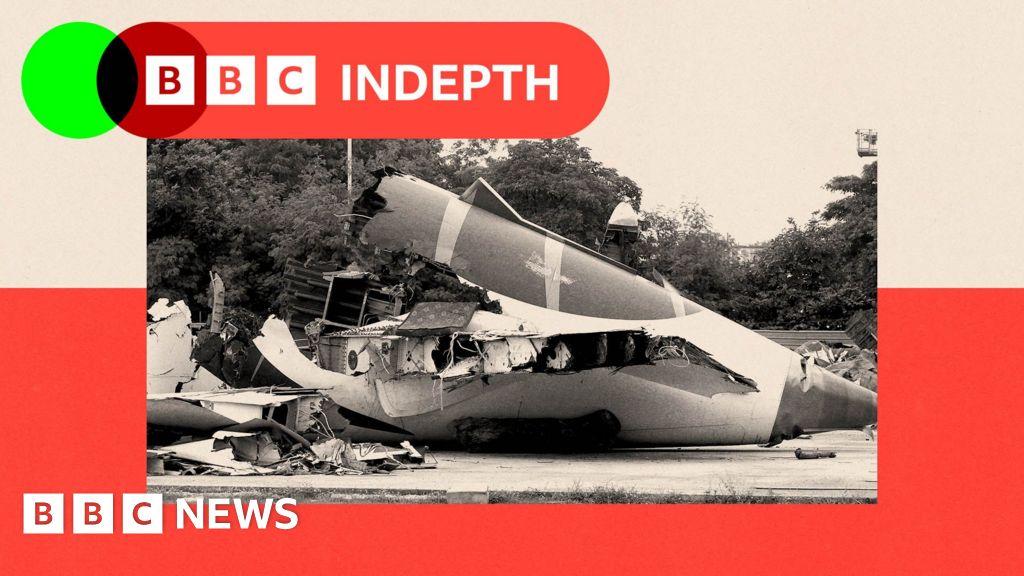
A year ago, Air India flight 171 crashed less than a minute after taking off from Ahmedabad airport in the western Indian state of Gujarat, en route for London. 260 people lost their lives. The official investigation that followed has sparked intense controversy, in India and beyond, with some questioning its integrity amid claims of conflicts of interest. It is not the first time such an investigation has proved contentious. So is it time for a different approach when investigating air crashes?
- +The furious dispute over what caused Air India flight 171 to crash
It was a hot and dry afternoon on 12 June last year, when Flight 171 left the terminal at Sardar Vallabhbhai Patel Airport in Ahmedabad.
It was a hot and dry afternoon on 12 June last year, when Flight 171 left the terminal at Sardar Vallabhbhai Patel Airport in Ahmedabad. Settling into their seats for the nine-and-a-half-hour journey to London were 230 passengers, 53 of them British citizens. Looking after them were 10 cabin crew.
On the flight deck were Captain Sumeet Sabharwal, a pilot with decades of experience, and his younger colleague, first officer Clive Kunder. Just 32 seconds after take-off the plane crashed, killing all but one of those on board. Another 19 people on the ground were also killed.
CCTV footage from the airport and a social media video show the aircraft taking-off in what looks like a normal fashion, but rather than gain height it appears to hang in the air, before gliding gently downwards.
It disappears from view behind buildings and trees. Seconds later a huge cloud of flame and black smoke appears, and the magnitude of the disaster becomes apparent. What is not at all clear from the footage, however, is what actually caused the crash.
Finding out why so many people died is the job of India's Aircraft Accident Investigation Bureau (AAIB), part of the country's Ministry of Civil Aviation. Under international law, as set out in Annex 13 of the Convention on International Civil Aviation, the country in which an accident occurs is directly responsible for the official investigation.
Other parties, including the country where the aircraft or its engines were built, can also take an active part as "accredited representatives". In the case of AI171, that means the US National Transportation Safety Board (NTSB). The NTSB sent a delegation which included technical experts from Boeing, which made the plane itself and GE Aerospace, which built the engines, as well as the US aviation regulator, the Federal Aviation Administration.
According to Annex 13, "the sole objective of the investigation of an accident or incident shall be the prevention of accidents or incidents. It is not the purpose of this activity to apportion blame or liability".
Nevertheless, there is a great deal at stake.
For Boeing, a company already reeling from years of safety scandals, it is about the integrity of one of its premium products: the 787 Dreamliner, an aircraft with a hitherto impeccable safety record. Air India, a loss-making airline belonging to the Tata Group, can ill-afford to see its brand tarnished. Families of those who died, meanwhile, want to know what really happened to their loved ones.
The final conclusions of the investigation have yet to be published, although more could become apparent in the coming days. But it has already generated intense controversy, which has exposed deeper questions about the way inquiries into major air incidents are carried out. So can national authorities be trusted to conduct investigations that critics say are vulnerable to perceptions of political pressure and corporate influence?
In theory, the inquiry should be impartial and informative – a learning process focused solely on improving passenger safety. But in the case of AI171, the information revealed by the investigation so far has triggered a major backlash from safety campaigners, pilots' groups and lawyers acting for the bereaved relatives.
A key factor in this has been the preliminary report issued by the AAIB a month after the accident. The 15-page document did not draw any conclusions about the causes of the crash, or make any recommendations.
Nonetheless, just two short paragraphs generated a great deal of controversy.
First, it was noted that according to the aircraft's flight data recorder, the two fuel cutoff switches - normally used when starting the engines before a flight and shutting them down afterwards – transitioned from the run to the cutoff position seconds after take-off. This would have deprived the engines of fuel, causing them to lose thrust rapidly.
The report then says: "In the cockpit voice recording, one of the pilots is heard asking the other why did he cutoff. The other pilot responded that he did not do so."
This brief statement, provided without a transcript or any indication of who was speaking, sparked intense speculation about the actions of the pilots. Newsweek, for example, focused on the "troubling possibility: that a seasoned captain may have deliberately doomed his jet – and nearly 250 lives". Former NTSB chairman Robert Sumwalt told CBS News the report showed "this was not a problem with the airplane or the engines. Instead…somebody in the cockpit shut the fuel off to those engines."
A few days later, The Wall Street Journal weighed in. Citing people familiar with the matter, it claimed that recordings of dialogue between the pilots suggested it was the Captain, Sumeet Sabharwal, who had flipped the fuel switches.
It is important to note that this was merely a preliminary report, and within days, the AAIB issued a statement condemning "selective and unverified reporting" in the international press as "irresponsible". It urged the public and the media to "refrain from spreading premature narratives that risk undermining the integrity of the investigative process."
By then, arguably, the damage had already been done.
"When a pilot is alive he can defend himself" says Capt. CS Randhawa, president of the Federation of Indian Pilots (FIP). "When the pilot is dead, all the agencies can collude – and they put the blame on the pilot, to save the manufacturer. And this is seen the world over. It's not the first time".
His organisation, which represents around 6,000 pilots, condemned the preliminary report as "irrevocably compromised". Together with Sumeet Sabharwal's 91-year-old father, Pushkar Raj Sabharwal, they took their concerns to India's Supreme Court, demanding a judicial investigation into the crash.
Former UK air accident investigator Tim Atkinson agrees that there is always a temptation to blame a dead pilot for a serious accident.
"It's incredibly, incredibly convenient for all concerned," he says. "You know, the regulator's off the hook, the operator's off the hook, the manufacturer's off the hook. And that's why you have to push back against it so hard."
However, he personally believes that in this case, there is no other credible explanation – a view that is common among aviation professionals.