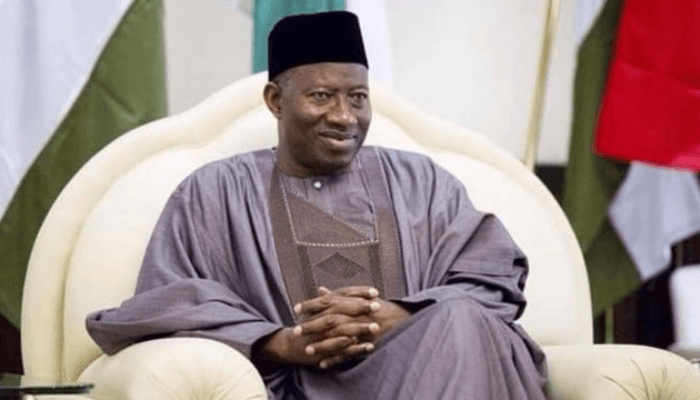
A Federal High Court’s ruling clearing former President Goodluck Jonathan to contest the 2027 Presidential poll is reshaping political calculations ahead of the next electoral cycle with analysts and political actors saying the judgment could significantly alter what many had previously seen as a relatively straightforward path to re-election for President Bola Tinubu.
- +Court clearance of Jonathan for presidential race alters 2027 permutations
Justice Peter Lifu of the Federal High Court in Abuja on Tuesday dismissed a suit filed by a lawyer, Johnmary Jideobi, seeking to stop Jonathan from contesting on the grounds that he had previously taken the Presidential oath of office twice.
Justice Peter Lifu of the Federal High Court in Abuja on Tuesday dismissed a suit filed by a lawyer, Johnmary Jideobi, seeking to stop Jonathan from contesting on the grounds that he had previously taken the Presidential oath of office twice.
The ruling came days after Tinubu secured the Presidential ticket of the ruling All Progressives Congress (APC) with about 10.9 million votes in the party’s primary, reinforcing expectations among supporters that the President remains firmly positioned ahead of 2027.
Before the judgment, political observers had largely predicted a replay of the 2023 contest involving Tinubu, former Vice President Atiku Abubakar and Peter Obi, who are both expected to remain major opposition figures under different political platforms.
But Jonathan’s potential entry into the race is now injecting fresh uncertainty into the political landscape, particularly within opposition circles struggling with internal divisions and leadership disputes.
Fred Agbedi, a member of the Goodluck Jonathan Campaign Organisation, said the Court ruling had effectively removed a major legal obstacle confronting the former president.
“With this judgment which aligns with previous judgments on the same subject matter, the coast is clear for President Goodluck Jonathan to contest the 2027 elections, there being no legal impediment against him,” Agbedi said.
He described the judgment as a turning point for political forces seeking an alternative direction for the country, urging Nigerians to support what he called Jonathan’s “rescue mission.”
“Our country must not be allowed to drift like a rudderless ship on the high sea,” he said. “We must collectively salvage our country from its present woes.”
Chris Uche, a Senior Advocate of Nigeria, who represented Jonathan in the matter, argued that the case should never have been entertained because similar legal questions had already been settled by Appellate Courts.
He described the suit as “an abuse of court process,” noting that the same issue had previously been determined by another Federal High Court and upheld on appeal.
The ruling is also being viewed through the prism of the deepening crisis within the opposition People’s Democratic Party (PDP), where factions continue to battle over leadership and control of party structures.
A PDP group led by Kabiru Tanimu Turaki recently indicated support for Jonathan as a possible consensus presidential candidate.
Umar Sani, a former media aide to ex-Vice President Namadi Sambo, said the judgment strengthened Nigeria’s democratic space by widening electoral choices for voters.
“There is no doubt that the judgment is a victory for multiparty democracy which we practice and that it would widen the political space for Nigerians, providing more options amongst the candidates for Nigerians to choose from,” Sani said.
He added that Jonathan remains widely admired by many Nigerians because of perceptions that the economy was more stable during his administration.
Still, some lawyers and political analysts warned that constitutional questions surrounding Jonathan’s eligibility may not be entirely settled.
Blessing Otuama, an Abuja-based Legal Practitioner, said provisions of Sections 137(2) and 137(3) of the Constitution could still trigger legal disputes if Jonathan eventually contests and wins.
“Sections 137(2) and Section 137(3) state explicitly that no individual can take the Oath of Allegiance and the Oath of Office for the Presidency more than twice,” she said.
“This is the position of the law and the 1999 Constitution. So, I do not know what Justice Lifu relied upon in his judgment.”
She also questioned whether Jonathan could still command the political structure and alliances necessary to mount a successful national campaign, noting that many former allies now occupy influential positions within Tinubu’s administration.
Osita Okechukwu, former PDP Deputy National Publicity Secretary similarly cautioned against attempts to pressure Jonathan into a politically uncertain contest, especially through factions lacking recognition from the Independent National Electoral Commission.
“Jonathan should not allow them to rubbish the reputation he had built for several years,” Okechukwu said.
He noted that while the former president had every constitutional right to clear his name in court, he had yet to publicly declare interest in the race.