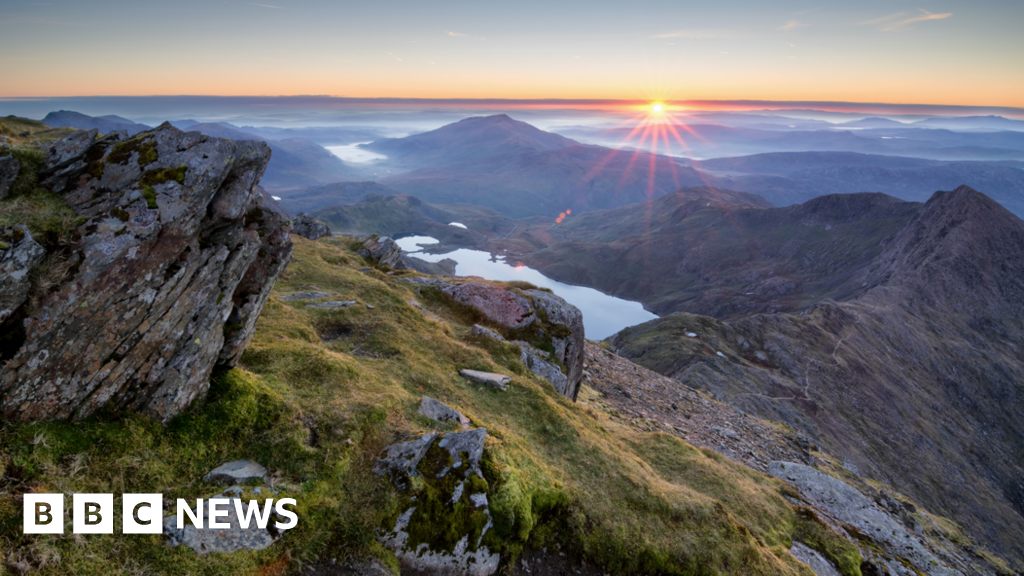
Fears over rogue parking by sunrise-chasers at national park after overnight ban
An overnight parking clampdown aimed at tackling antisocial behaviour at a beauty spot where people hike to catch the sunrise will not solve the problem, locals say.
An overnight parking clampdown aimed at tackling antisocial behaviour at a beauty spot where people hike to catch the sunrise will not solve the problem, locals say.
Eryri National Park Authority (ENPA) has restricted overnight parking at 11 of its car parks since 1 April, which it said was "necessary to address increasing issues linked to overnight stays".
Nearly four million people visit Eryri National Park, also known as Snowdonia, each year. Many begin the hike up to its highest peak - Yr Wyddfa - during the early hours of the morning to reach the top by sunrise.
But some fear the ban could encourage parking in residential streets, while one local guide fears an impact on her business.
The ENPA said the changes were made "to address increasing issues linked to overnight stays, particularly unauthorised campervans".
It said there had been a rise in "informal camping" in some locations which had led to "littering and other environmental pressures as well as anti-social behaviour".
It said the measures followed "three years of monitoring" and had been "strategically introduced in specific locations where pressures have been greatest".
It pointed out that some car parks across Eryri remained available 24 hours a day.
The long-stay car park at Betws-y-Coed, a small village in Conwy which is a popular starting off point for people visiting Eryri, is on the list of those where overnight parking is now banned.
Ian Young, who lives near the car park on a road where there are no parking restrictions, said a minority of overnight campers had used his gardens as toilets and littered the streets.
But he feared the problem could get worse if the night-time parking ban was enforced in the car park, as it could encourage more visitors to park up on his street instead.
Young said he runs a holiday let, while his neighbour has a bed and breakfast, and that a "minority" of people have no respect, potentially impacting his business.
Ian Smith, who lives on the same road, suggested the car park should remain open overnight and include facilities for campervans and motorhomes.
"That would be a sensible measure. You know, in these days when campervans are everywhere, everybody's got one," he said.
"Now's the time to take that ball by the horns and do it."
Betws-y-Coed Community Council said it "understands the reasons for the ban on overnight parking including campervans and slept-in vehicles".
But it said it had recorded "noticeable knock-on effects" of the new ban, including more people parking on roadsides and lay-bys overnight.
It said residents had been affected by overnight campers, with reported issues including late-night noise, obstructive parking, use of nearby vegetation as toilets, and bagged waste being left by litter bins.
The ENPA has rolled out a ban on all vehicles parking overnight in 11 of its car parks.
Parking overnight at Llyn Tegid and Llangower is banned between 22:00 and 06:00, while it is banned between 22:00 and 03:00 in the other nine.
ANPR cameras are being trialled at Llyn Tegid, with anyone who parks there overnight risking a fine.
Parking at Cae Llan, Pen-y-pass and Nant Peris will continue to be available for 24 hours a day.
Gemma McInnes, a hiking guide in Eryri, fears she could lose money and clients as a result of the ban.
McInnes, from Cerrigydrudion, Conwy, wants a rethink and said the current plan "creates more of an issue".
"There's not enough park car parking spaces as it is in the national park on a day-to-day basis," she said.
McInnes, who leads sunrise hikes for people raising money for charity, said those hikes would "definitely be impacted" and the ban put "the majority of them at risk".
"We're not talking thousands, we're talking hundreds of thousands of pounds that has been given to charity events, for people that make the effort."
Conor Carter, a social media content creator from Birmingham who has parked overnight to climb Yr Wyddfa for sunrise, said the ban could push people to either avoid Eryri National Park or park "inappropriately on the roads and cause obstructions".
"The reason I set up my Instagram page was to inspire others to get outside, show people that you can do something good for free. I know it's not entirely free, but it's a nice hobby to have," he said.
He said he encouraged people to research their route before a hike, including where to park and if there are any restrictions.
He said spring and summer sunrise hikes "would not be feasible" if parking was not available until after 03:00.
Eryri National Park said it understood the concerns raised.
It said it would "encourage visitors planning to stay overnight to make use of official campsites or alternative facilities such as the Arosfan sites for motorhomes, which are located in towns and villages just outside the National Park boundaries in Gwynedd".
"These options not only provide appropriate facilities but also contribute to the local economy, while helping to reduce pressure on sensitive locations within the Park and nearby communities," a spokesperson added.
"Our car parks are still open for 17 hours a day, which provides ample time for leisure opportunities, and some of our key car parks remain open 24 hours a day for those who wish to access the National Park at other times."