BlockDAG’s Turbo Presale Token Could Deliver 7,900% While RENDER Price Up 18% & TIA Stays Bearish
The AI compute narrative is back and it’s moving serious capital.
The AI compute narrative is back and it’s moving serious capital. RENDER just pushed past $2.35, climbing nearly 18% in 48 hours as on-chain activity hits 12-week highs. Meanwhile Celestia is facing an entirely different conversation, analysts warning that TIA’s valuation can no longer coast on speculative hype as real competition from EIP-4844, EigenDA, and Avail mounts by the day. The market is separating assets with mechanical demand floors from those coasting on borrowed narratives.
But while RENDER’s move rewards those who were already in and TIA’s reset punishes those who held too long, the most asymmetric position in the market right now sits at neither of those addresses.
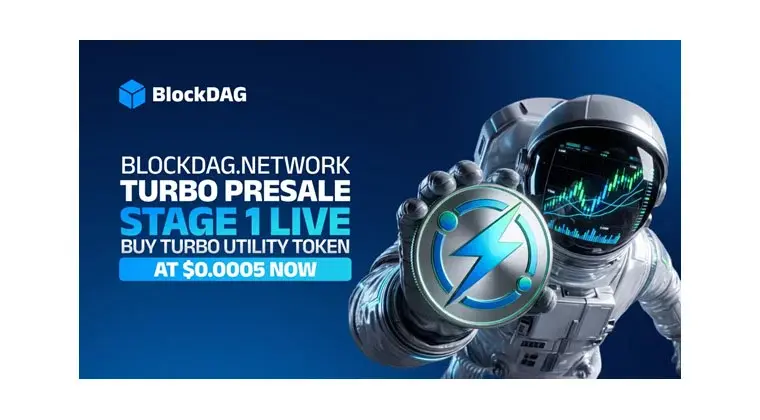
BlockDAG’s Turbo is that position. A fixed 50B supply. A 90-day presale across ten rounds. A burn engine running every single week. Casino utility, staking, VIP access, and NFT mechanics already in motion. And a top crypto presale entry at $0.0005 that could look like generational value once exchange listings begin. This is where 7,900% is born.
Fifty billion tokens. That’s it. No more get minted after that, no exceptions, no backdoor the team can use to quietly expand supply later. What exists at launch is everything that will ever exist — and from day one, that number starts falling.
Here’s how. Every week, without fail, the Foundation runs a burn. Nine out of every ten tokens earmarked for that cycle get sent to a permanent burn address. Not locked. Not vested. Gone. The transaction hash goes public so anyone can verify it actually happened. The remaining one in ten goes to a randomly selected group of holders as a prize pool. Then the following week, it runs again. And the week after that.
The target is to cut the total supply from 50 billion down to 25 billion over time. Half the tokens, permanently removed, through nothing more than this weekly process repeating itself.
Meanwhile the demand side is being built out in parallel. Casino and gaming activity creates constant transaction volume. Staking takes tokens off the market. VIP tiers give holders a financial reason to accumulate rather than sell. NFT mechanics pull in another layer of buyers with different motivations. The prize pool gives everyone else a reason to simply stay put. Every single one of these is a force pushing against selling pressure.
This is the same basic dynamic that made Bitcoin’s halving cycles so powerful. Supply got scarcer. People who understood that early enough were already holding when the rest of the market finally noticed.
TURBO is at that same early moment right now. The burn is already running. The demand layer is being built. Exchange listings haven’t happened yet. Every access round that closes removes a chunk of public allocation that never comes back. The entry that exists today is the cheapest one that will ever exist.
RENDER’s move isn’t speculative froth dressed up as momentum. The network operates on a Burn-and-Mint tokenomics model, actual GPU rendering and compute usage burns RENDER tokens directly out of supply. Real-world utilization is the deflationary mechanism. The more the network runs, the more tokens disappear.
On-chain activity just hit 12-week highs. That means the burn is accelerating at the same moment the AI compute narrative is capturing fresh institutional attention in 2026. Price following real network usage is a fundamentally different story from price following a tweet cycle, and the market is pricing that difference correctly.
For anyone building a watchlist of the best crypto to buy during the current AI infrastructure rotation, RENDER has the cleanest mechanics in the sector. The honest caveat: 18% in 48 hours means the frictionless entry has passed. Buying here means buying into someone else’s momentum at a price already reflecting the news.
Celestia is having a different weekend entirely. The data availability narrative that drove TIA’s earlier moves is now under direct scrutiny from analysts watching the competitive landscape close in from multiple directions. Ethereum’s EIP-4844, EigenDA, and Avail are all mounting serious pressure on Celestia’s core value proposition, and the market knows it.
The thesis has fundamentally shifted. TIA can no longer be evaluated as an early-narrative bet on a new primitive. It is now a binary execution bet on whether major rollups are consistently paying fees to publish data blobs on Celestia’s network. Fee revenue is the only metric that matters. Builders are watching on-chain data like a hawk. Speculators are reducing exposure.
For anyone asking whether TIA is still the best crypto to buy for long-term upside, the answer depends entirely on adoption data that doesn’t yet exist at the scale the valuation requires. That’s a wide range of outcomes with the margin for error fully collapsed. Patient, high-conviction investors only.
RENDER rewarded the people who understood its burn model before the AI narrative became a mainstream talking point. TIA is now paying the price for a valuation that was always ahead of its actual adoption numbers. Neither outcome is surprising in hindsight — both were visible in the mechanics long before the price moved to reflect them.
TURBO has the same kind of mechanical story. It just hasn’t played out yet.
The setup is straightforward. A fixed 50 billion token supply that shrinks every week through Foundation burns. Real utility across gaming, staking, and VIP access. Stage 1 open at $0.0005 with a projected listing price of $0.04. RENDER burns tokens through actual GPU compute usage. TURBO burns through its weekly Foundation cycle. The core logic is identical. The difference is timing — RENDER has already moved 18% to $2.35. TURBO is still at $0.0005.
That gap between entry price and listing target is 7,900%. It exists today. It will not exist once exchange listings begin and the buyers who missed the presale start showing up with market orders.