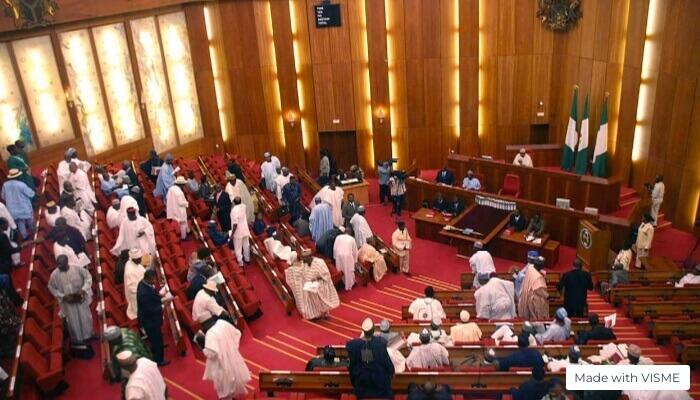
The National Assembly has said it is awaiting an executive bill on the proposed establishment of state police, as renewed insecurity across the country continues to intensify legislative pressure for a decentralised security architecture.
- +National Assembly awaits executive bill on state police
- +…as lawmakers renew push for security overhaul
A senior lawmaker involved in ongoing consultations said discussions on the proposed policing structure have reached an advanced stage, but the legislature is constrained by procedure, noting that the initiative must originate from the executive before it can be formally processed.
…as lawmakers renew push for security overhaul
A senior lawmaker involved in ongoing consultations said discussions on the proposed policing structure have reached an advanced stage, but the legislature is constrained by procedure, noting that the initiative must originate from the executive before it can be formally processed.
The lawmaker explained that the complexity of the proposal, which seeks to amend key provisions of the 1999 Constitution, makes it unsuitable for individual sponsorship within the legislature.
According to the lawmaker, “We are more than ready to approve the bill once the executive transmits it. There is no hesitation on our part. The commitment is there, but the process matters.”
The source added that, “This is not something a single member can sponsor. It goes beyond individual legislative input.
“It requires coordinated executive action because it touches on the structure of policing in the federation.”
The lawmaker further disclosed that the executive is currently reviewing relevant documents and memoranda tied to the proposed reform, including inputs aimed at addressing constitutional gaps that have long constrained policing effectiveness.
“We understand the urgency, especially given the security situation across the country.
“But the executive is still fine-tuning its position, reviewing memoranda and aligning the proposal with existing constitutional frameworks,” the lawmaker said.
The source also compared the process to recent executive-driven tax reform bills, noting that similar coordination is expected for the policing proposal.
“We are waiting for the executive to transmit it the same way other major reform bills came in. Once it comes, we will act swiftly,” the lawmaker added.
The proposed state police legislation, currently embedded within wider constitutional amendment discussions, is expected to be considered in batches, with lawmakers indicating that state policing could be one of the earliest reforms to be prioritised.
A lawmaker familiar with the constitutional review process noted that decentralised policing remains one of the most widely supported reform proposals across political and regional divides.
“This is part of a broader restructuring conversation. State police is not in isolation. It sits within a package of security and governance reforms,” the lawmaker said.
The latest position from the National Assembly comes 24 hours after the House of Representatives renewed calls for urgent reforms in Nigeria’s security framework following fresh abductions of schoolchildren and teachers in Oyo State and Borno State.
Lawmakers at the House session called for intensified rescue operations and a comprehensive review of the country’s security architecture, with strong backing for state police and community-based policing structures.
The resolutions followed the adoption of two motions of urgent public importance, which highlighted the growing wave of school kidnappings and attacks on rural communities.
Olamijuwonlo Alao-Akala, representing Oyo State, who led one of the motions, described the recent abductions in Orire Local Government Area as deeply distressing, particularly the killing of a teacher during captivity.
Alao-Akala said, “We are confronted with a reality where schools have become targets and teachers and pupils are no longer safe. The brutality we are witnessing is unacceptable and demands immediate structural response.”
He added that, “We have made recommendations in the past, including decentralised policing and stronger intelligence systems, but implementation has remained slow. That delay is costing lives.”
Another lawmaker, Bamidele Salam representing Osun State, warned that school kidnappings were becoming a recurring national crisis.
Salam said, “What began with Chibok has evolved into a broader pattern. Schools in vulnerable communities are now soft targets. If education is under attack, then the future is under attack.”
He further argued that, “We cannot continue to treat these incidents as isolated. There must be a dedicated security architecture for schools, with clear funding and accountability.”
Etanabene Benedict representing Delta State also supported the creation of state police, saying the centralised security structure had become overstretched.
Benedict said, “The level of insecurity we are dealing with today requires proximity. Security must be closer to the people. State police will allow governors and local authorities to respond faster and more effectively.”
He added that, “We must stop politicising insecurity. Lives are being lost. Communities are living in fear. This is no longer theoretical.”
Midala Balami representing Borno State also raised concerns over fresh abductions in the state, noting that repeated attacks have significantly disrupted education and public confidence.
Balami said, “We are dealing with a persistent security crisis that has made schooling unsafe in many communities. Families are afraid, teachers are afraid, and children are paying the highest price.”
He added that, “We cannot normalise this situation. Every attack weakens trust in government and discourages school attendance.”
Following extensive debate, the House urged the federal government and security agencies to intensify rescue operations for abducted persons and strengthen protection for schools nationwide.
Lawmakers also reiterated support for the establishment of state police, local government policing units, decentralised courts, and improved intelligence-sharing mechanisms.
A lawmaker involved in the debate said, “What we are seeing is a convergence of opinion. Across party lines, there is agreement that the current centralised structure is not enough.”
The House further mandated committees on defence, interior, police affairs, national security, basic education, and legislative compliance to engage security agencies and monitor implementation of resolutions.
Meanwhile, developments within the constitutional review process indicate that groundwork for state police is already being formalised.
Olatunji Disu, Inspector General of Police, recently on March 26 submitted a 75-page framework on the establishment of state police to Barau Jibrin, Deputy President of the Senate and chairman of the Senate Committee on the Review of the 1999 Constitution.
The document, prepared by a committee of the Nigeria Police Force, outlines proposed governance structures, operational modalities, and coordination mechanisms between federal and state policing units.
Barau Jibrin said the Senate would carefully review all submissions, stressing that reforms must balance efficiency with accountability.