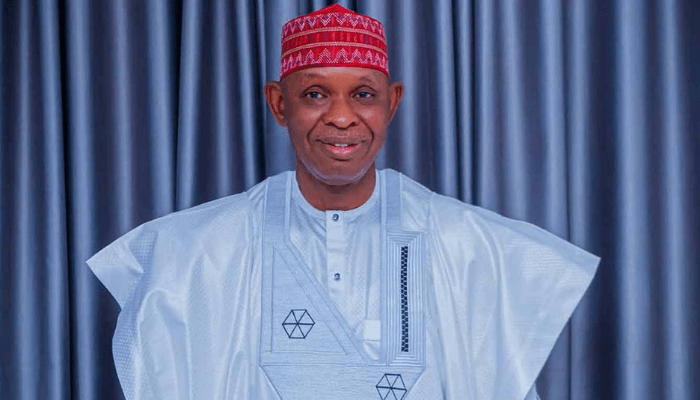
Governance activities in Kano State appear to have slowed significantly in recent weeks following a wave of political defections and internal power struggles that have reshaped the state’s political landscape.
- +Political realignments stall governance in Kano as power struggles deepen
- +Deputy Governor Exit Leaves Power Vacuum
- +Cabinet Resignations and Policy Freeze
- +Civil Service Productivity Declines
The crisis was triggered by the dramatic defection of Governor Abba Kabir Yusuf from the New Nigeria Peoples Party-aligned Kwankwasiyya political movement to the ruling All Progressives Congress (APC).
The crisis was triggered by the dramatic defection of Governor Abba Kabir Yusuf from the New Nigeria Peoples Party-aligned Kwankwasiyya political movement to the ruling All Progressives Congress (APC).
The governor’s move was accompanied by more than 30 members of the Kano State House of Assembly, effectively fracturing the once-united Kwankwasiyya bloc that had propelled the administration into power.
Soon after the governor’s defection, his long-time political mentor, Rabiu Musa Kwankwaso, announced his own move to the African Democratic Congress (ADC), widening the rift and setting off an intense political contest for influence across the state.
Investigations by BusinessDay indicate that the resulting political tensions have begun to affect the day-to-day functioning of government institutions.
Deputy Governor Exit Leaves Power Vacuum
One of the most immediate consequences of the political upheaval was the resignation of the state’s deputy governor, Aminu Abdulsalam Gwarzo. Gwarzo, who remained loyal to Kwankwaso following the governor’s defection, faced mounting pressure from the Assembly after lawmakers initiated impeachment proceedings against him.
Sources familiar with the development say the impeachment move was widely interpreted as part of the broader effort to consolidate the governor’s new political alignment within the state.
With Gwarzo’s resignation, Kano has been left without a deputy governor—an unusual situation that has persisted for several weeks. As of the time of filing this report, Governor Yusuf has yet to nominate a replacement.
Multiple APC insiders revealed that the delay stems from internal disagreements within the party’s Kano leadership.
According to party sources, a faction aligned with former governor Abdullahi Umar Ganduje is pushing for the appointment of Murtala Sule Garo, who served as the APC’s deputy governorship candidate during the 2023 election.
However, the governor is reportedly leaning toward Jibril Isma’il Falgore, the current Speaker of the Assembly, whom he considers a trusted ally capable of stabilising relations within the legislature.
“The choice of deputy governor has become a delicate balancing act,” a senior APC source said. “Whoever emerges will determine which political bloc gains the upper hand in Kano.”
Cabinet Resignations and Policy Freeze
The political turbulence has also begun to ripple through the state executive council.
At least five commissioners and several senior political aides have reportedly resigned their positions in recent weeks, further weakening the administration’s operational capacity.
Officials within the Government House say Governor Yusuf is currently reviewing the composition of his cabinet and may soon embark on a major reshuffle aimed at consolidating his new political base within the APC.
Adding to the uncertainty is an internal directive issued by the Secretary to the State Government, Ibrahim Umar Faruq, instructing ministries, departments, and agencies to refrain from entering into new financial commitments without explicit approval.
The memo, circulated across ministries, has effectively slowed policy execution and public sector spending, according to several civil servants who spoke anonymously.
Civil Service Productivity Declines
Beyond the political class, the uncertainty appears to be affecting morale within the state bureaucracy.
A visit to several offices at the Audu Bako Secretariat—the administrative hub of the state government—revealed reduced activity during normal working hours.
Many offices opened late, while some workers reportedly arrived between 11 a.m. and noon. Several employees were also observed leaving before the official closing time of 3:30 p.m.
Some departments appeared largely deserted.
A senior civil servant who requested anonymity attributed the trend to the broader political uncertainty.
“Many officials are unsure about the direction of the government or whether their supervisors will remain in office,” the source said. “Until the political situation settles, many ministries are simply marking time.”
Efforts by BusinessDay to obtain an official response from the Kano State Government were unsuccessful.
Attempts to reach the governor’s spokesperson, Sanusi Bature Dawakin-Tofa, did not yield results as he was said to have travelled out of Kano alongside Governor Yusuf at the time of filing this report.
Several calls placed to his telephone number were also not responded to.
Political analysts warn that unless the administration quickly resolves the deputy governorship vacancy and stabilizes its cabinet, governance in Kano may remain stalled.
“The state is currently experiencing a transition within a transition,” said one political observer in Kano. “You have a governor adjusting to a new party while the former political structure that brought him to power is collapsing.”
For residents of Kano State, the larger concern is whether political realignments will continue to overshadow governance in one of Nigeria’s most politically influential states.