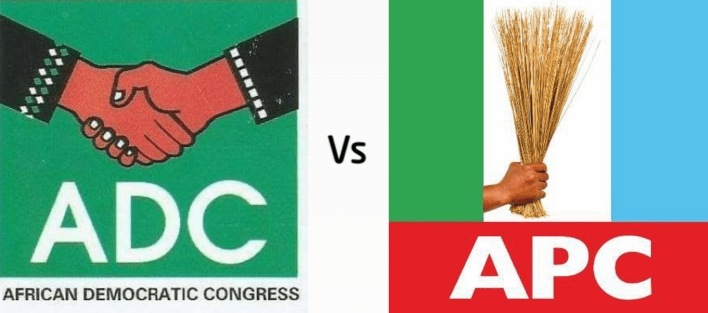
The fragile hopes of a united front against the ruling All Progressives Congress (APC) took a significant hit this week as the judiciary intervened in the internal leadership crisis of the African Democratic Congress (ADC). A Federal High Court ruling has not only paralysed a key faction of the party but has also signalled a deepening malaise across Nigeria’s opposition landscape. The Peoples Democratic Party (PDP) and Labour Party (LP) continue to fracture as the 2027 general elections approach.
- +Nigeria’s “strongest” opposition party suffers major court ruling blow
- +…Courts overstepping jurisdiction in party affairs, legal analysts say
- +Judicial hammer falls on ADC factionalism
- +Constitutional adherence versus political survival
- +Courts overstepping jurisdiction in party affairs, legal analysts claim
In a judgment that reverberated through the political corridors of the country, Federal High Court Justice Joyce Abdulmalik restrained the Independent National Electoral Commission (INEC) from recognising any state congresses organised by the disputed caretaker leadership of the ADC.
…Courts overstepping jurisdiction in party affairs, legal analysts say
Judicial hammer falls on ADC factionalism
In a judgment that reverberated through the political corridors of the country, Federal High Court Justice Joyce Abdulmalik restrained the Independent National Electoral Commission (INEC) from recognising any state congresses organised by the disputed caretaker leadership of the ADC. The ruling specifically targets the faction led by David Mark, barring the former Senate president from interfering with the functions of duly elected state executives.
This legal setback for the ADC is not an isolated incident but a symptom of a broader fragmentation currently hobbling Nigeria’s opposition. As the 2027 general elections loom, the major challengers — including the PDP, LP, and Accord — are grappling with existential crises. Analysts warn that if these internal wars persist, the opposition risks failing to field a credible, unified candidate for the 2027 presidential poll.
The fractures are driven by leadership tussles, including parallel structures in the LP between the Julius Abure loyalists and caretaker committees. Trust deficits also plague the opposition, with accusations that “double agents” within the PDP national working committee are working for the ruling APC. Furthermore, a steady migration of governors and lawmakers to the APC is often cited as a strategy for political survival.
Constitutional adherence versus political survival
The court’s decision to set aside the appointment of the ADC congress committee highlights a growing trend of the judiciary becoming the final arbiter of internal political affairs. While courts typically avoid domestic party matters, Justice Abdulmalik noted that intervention is mandatory when constitutional or statutory provisions are breached. For the ADC, PDP, and LP, the reliance on the judiciary to resolve leadership disputes suggests a failure of internal dispute resolution mechanisms.
The court dismissed the defendants’ arguments that the plaintiffs should have exhausted internal party channels. It ruled that the breach of the 1999 constitution and the party’s own rules gave the plaintiffs the necessary locus standi. As the opposition fragments into smaller, warring factions, the APC continues to consolidate power. The momentum experienced by the Labour Party in 2023 appears to be waning as it struggles to translate popular support into a cohesive institutional structure.
But Terver Shirsha Atsar, a vhieftain of ADC and an Ushongo/Kwande federal constituency hopeful in Benue State, said the party is already mindful of the situation.
“The court did not nullify the convention. It merely reaffirmed the tenure of the current state executives, which has not yet expired, he said.
“This is is why the newly elected executives have not been sworn in, pending the expiration of the existing tenure. Those rushing to conclude that the judgment nullified the convention or congresses are either mistaken or being mischievous.”
He also indicated that the party will appeal the judgment.
“We are not seeking an alternative. We must resist any drift toward a one-party state. This is a collective responsibility—not just of the opposition, but of all well-meaning Nigerians who want this country to survive,” he said.
Courts overstepping jurisdiction in party affairs, legal analysts claim
Abubakar Marshall of Falana and Falana’s Chambers anchors his critique on the erosion of non-justiciability in Nigerian politics. He argues that recent judicial interventions in party leadership contradict the Electoral Act 2026, which explicitly designates internal structures and discipline as matters for the parties themselves to resolve.
“I believe the instant matter is one that was squarely within the provisions… which the court has regarded as internal affairs of political parties,” Marshall said, highlighting the shift away from established precedent.
Realwan Okpanachi, an ADC legal representative, views the recent rulings as a direct violation of Supreme Court jurisprudence. He contends that the courts have overstepped by granting reliefs in areas — such as congress administration and leadership disputes — that have historically been shielded from judicial interference.
“The court went beyond its jurisdiction in granting those reliefs,” Okpanachi said, insisting that the decision fails to align with long-standing positions held by the apex court.
Despite the immediate setback, Okpanachi emphasised that the judicial process offers a path for correction through appellate review.
“This is why we have the Court of Appeal and the Supreme Court. If there is an error, the appellate courts will correct it,” he said.
The Supreme Court is scheduled to deliver judgment on Thursday in two politically sensitive appeals involving leadership disputes in the ADC and PDP.