Blessing Ebere remembers the exact moment she decided to sell her generator. It was sometime in 2022, a few months after Renewvia Solar Nigeria switched on a new mini-grid serving her community in the Etche Local Government Area of Rivers State.
- +Solar power ignites economic boom in Nigerian village that oil forgot
- +…Renewvia scaling to meet demand
- +1 Renewvia Solar structure in Ozuzu community
- +2 Blessing Ebere, a market woman in Ozuzu community
- +3 Major road in-ward Ozuzu community
- +4 Samuel Adewumi, Renewvia regional service manager for the South South zone
- +When the lights came on, everything changed
- +5 Ice block business in Ozuzu community
- +7 John Nwala runs a beer parlour in Ozuzu community
- +8 Happiness Lucky runs a provison store in Ozuzu community
- +9 Stephen Nwala, a 32-year-old youth in Ozuzu community
For the first time in her 56 years on earth, reliable electricity hummed through the wires strung across Ozuzu’s muddy lanes.
…Renewvia scaling to meet demand
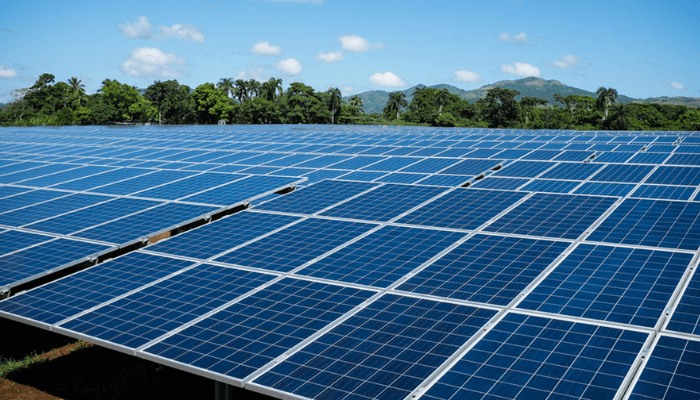
1 Renewvia Solar structure in Ozuzu community
For the first time in her 56 years on earth, reliable electricity hummed through the wires strung across Ozuzu’s muddy lanes. Her refrigerator ran through the night. Her television stayed on past sunset. She slept without the rattling diesel racket that had defined every night of her adult life.
2 Blessing Ebere, a market woman in Ozuzu community
“We were getting close to 23 hours of power supply,” she said, seated outside her trading shop one afternoon. “The solar was very good.”
So, she sold the generator. Then her neighbours sold theirs. Then almost everybody in Ozuzu sold theirs too.
A near-total transition away from generators highlighted both the system’s reliability at commissioning and the strong economic case for solar power in rural communities.
That decision, made by nearly every household in this small farming and trading community tucked inside the Niger Delta, is now at the centre of an uncomfortable paradox — a familiar next phase in successful electrification projects — playing out across rural Nigeria, and, increasingly, through sub-Saharan Africa.
The mini-grid revolution that was supposed to leapfrog decades of energy poverty is working, perhaps better than anyone anticipated. But that breakthrough seems to have recreated a problem it fought so hard to eliminate.
Ozuzu is, by most measures, the kind of place that development economists describe with clinical detachment as “energy-poor”.
3 Major road in-ward Ozuzu community
There is no national grid connection here, never has been, not in anyone’s memory. The community sits in Etche, a local government area that history-minded Nigerians will recognise as one of the earliest sites of oil discovery in the country, a bitter irony that is not lost on its residents.
The land beneath their feet helped fuel one of Africa’s largest petroleum economies for six decades. The lights still didn’t come on.
“Throughout my lifetime, there was no national grid power in this community,” Ebere said flatly. It was not a complaint, particularly. It was simply a statement of fact delivered the way you might describe the weather.
When Renewvia arrived to conduct surveys and community consultations in 2021, they found fertile ground, in both the agricultural and figurative sense.
The company, which executes rural electrification work under Nigeria’s federal electrification project, spent nearly a year interviewing residents, assessing demand, and securing consent before installing the mini-grid.
The project was backed by the Rural Electrification Agency, which administers the Nigeria Electrification Project on behalf of the federal government.
“It wasn’t hard convincing them,” said Samuel Adewumi, the company’s regional service manager for the South-South zone, standing near the solar installation during a recent visit. “You get to some communities, and they are really happy to accept you, because what you are going to provide them is light. Light is power. Light is like life.”
4 Samuel Adewumi, Renewvia regional service manager for the South South zone
The 250-household mini-grid powered up in 2022. The response was immediate and, in hindsight, entirely predictable.
When the lights came on, everything changed
Within months of electrification, Ozuzu began to change. People who had never operated a refrigerator went out and bought one.
Traders who had been hand-selling warm drinks to customers began stocking cold ones. Some imaginative businessmen saw the positive side of it and utilised the opportunity to make cool money as their services have availed people the privilege of having cool or chilled drinks at any time of the day.
5 Ice block business in Ozuzu community
John Nwala, who had spent years doing dredging work in a nearby river, looked at the foot traffic flowing into his newly illuminated community and opened a beer parlour.
7 John Nwala runs a beer parlour in Ozuzu community
“People came from five neighbouring communities to patronise my business,” he said, “because the solar was efficient.”
He was not exaggerating. The economics of solar-powered commerce in a region where diesel costs roughly N1,500 per litre, a price that makes generator-powered businesses barely viable, are compelling enough to function as a serious competitive advantage.
Ozuzu had cheap, reliable power. Surrounding communities did not. The result was a gravitational pull: customers, traders, and eventually new residents began drifting toward the light.
“Some people moved into this community because of the solar,” said Happiness Lucky, a shop owner who has watched the transformation unfold from her storefront. It was said without drama, as simple cause and effect.
8 Happiness Lucky runs a provison store in Ozuzu community
Stephen Nwala, a 32-year-old from the community, sold three generators. He calculated, correctly, that the recurring cost of petrol made diesel generation economically irrational compared to Renewvia’s pay-as-you-go metered service. “Solar was cheaper and reliable,” he said.
Across Ozuzu, the generators disappeared. Nobody kept one as a backup. Why would you? The solar was on for twenty-three hours a day.
This is the part of the story that the promotional materials for rural electrification projects rarely include in their brochures.
When you take a community that has no reliable electricity and give it reliable electricity, people behave the way people everywhere behave when a chronic scarcity suddenly resolves: they consume. They buy appliances. They start businesses that require power. They invite relatives to come live with them in the newly lit homes. The population grows. Demand grows. The infrastructure, designed based on surveys conducted before all of this happened, stays the same size.
“Our energy demands have increased by more than 100 percent,” Nwala said, reflecting the rapid growth in commercial activity, appliance ownership, and population inflow following electrification.image.jpeg
9 Stephen Nwala, a 32-year-old youth in Ozuzu community
The 24-hour supply that had become Ozuzu’s calling card has eroded. Residents now describe a service that delivers fewer hours than before, a regression that stings harder precisely because of the baseline they’d come to expect.
Blessing Ebere, who sold her generator because the solar was so dependable, now finds herself without a backup on the nights the supply falls short.
“We no longer get 24 hours of light,” she said. “We now get fewer hours of supply.”