Across continents, ancient sites continue to draw global attention for what they reveal about early civilisations, belief systems and human ambition.
- +The top 5 most significant ancient sites to see
- +1. Great Pyramid of Giza, Egypt
These landmarks shape cultural identity, historical research and tourism.
These landmarks shape cultural identity, historical research and tourism. Built as temples, tombs and defensive walls, they proclaimed power and faith, and today these five enduring monuments remain among the world’s most remarkable ancient wonders.
Here are five of the most significant ancient sites to visit.
1. Great Pyramid of Giza, Egypt
Built around 2550 BC, the Great Pyramid of Giza remains one of the most studied structures in history. Commissioned by Khufu, it was originally 146.6 metres tall and held that record for thousands of years. Its alignment with the cardinal points and the scale of its construction continue to prompt research into ancient engineering methods.
Visitors can enter the pyramid through narrow corridors leading to the King’s Chamber, where the stone sarcophagus still stands. The surrounding plateau includes other pyramids and the Great Sphinx of Giza, offering a broader view of Egypt’s Old Kingdom period.
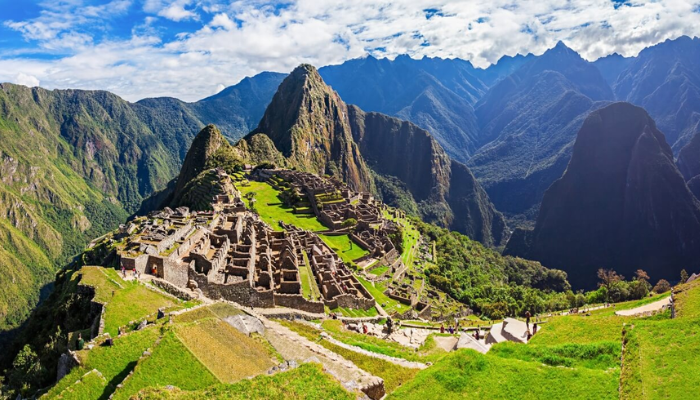
Located high in the Andes, Machu Picchu was built in the 15th century during the rule of Pachacuti. The site remained unknown to the outside world until Hiram Bingham documented it in 1911.
Historians say the settlement may have served as a royal estate or a centre for ritual activity. Its terraces, drainage systems and stonework reflect knowledge of agriculture and planning.
Travellers reach the site through the town of Aguas Calientes or by walking the Inca Trail. Key features include the Temple of the Sun, the Room of the Three Windows and the Intihuatana stone, often described as an astronomical marker.
Stonehenge dates to around 2500 BC and continues to be the subject of new findings. Recent studies suggest it may have been built to connect early farming communities during a period of change.
Research has shown that some stones were transported over long distances, including from what is now Scotland. This indicates a level of coordination between groups.
Efforts to protect the site have led to changes in its surroundings, including the removal of nearby roads. A visitor centre now provides historical context while preserving the setting.
Petra was established as early as the 5th century BC and became the capital of the Nabataean Kingdom. It served as a trade centre linking Arabia, Egypt and the Mediterranean.
The city is known for structures carved into rock, including “Al-Khazneh” or “The Treasury”. These structures combine elements from different architectural traditions.
Visitors enter Petra through the Siq, a narrow passage that leads to the main façade. Other sites include the Monastery and a theatre. The layout reflects how the Nabataeans adapted to their environment.
The Colosseum was built between AD 72 and 80 under Roman rulers. Also known as the Amphitheatrum Flavium, it remains the largest amphitheatre constructed in the Roman world.
It could hold up to 80,000 people and was used for public events such as “gladiatorial combats”, animal hunts and staged performances. These events reflected the structure of Roman society and governance.
Below the arena floor lies the hypogeum, a system of tunnels where animals and performers waited before entering the arena. Today, the site is one of the most visited landmarks in Europe and a symbol of Roman history.