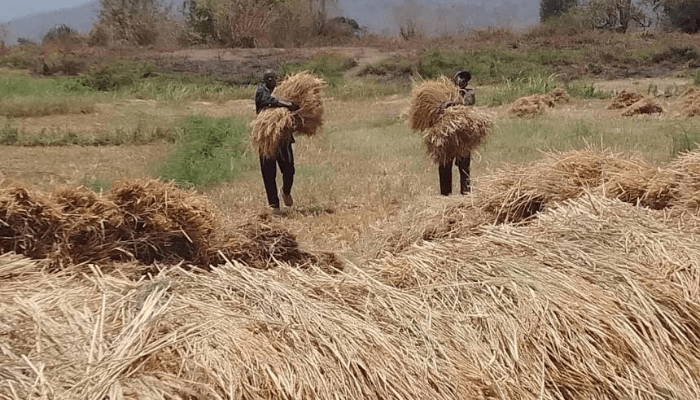
Production costs, insecurity force farmers to retreat as planting season approaches
As the rainy season approaches, farmers across parts of Nigeria have raised fresh concerns over escalating production costs, warning that the trend could deepen food insecurity and worsen economic hardship for millions of households.
As the rainy season approaches, farmers across parts of Nigeria have raised fresh concerns over escalating production costs, warning that the trend could deepen food insecurity and worsen economic hardship for millions of households.
In separate interviews, farmers lamented the persistent increase in the costs of agricultural inputs and transportation. They described the situation as increasingly unsustainable despite their ongoing efforts to cultivate crops.
Key factors affecting agricultural productivity have remained largely unchanged, even as the prices of fertilisers, seedlings, agrochemicals, and other essential inputs continue to rise sharply. Farmers said this has forced many to operate at a loss.
Williams Joseph Zamdai, a commercial farmer, who produces for both household consumption and the market, expressed dissatisfaction with what he described as an unfavourable operating environment. Along with security issues, he identified high input costs, rising transportation costs, and increasing fuel prices as major constraints, noting that these factors have significantly eroded profit margins and discouraged large-scale farming.
“Security is a serious issue. Many farmers are afraid to access their farmlands because their safety cannot be guaranteed,” Zamdai said. He also cited ongoing clashes between herders and farmers as a longstanding challenge disrupting agricultural activities in rural communities, adding that the lack of a lasting solution has compounded difficulties.
Reflecting on the previous farming season, Zamdai described it as a total loss.
“I spent more than N2.5m on my farm last year, but what I harvested cannot fetch more than N1m in the market,” he said. “Farming is the only business we know, but it has become increasingly frustrating.”
Zamdai is considering scaling down to subsistence farming to avoid further financial losses. “We may only farm for our own consumption going forward. Investing heavily in commercial farming now feels like a waste of resources, time, and energy,” he said.
Zamdai also alleged that the current political climate is affecting food availability, claiming that some politicians have stockpiled grains for campaign purposes, thereby distorting the market. He called on the government to intervene urgently by addressing rising input costs, improving transportation infrastructure, and ensuring adequate security.
Another farmer, Jonathan Babangida, described the 2025 farming season as particularly challenging, citing heavy financial losses despite large-scale cultivation of rice, beans, maize, and soybeans.
“Chemical fertilisers were very expensive. We bought NPK for between N50,000 and N60,000, while urea sold for N35,000 to N40,000,” Babangida said. He added that the cost of herbicides and pesticides surged significantly, rising from about N1,500–N2,000 to as much as N5,000 or N7,000.
Babangida also highlighted the rising costs of mechanised farming, noting that hiring tractors and harvesters has become increasingly expensive due to higher fuel prices. “To harrow land using a tractor used to cost about N80,000, but it has increased to N120,000, and it may rise further,” he said.
Despite these rising costs, returns remain low. Babangida noted that a 100kg bag of maize previously sold for N18,000–N20,000, and although prices have increased to about N25,000, profits remain minimal. He further explained that expenses related to storage, packaging, and loan repayments have added to financial burdens.
As the new farming season approaches, many farmers are scaling down operations, with some opting for subsistence farming instead of commercial production. Babangida added that some are shifting away from capital-intensive crops such as rice and maize towards soybeans, which require less investment and fertiliser.
Like Zamdai, Babangida identified insecurity as a major concern, noting that farmers are increasingly reluctant to cultivate distant farmlands due to safety risks. He urged the government to subsidise agricultural inputs and ensure that such support reaches genuine farmers. He also called for improved security measures, including strengthening forest guards to protect farmlands and rural communities.