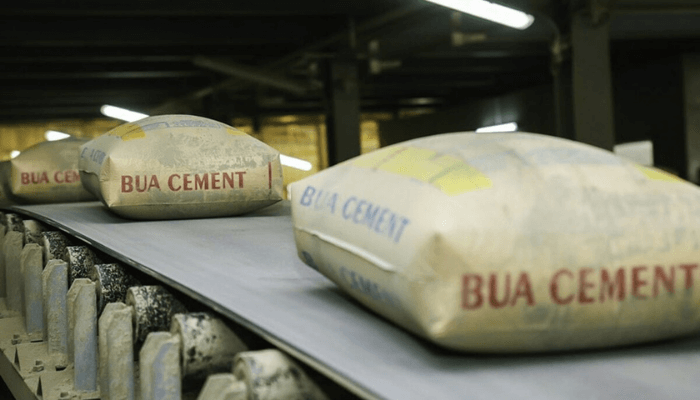
BUA Cement Plc reported profit after tax of N176.38 billion for the three months ended March 31, 2026, from N81.12 billion in the same period of 2025.
- +BUA Cement more than doubles profit on strong sales
Data from the unaudited financial report shows that revenue rose to N354.98 billion from N290.82 billion, driven by sales of bagged cement of N340.58 billion and bulk cement of N14.40 billion.
Data from the unaudited financial report shows that revenue rose to N354.98 billion from N290.82 billion, driven by sales of bagged cement of N340.58 billion and bulk cement of N14.40 billion.
According to market survey, BUA Cement prices in Nigeria were reported to be around N10,000 to N11,000 per 50kg bag, indicating an overall industry price increase of about 30 percent in 2026.
During the period, the cost of sales stood at N153.08 billion, compared with N152.07 billion. The cost base was driven by energy consumption of N67.34 billion, materials of N27.31 billion, and operation and maintenance service charges of N31.41 billion.
Gross profit increased to N201.90 billion from N138.75 billion, reflecting the gap between revenue and production costs.
Operating profit rose to N179.51 billion from N119.04 billion. This was after selling and distribution costs of N15.44 billion, driven by distribution expenses of N11.39 billion and depreciation of N3.25 billion, and administrative expenses of N7.27 billion, driven by employee costs of N2.67 billion and security expenses of N725.39 million.
Finance income increased to N11.28 billion from N1.53 billion, driven by interest income. Finance costs declined to N11.12 billion from N19.32 billion, with interest on borrowings at N10.01 billion and debt securities at N1.12 billion.
Net foreign exchange gain of N13.01 billion, compared with a loss of N836.81 million in 2025, contributed to the profit before tax of N192.68 billion.
According to the company’s earnings report for Q1, the result was driven by cost efficiency, reflecting the outcome of Management’s earlier strategic alignment, and supported by strong interest income growth and foreign exchange gains.
Direct cost per tonne declined for the second consecutive year, down 2.1 percent year-on-year, underscoring sustained cost control and operational efficiency.
On the balance sheet, total assets increased to N1.99 trillion from N1.58 trillion reported in the same period of last year. The asset base was driven by property, plant, and equipment of N1.21 trillion and cash and short-term deposits of N404.05 billion.
Inventories stood at N165.90 billion, including raw materials of N53.45 billion and engineering spares of N61.22 billion. Prepayments and other assets were N163.07 billion.
Equity rose to N849.28 billion from N469 billion, driven by retained earnings of N638.69 billion.
Total liabilities rose to N1.14 trillion from N1.11 trillion. Trade and other payables were N294.08 billion, while short-term borrowings reduced to N127.37 billion from N156.30 billion.
Net cash from operating activities more than doubled to N180.00 billion, with profit before tax rising to N192.68 billion, adjusted for depreciation of N11.50 billion and working capital changes.
Cash used in investing activities was N31.59 billion, driven by capital expenditure on property, plant, and equipment of N42.06 billion.
Financing activities recorded a net cash outflow of N23.54 billion, driven by repayment of borrowings of N138 22.91 billion.
Cash and cash equivalents closed at N404.05 billion, up from N138 billion reported last year, despite outflows from investing and financing activities.
Speaking on the results release, Yusuf Binji, the company’s managing director, said, “It is encouraging to see our results and organisational transformation aligning so well. Revenue growth remained strong as we continue to meet cement demand, including in the bulk segment.
“We also progressed our business transformation programme during the quarter, including the realignment of the Transport Department for greater effectiveness. While the transition presented some challenges, we have now achieved operational stability.
“Following the strategic alignment initiated mid-last year, we expect the benefits to be fully reflected in our bottom line this fiscal year and sustained thereafter. Considering the current geopolitical environment, our cost reduction initiatives have proven timely, safeguarding our profitability and reinforcing operational agility. Over the coming quarters, our focus will be on further reducing operating costs through optimisation and enhanced monitoring while increasing brand penetration, particularly within what we define as “new markets,” he said.