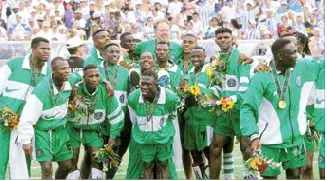
30Thirty years after Nigeria’s historic run at the 1996 Olympic Games in Atlanta, the heroes who delivered the country’s most celebrated athletics and football as well as other landmark medals have taken different paths. ABIODUN ADEWALE looks at where Nigeria’s 1996 Olympic heroes are today and how their lives have unfolded since that historic Games
- +30 years on: Remembering Nigeria’s 1996 Olympic heroes
Before athletics, Ajunwa had a football career and was part of the Super Falcons team to the 1991 FIFA Women’s World Cup.
Before athletics, Ajunwa had a football career and was part of the Super Falcons team to the 1991 FIFA Women’s World Cup. She was unused in that tournament. A year later, she was banned for four years over doping despite maintaining her innocence.
In 1996, she returned to the Games in Atlanta and, to date, remains Nigeria’s only individual Olympic gold medallist. She was also in the Nigeria Police Force and retired as a Deputy Commissioner of Police in 2023. She is now a retired police officer.
She now runs a foundation dedicated to lifting young Nigerians through sports and education.
Babayaro was the first-choice goalkeeper but lost his place to Dosu Joseph in Atlanta. The 1993 U-17 World Cup winner’s international career ended at that level. He turned to the entertainment industry on retirement.
He released his debut album, Best of Both Worlds, courtesy of Rectitude Records in 2010. In 2015, he was named General Manager of National League outfit Kaduna United while he ran his own team, Pioneers Academy. Recently, he delved into digital media by hosting the Special Delivery Podcast on YouTube.
Celestine, Emmanuel’s younger sibling, struck in the 28th minute to cancel out Claudio Lopez’s opener as Nigeria went on to beat Argentina 3-2 in the final at Sanford Stadium, Athens, and claim a first-ever football gold medal, the first by an African team. That was his second goal at the tournament, having also scored during the quarter-final win over Mexico.
Cele, as he is fondly called, went on to play for Chelsea, where he won the UEFA Cup Winners’ Cup (1998), UEFA Super Cup (1998) and the English FA Cup (2000), as well as Newcastle and LA Galaxy. He was at the 1998 and 2002 World Cups and captained the U-23 team at the 2000 Olympics in Sydney, where they crashed out in the quarter-finals.
The left-back announced his retirement from football on July 8, 2010, and was declared bankrupt just seven months later. He has led a quiet life since then, rebuilding his life after football.
The hard-as-nails ex-defender had a glorious club career, where he played for crosstown rivals AC Milan and Inter, Kaiserslautern, Derby County and Partizan Belgrade. He quit the national team in 2005 after playing at the ’98 and 2002 World Cups and reaching the 2000 AFCON final.
He turned pastor on retirement and operates a church, Shelter in The Storm Miracle Ministries of All Nations, in Lagos.
Kanu was the golden boy of the ’96 Games, grabbing three crucial goals — in the opening 1-0 win over Hungary as well as the equaliser and winner against Brazil in the semi-final.
He remains one of Africa’s most decorated footballers after winning the U-17 World Cup, UEFA Champions League, UEFA Cup, UEFA Super Cup, three FA Cups, EPL (two) and two African Player of the Year awards, amongst others.
Papilo is involved in private business, which spreads across the hospitality industry and other sectors. He also owns a football club, Papilo FC, as well as kit-making outfit King Kanu.
He was appointed chairman of nine-time Nigerian champions and two-time CAF Champions League winners Enyimba in 2023.
Aside from his numerous trophies at club level and a few with Nigeria, Kanu is a two-time African Footballer of the Year, winning the award in 1996 and 1999.
The publicity-shy Okechukwu has largely withdrawn from the limelight, preferring to live a quiet lifestyle since he called it quits in the mid-2000s.
When asked recently about what he was doing on retirement from the game, Gentle Giant said, “I’m doing very well and I’m very fine but I don’t play football anymore.”
Recently, he was said to have been appointed Sporting Director of Enyimba, but that was disputed due to the lingering leadership crisis at the team.
Amuneke seemed to be a specialist in showing up when it mattered most between 1994 and 1996. The ex-Barcelona man grabbed the winner to enter the record books as the man who handed Africa its first Olympic gold, before injury cut short his promising career.
Amuneke has since gone into coaching, assisting Manu Garba in 2013 as the Golden Eaglets won a fourth world title, before leading the team to a record fifth title in Chile in 2015.
His coaching career became more famous for giving Super Eagles star striker Victor Osimhen a 15-minute chance to prove himself during trials for the 2015 U-17 team in Abuja. He was promoted as Flying Eagles coach, but his side crashed out of the qualifiers for the 2017 U-20 AFCON.
After guiding Tanzania to their first AFCON appearance in over 40 years in 2019, Amuneke left the job. He was an assistant coach with the Super Eagles in 2022 and was among the candidates for the Super Eagles coaching role in 2024.
Amuneke won the African Player of the Year Award in 1994 and currently works with Heartland Football Club of Owerri.
Babangida played all the matches in Atlanta and scored one goal — the 82nd-minute opener in the 2-0 win over Japan in the group stage.
Having played most of his career in Holland, he called it quits in 2004 after a season at Changchun Yatai.
He worked as an agent but has experience in coaching, having led FC Taraba to a first-ever appearance in the elite domestic league. He was special assistant and liaison to ex-Eagles coach Sunday Oliseh.
In 2024, Babangida was involved in a fatal accident along Kaduna–Zaria Road, where he lost his then one-year-old son and his brother, Ibrahim Babangida, who was a 1993 U-17 World Cup winner.
Since the incident, Babangida has spent most of his time in The Netherlands, where his former clubs have risen to help him recover from the mental stress of the losses.
He also published his autobiography, ‘Between Sun and the Shadow’, which chronicles his life and contributions to Nigerian football.
At the Olympics in 1996, Oruma didn’t feature for Nigeria until the semi-final against Brazil and the final against Argentina. He came on as a second-half substitute in both games.
Since he retired from football in 2010, former Marseille midfielder Oruma has been reportedly ill and largely out of the scene. In 2018, he opened up about how he was defrauded of almost N2bn in an investment.
Fatusi wore the No. 9 jersey in Atlanta and featured in three games during the tournament. He came in as a second-half substitute in the 1-0 defeat against Brazil during the group stage, the 2-0 win over Mexico in the quarter-final and the 4-3 extra-time win over Brazil in the semi-final.