Nigeria’s Policy Graveyard: The Widening Gap Between Reform Ambition and Economic Reality
- +The Nigeria policy watch – Policy, performance & accountability
Welcome to the inaugural edition of The Nigeria Policy Watch, a BusinessDay Monday Weekly dedicated to rigorous, data-driven scrutiny of policy formulation and execution across Africa’s most populous economy.
Welcome to the inaugural edition of The Nigeria Policy Watch, a BusinessDay Monday Weekly dedicated to rigorous, data-driven scrutiny of policy formulation and execution across Africa’s most populous economy. This maiden edition offers a broad introductory overview of the systemic forces that have shaped and constrained Nigeria’s reform record. Subsequent editions will x-ray the adequacy of policy formulation and implementation sector by sector: monetary policy, fiscal management, energy, agriculture, manufacturing, trade, infrastructure and social investment. Our standard is straightforward and will beam a searchlight on what was promised, what was delivered, and what the gap costs Nigeria.
There is a pattern so deeply embedded in Nigeria’s economic history that it now resembles institutional muscle memory. A crisis becomes undeniable. A presidential committee is convened. A reform blueprint is unveiled with ambitious targets, implementation timelines and carefully worded promises of structural transformation. Ministers hold press conferences.
Regulatory agencies issue new frameworks. Development partners commend the direction of travel. Then, slowly and predictably, the structure collapses; the structure collapses under the weight of weak implementation, political compromise and institutional decay.
The power sector is perpetually structurally impaired despite two full decades of reform. Farmers continue to battle insecurity, broken logistics and rising input costs. Manufacturers have been forced to generate their own electricity at enormous expense: the Manufacturers Association of Nigeria estimates that firms now spend as much as 40 percent of total production costs on self-generated power. Infrastructure projects stall mid-execution. Each incoming administration inherits the same structural constraints, commissions new reform programmes and restarts the cycle.
This pattern has long since transcended governance failure. It has become one of the most revealing explanations for Nigeria’s persistent inability to convert reform ambition into productive economic transformation.
That contradiction sits at the heart of The Nigeria Policy Watch. While forthcoming editions will examine monetary policy, fiscal management, energy, agriculture, manufacturing, trade and social policy in close detail, this inaugural edition focuses on three sectors that most starkly capture the scale and cost of Nigeria’s implementation gap: power, agriculture and manufacturing. Together, they form the productive spine of the economy. Energy powers industry. Agriculture stabilises food systems and household welfare.
Manufacturing determines whether diversification is real or rhetorical.
Nigeria’s economic history is not defined by a shortage of reform programmes. It is defined by the persistent failure of those reforms to achieve their stated objectives.
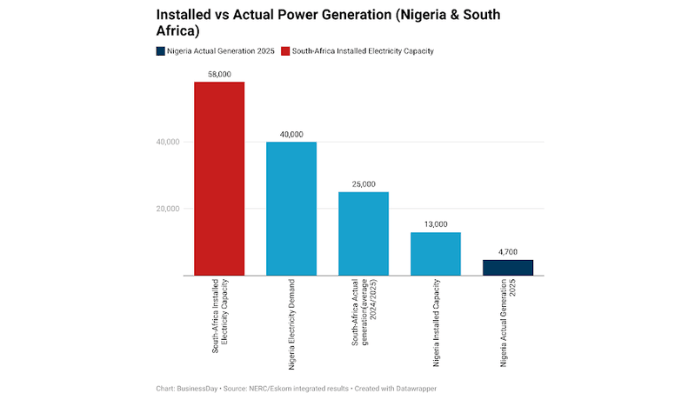
In the power sector, the Electric Power Sector Reform Act of 2005 set out to unbundle the electricity industry, attract private-sector capital and raise generation to levels sufficient for industrialisation. The reform envisioned 40,000 megawatts of electricity generation by 2020. The 2013 privatisation exercise transferred generation and distribution assets to private investors with promises of improved efficiency, better collections and expanded access.
Two decades later, the national grid struggles to deliver an average of 5,000 megawatts.
Agricultural policy tells a structurally similar story. The Anchor Borrowers Programme, introduced in 2015 under former Central Bank Governor Godwin Emefiele, aimed to lift smallholder productivity, reduce food import dependence and forge stronger linkages between farmers and processors. More than ₦1 trillion was reportedly disbursed across multiple commodities.
In narrow terms, the programme recorded partial gains. Rice production rose during the intervention period and integrated mills expanded. But the broader structural outcomes remained weak. Food inflation climbed to nearly 40 percent in 2024. Rice prices surged more than 200 percent between 2016 and 2023. Loan recovery deteriorated sharply, with more than half of rice-sector intervention loans reportedly unrecovered.
Manufacturing policy reflects the same contradiction. Successive industrialisation frameworks sought to raise the sector’s contribution to GDP to roughly 20 percent while reducing import dependence and strengthening industrial competitiveness. Yet manufacturing contributed only 7.62 percent to GDP in the third quarter of 2025, according to National Bureau of Statistics data cited by the Manufacturers Association of Nigeria.
The aggregate data across Nigeria’s key productive sectors reveal an economy struggling to convert policy activity into sustained productivity growth.
In electricity, average generation in 2025 remained below 5,000 megawatts despite installed capacity above 13,000 megawatts — a utilisation gap that points not to absent investment but to absent execution. More than a quarter of electricity generated is still lost before reaching end users through technical and commercial inefficiencies. Distribution companies collected only around 71 percent of billed revenue in Q1 2025, according to the Nigerian Electricity Regulatory Commission, trapping generators, gas suppliers and distributors alike in chronic liquidity stress.
The private sector has increasingly responded by exiting the grid altogether. Industry estimates suggest that more than 250 companies and institutions now operate captive power systems independently — collectively generating more electricity than the national grid supplies on average.
Manufacturing, meanwhile, has become the sector absorbing the cumulative cost of every unresolved structural weakness in the economy. Manufacturers spent hundreds of billions of naira on alternative energy in 2025 alone. Commercial lending rates climbed above 35 percent following aggressive monetary tightening by the Central Bank of Nigeria. Foreign-exchange liberalisation sharply raised the cost of imported raw materials, machinery and fertiliser.
The evidence increasingly points to a single conclusion: Nigeria’s binding economic constraint is no longer policy formulation. It is implementation capacity.
The country already possesses extensive reform frameworks across electricity, petroleum, agriculture, manufacturing and infrastructure. What remains weak is the institutional architecture required to execute those reforms consistently and without political interruption.