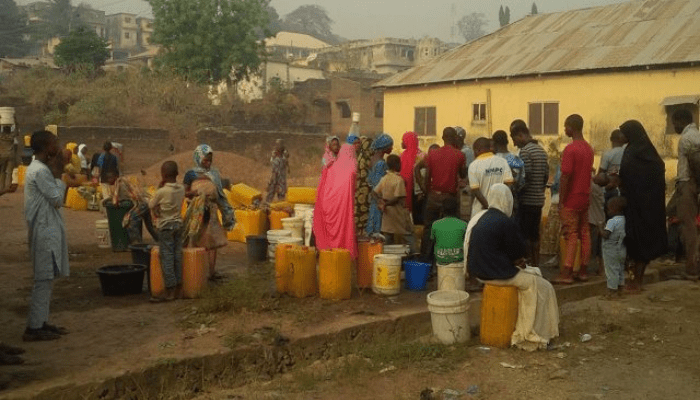
Despite billions of naira invested in water infrastructure projects across the Federal Capital Territory (FCT), residents and businesses in many parts of Abuja continue to face water shortages, relying on boreholes, water vendors, and tankers for daily supply.
- +Abuja battles water scarcity despite over N155bn spent on projects
- +…Residents fear Nigeria’s FCT may suffer typhoid, cholera, others
BusinessDay findings revealed that rapid urbanisation, aging infrastructure, incomplete transmission networks, climate pressures, operational inefficiencies, and governance challenges are major factors behind the crisis.
…Residents fear Nigeria’s FCT may suffer typhoid, cholera, others
BusinessDay findings revealed that rapid urbanisation, aging infrastructure, incomplete transmission networks, climate pressures, operational inefficiencies, and governance challenges are major factors behind the crisis.
Recent water projects undertaken by the FCT Administration have gulped over N155 billion, including $470 million (N65 billion) Greater Abuja Water Supply Project and the rehabilitation of the Phase II Water Treatment Plant at Lower Usuma Dam.
Others are N90 billion Bwari Township Water Supply Project and planned rural water expansion projects in Area Councils supported through Chinese financing and UNICEF partnerships.
Mohammed Dan-Hassan, former Executive Director of the FCT Rural Water Supply and Sanitation Directorate, tells BusinessDay that Abuja’s water infrastructure has not kept pace with population growth.
Hassan explains that insecurity, economic migration, and urban expansion have increased pressure on existing facilities across the FCT.
“The rate of influx is not commensurate with the rate of development,” he said. “People flood the capital territory, and it is overstretching the available facilities.”
He notes that while Abuja’s water treatment plants have the capacity to produce significant volumes of water, but distribution remains the major challenge.
The four treatment plants at the Lower Usuma Dam Water Works were designed to produce thousands of cubic metres of water per hour continuously.
However, production cannot operate at full capacity because transmission infrastructure to expanding districts is incomplete. “You can produce water, but where will you take it to?” he asked.
Hassan highlighted the Greater Abuja Water Supply Project, largely executed by Chinese contractors, which is expected to expand trunk pipelines and transmission systems to underserved districts along the Airport Road corridor and satellite communities.
Major pipelines are currently being laid along routes such as the Kubwa Expressway and Airport Road to extend supply to areas including Lugbe, Lokogoma, and Karsana. However, until transmission lines, reservoirs, and service connections are completed, many communities will remain outside the central water network.
This situation has forced households and businesses to depend on groundwater through private boreholes. Experts warned that reliance on groundwater poses health and sustainability concerns, particularly where water quality testing is not conducted.
Hassan estimated that water supply coverage in the FCT stands at about 60% to 65%, leaving a large proportion of residents without reliable access to pipe-borne water.
“The accessibility to pipe-borne water is not yet up to an optimal level,” he said. “Until all the infrastructure is in place, residents will continue to rely on groundwater and vendors.”
Shortages are more pronounced in satellite towns and growing communities, including Lugbe, Sauka, Goza, Kubwa, Nyanya, and Gwagwalada. Residents in these areas reported going months without public water supply despite ongoing infrastructure projects.
In several communities, people said they spend thousands of naira weekly purchasing water from vendors.
Some residents complained that despite the inauguration of water projects across the capital, many communities remain without access to public supply.
Aisha Musa, a resident of Aco Estate described the situation as “suffering in silence,” while others warned that dependence on shallow wells and unregulated boreholes increases the risk of water-borne diseases.
Residents also cited failed borehole projects linked to groundwater depletion and difficult geological conditions.
Hassan identified illegal connections to trunk pipelines as another challenge affecting supply. Unauthorised connections reduce pressure before water reaches reservoirs and district storage facilities. “People connect directly to the trunk lines, which is not supposed to happen,” he said. “That reduces pressure before the water even gets to the reservoirs.”
He added that vandalism and tampering with infrastructure have also increased maintenance costs and disrupted supply.
Climate variability is also affecting both surface water and groundwater availability in the FCT. Hassan said fluctuating rainfall patterns, evaporation, and sedimentation at the Lower Usuma Dam had reduced water storage efficiency.
To address declining water levels during dry periods, authorities introduced inter-basin water transfer from the Gurara Dam in Kaduna State to support supply at the Lower Usuma reservoir.
Groundwater resources are also under pressure. “Twenty years ago, drilling 40 to 50 metres was considered deep,” he said. “Now, in many places, you need to drill 100 to 200 metres before finding sufficient water.” He linked declining groundwater levels partly to reduced rainfall recharge associated with climate change.
Attah Benson, National Coordinator of the Society for Water and Sanitation (NEWSAN), said recurring shortages reflect institutional and governance challenges. “The issue of water shortage in the FCT has been a long one,” he said. “Government keeps making excuses, but citizens cannot live without water.”
Benson warned that prolonged shortages expose residents to unsafe water sources, poor sanitation, disease outbreaks, lost productivity, and rising healthcare costs.
He said the impact is particularly severe for women and children, who often spend hours searching for water. “We are just lucky diseases have not escalated further,” he said, referring to previous cholera outbreaks in the nation’s capital.
BusinessDay findings also point to operational difficulties within the FCT Water Board. Residents complained of irregular billing, lack of printed bills, and difficulties retrieving account information.
Some consumers said they were unable to access their account details without presenting old paper bills due to system limitations.
Officials within the Board reportedly attributed some of the challenges to procurement delays, shortages of water treatment chemicals, and unpaid electricity debts affecting water facilities.
Sources also alleged that centralised approval processes within the FCT Administration had slowed down operational decisions and delayed routine purchases.
The Water Board is reportedly considering an electronic billing system to address some of the administrative issues.
However, experts said the water projects would require phased implementation before residents begin to see significant improvements.