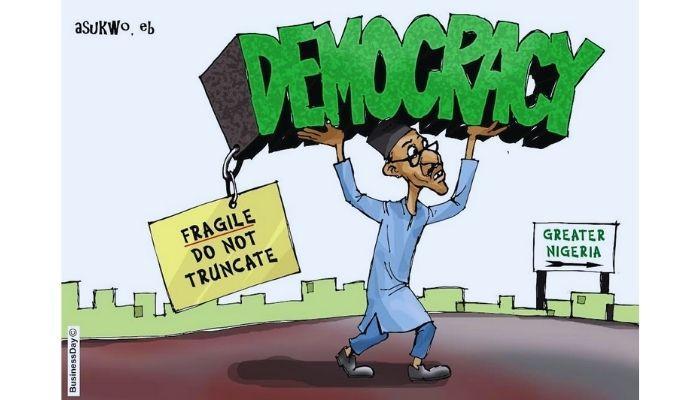
As Nigeria marks twenty-seven years of uninterrupted democratic governance and three years of President Bola Ahmed Tinubu’s administration, two significant assessments of the nation’s condition have emerged almost simultaneously. One comes from the International Monetary Fund (IMF), a global financial institution whose verdicts often influence international perceptions and investor confidence. The other comes from the Federal Government itself, presented during the Democracy Day briefing by top officials led by the Minister of Information and National Orientation, Mohammed Idris, and the Secretary to the Government of the Federation, Senator George Akume.
- +Democracy, Reforms and the Burden of Proof
Interestingly, both narratives tell different sides of the same story.
Interestingly, both narratives tell different sides of the same story. The IMF acknowledges that Nigeria’s economic reforms have strengthened macroeconomic stability and improved resilience. The Federal Government points to positive GDP growth, fiscal reforms, increased student loan disbursements, expanded social intervention programmes, improved access to consumer credit, and the country’s removal from the Financial Action Task Force (FATF) grey list as evidence that Nigeria is moving in the right direction. Yet, the IMF simultaneously warns that poverty is rising, food insecurity remains widespread, inflation continues to exert pressure on households, and more than sixty percent of Nigerians now live below the poverty line.
Far from being contradictory, these two assessments may actually be describing the same reality from different vantage points. The Federal Government is largely measuring progress through institutional and macroeconomic indicators. The IMF is reminding policymakers that the ultimate test of economic policy lies not merely in balance sheets, growth statistics, or investor sentiment, but in the lived experiences of ordinary citizens. The central question, therefore, is not whether reforms were necessary. It is whether the gains of reform are reaching Nigerians quickly and broadly enough. To answer that question, one must first acknowledge a difficult truth. Many of the reforms introduced since 2023 were unavoidable.
For decades, successive governments postponed tough economic decisions. The fuel subsidy regime had become fiscally unsustainable. Multiple foreign exchange windows created distortions that encouraged arbitrage and rent-seeking. Government revenues remained inadequate relative to developmental needs. Public debt obligations increasingly constrain fiscal flexibility. When President Tinubu announced that “fuel subsidy is gone” and subsequently liberalised the foreign exchange market, he addressed structural weaknesses that many economists had long identified. In this regard, the administration deserves recognition for confronting problems that previous governments often preferred to defer.
However, good economics does not automatically translate into good politics or social welfare. The removal of fuel subsidy and exchange-rate liberalisation triggered immediate inflationary consequences. Transportation costs rose sharply. Food prices escalated. Production expenses increased. Household purchasing power weakened considerably. While economists often describe such outcomes as adjustment costs, ordinary citizens experience them as hardship. This distinction matters because citizens judge governments less by economic theory than by everyday realities. The IMF’s observation that over sixty percent of Nigerians now live in poverty should therefore not be dismissed as anti-government criticism. Rather, it should be seen as a warning that economic reform must be accompanied by effective social cushioning mechanisms.
To its credit, the Federal Government has attempted to mitigate the impact of reforms through several intervention programmes. The Student Loan Scheme under NELFUND represents one of the most ambitious educational financing initiatives in Nigeria’s history. Supporting over one million students and disbursing more than N184 billion in tuition and upkeep allowances is no insignificant achievement. For many young Nigerians, access to higher education would have become increasingly difficult without such support. Similarly, the expansion of conditional cash transfers, consumer credit facilities, and grant schemes demonstrates recognition that vulnerable citizens require assistance during periods of economic transition. The government’s removal of Nigeria from the FATF grey list is another notable accomplishment. Beyond its technical significance, it signals improved compliance with international financial standards and enhances Nigeria’s attractiveness to investors. These achievements deserve acknowledgement.
Yet, the government’s burden of proof extends beyond programme outputs and statistical milestones. The average citizen wants to know whether food has become more affordable, whether jobs are more available, whether electricity supply has improved, whether insecurity is receding, and whether personal economic prospects are brighter than they were three years ago.
On these questions, public perceptions remain mixed. This is where the IMF report becomes particularly instructive.
The Fund is essentially cautioning against equating macroeconomic stabilisation with social progress. An economy may be improving on paper while many citizens continue to experience hardship. Indeed, history offers numerous examples of countries that achieved fiscal and monetary stability without immediately reducing poverty. The relationship between macroeconomic reforms and improved living standards is rarely instantaneous. Economic restructuring often requires time before benefits become broadly distributed. The challenge for governments is maintaining public confidence during that waiting period. This is perhaps the most delicate aspect of Nigeria’s current situation.
The Federal Government argues that the country is moving “from fragility toward firmer footing.” The IMF agrees that the footing is firmer but warns that millions remain trapped in difficult conditions. Both positions can simultaneously be true. The real policy challenge lies in bridging the gap between economic stabilisation and social welfare. This gap is especially visible in the area of food security. According to the IMF, more than 27 million Nigerians experienced food insecurity in 2025. This statistic should concern policymakers irrespective of political affiliations. Food insecurity is not merely a humanitarian issue. It is a developmental challenge, a security concern, and a governance test. A nation where millions struggle to access adequate nutrition faces constraints on educational attainment, labour productivity, health outcomes, and social stability.