Five years after, PIA host community development trusts deliver results amid persistent challenges
For most of Nigeria’s oil-producing history, resource benefits flowed to the federal government while the communities living with wells, pipelines, spills and flares received little in return.
For most of Nigeria’s oil-producing history, resource benefits flowed to the federal government while the communities living with wells, pipelines, spills and flares received little in return. Extra-statutory arrangements, such as corporate social responsibility initiatives and Memoranda of Understanding tried to bridge the gap. Still, they carried no legal backing and were deployed at the discretion of oil companies. The Petroleum Industry Act (PIA) 2021 changed that calculus.
Chapter Three of the Act introduced the Host Community Development Trust (HCDT), Nigeria’s first legally binding mechanism, which compels oil and gas settlors to fund development directly in the communities where they operate, at 3% of their annual operating expenditure.
Five years on, the HCDT tells two stories at once: one of real, measurable progress, and another of persistent structural weakness that echoes the failures of the benefit-transfer mechanisms it was designed to replace.
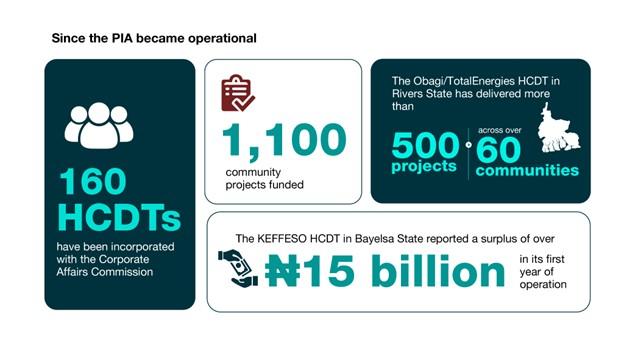
Since the PIA became operational, more than 160 HCDTs have been incorporated with the Corporate Affairs Commission. By October 2025, cumulative contributions to the trusts had exceeded N373 billion, funding more than 1,100 community projects. Individual trusts illustrate what the model can achieve when it works. The Obagi/TotalEnergies HCDT in Rivers State has delivered more than 500 projects across over 60 communities, including a two-storey classroom block, a remodelled cottage hospital, road pavements and a water bottling factory.
The KEFFESO HCDT in Bayelsa State reported a surplus of over N15 billion in its first year of operation. Across Akwa Ibom, Bayelsa and Rivers States, the trusts have funded solar streetlights, boreholes, electricity distribution infrastructure, education scholarships, transformers and vocational training that are visibly changing daily life in host communities.
Yet these numbers risk obscuring a slower and more uneven reality underneath. No settlor met the nine-month deadline the PIA set for establishing a trust, and five years in, an estimated 30% of licence holders still have no incorporated trust. As of mid-2024, roughly 97 of the trusts that had been incorporated remained unfunded, and even where settlors claim to have disbursed their 3% obligation, host communities frequently have no means of verifying the figures against actual operating expenditure. Litigation between communities and the settlors over trust boundaries, inclusion and board composition has slowed implementation further, and despite the National Upstream Petroleum Regulatory Commission’s (NUPRC) power to fine or revoke the licences of defaulting settlors, no sanctions have been documented to date.
A bigger structural risk lies beneath these delays. Research by Policy Alert, supported by BudgIT and Oxfam Nigeria, found that in many communities, the first meetings to nominate trustees were held without the knowledge of host community members, leaving boards dominated by settlors’ former employees, political actors and traditional elites rather than community-chosen representatives. Community needs assessments, meant to shape each trust’s development plan, are often populated by local elites rather than genuine grassroots input.
Women, youths and persons with disabilities remain largely excluded from trust structures, despite regulatory provisions calling for inclusion. Perhaps most consequentially, the law gives host communities almost no formal framework to monitor compliance or enforce accountability. Trusts are largely accountable to settlors and regulators, not to the communities they exist to serve, and there is no mandated mechanism for boards to disclose budgets, accounts or activities to their communities. Deep offshore settlors, meanwhile, have largely avoided establishing trusts altogether, citing the regulator’s delay to formally assign them littoral host communities.
These are implementation gaps that BudgIT strives to close in many communities across the Niger Delta. Long before the PIA’s passage, its FixourOil campaign monitored the petroleum reform bill through years of legislative delay. Since enactment, BudgIT has conducted several town hall meetings, workshops and peer-learning sessions across Niger Delta communities to close the information gap that leaves residents unaware of their rights under the trust model. It has trained journalists to report more effectively on extractive-sector issues and supported community-based organisations to extend awareness campaigns in local dialects. BudgIT has also used advocacy visits to flag implementation challenges with the regulator and facilitated field studies in partnership with Policy Alert and with the support of Oxfam Nigeria, which produced much of the evidence now informing reform proposals.
In November 2025, BudgIT, together with partners, convened a Host Community Development Trust Summit, bringing together HCDT leadership, community representatives, CSOs, and regulators, alongside oil company representatives. The summit gave trusts at different stages of maturity, from fully established with ongoing projects to newly incorporated, a platform to share lessons and address common obstacles, reinforcing the case that benefit sharing works best when communities are treated as partners rather than passive beneficiaries.
Drawing on the evidence from research, multiple field visits and stakeholder engagements, several reform needs increasingly emerge. HCDT regulations should be updated to mandate Trust boards to hold annual town hall meetings and disclose budgets, accounts and audited financial statements to their communities. Reports should also be made publicly available, ideally through the NUPRC web portal, such as HOSTCOMPLY.
Continuous community sensitisation, delivered through radio, town halls and social media, is needed to close the awareness gap that allows settlors and local elites to dominate trust governance. Furthermore, the NUPRC should proceed from making threats to actual enforcement of sanctions against erring operating companies, including for the 125-plus settlors yet to establish trusts. Gender and social inclusion provisions in HCDT regulations need active enforcement rather than passive endorsement, and the National Assembly’s oversight committee should hold the regulator itself accountable for enforcement failures.
The HCDT remains the most ambitious benefit-sharing reform in Nigeria’s oil and gas history. Its early results show what is possible when trusts function as designed. Closing the gap between design and lived experience will determine whether it becomes a lasting departure from the extractive sector’s troubled history, or simply its latest iteration.
Enebi Opaluwa is the Head of Natural Resource and Climate Governance at BudgIT Foundation