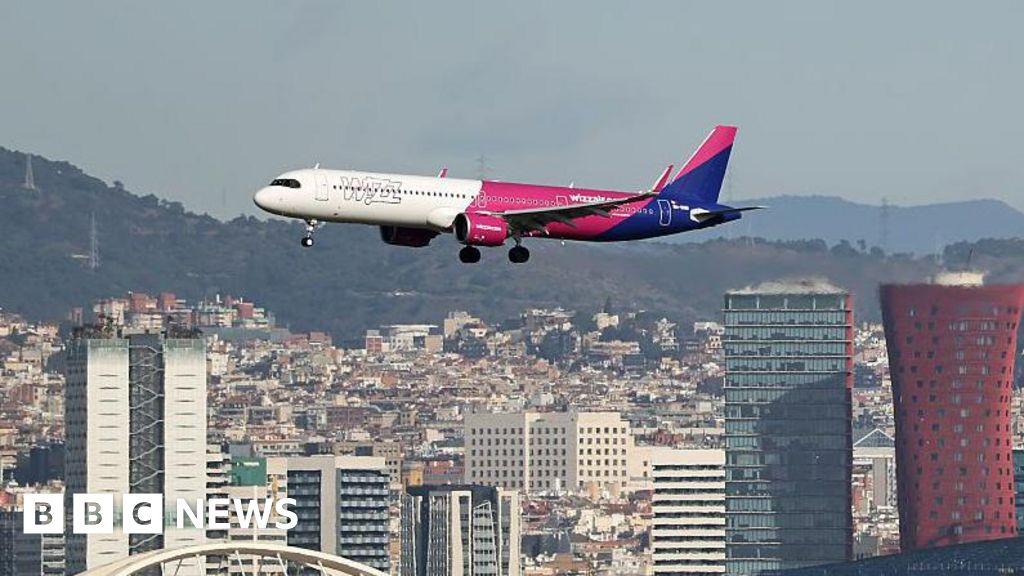
European flight prices are falling as airlines try to overcome customer "hesitancy" over the economic hit from the US-Israel war with Iran, Wizz Air's chief executive has said.
- +European flight prices are falling in short term, Wizz Air boss says
József Váradi said European airlines can make price cuts in the "short term" because they have bought fuel at a price set before the war began.
József Váradi said European airlines can make price cuts in the "short term" because they have bought fuel at a price set before the war began.
His comments contrast with many airlines who have said they are raising prices or cutting flights due to surging jet fuel costs caused by the conflict.
Meanwhile, Spain's industry and tourism minister has advised people to buy flights sooner rather than later to avoid potentially costlier airfares due to the war.
The price of jet fuel in Europe has surged since 28 February when the US and Israel first started attacking Iran.
Back then, it cost $831 (£614) per metric tonne. After more than doubling to $1800, it has since settled back at closer to $1500 – still very high by historical standards.
Europe is heavily dependent on jet fuel imports to meet its needs, and under normal circumstances more than half of these would come from the Gulf region.
However, those supplies have been blocked for the past eight weeks by the effective closure of the Strait of Hormuz due to the war.
As well as pushing up fuel prices, the situation has raised fears of potential shortages, which could lead to disruption and flight cancellations over the summer.
While Váradi said Europe's dependence on jet fuel supplies from the Middle East was "kind of crazy" and needed to be addressed, he believed summer disruption fears have been overplayed.
"I don't think we'll be running out of fuel," he told reporters. "Jet fuel is currently $1500 per metric tonne… and that creates a lot of room to be creative.
"I know for a fact that tankers are going to the United States to pick up fuel and bring that to Europe."
But if shortages did occur, Váradi said it would create a "complete mess", with some airports or suppliers having fuel when others did not.
"Ultimately, if there is not fuel anywhere, then you will have to cancel [flights]," he said.
Although costs have gone up for European carriers, he suggested that passengers could actually benefit in the short term as airlines tried to boost demand to overcome concerns about the conflict.
"Simply people don't know what's going to happen," he said. "Is it going to translate into a bigger energy crisis? Am I going to lose my job? Inflation is through the roof, so am I not going to be able to fill my car?
"So, there is a level of hesitancy," he said. "But to be honest, that level of hesitancy can be overcome through price stimulation. So, short term, you are actually seeing prices dropping."
This was possible, he explained, because many European airlines use hedging policies when buying fuel – committing to buy in advance at fixed prices, a process which can help mitigate sudden increases in costs.
He added that many customers were still choosing to book now, because they feared being hit by price rises if they waited.
Spain's Minister for Industry and Tourism Jordi Hereu has said higher fuel costs due to the war in Iran risked pushing up airfares and slowing demand.
"What we're recommending is that people buy their tickets now because it's true that [airlines] are currently using kerosene that was purchased some time ago, and therefore there's an element of price fluctuations involved," Hereu said in an interview with Spanish newspaper Expansion.
"It's already clear that prices have risen and this could affect demand," he added.
Even if an end to the war was close, Váradi believed jet fuel prices will remain above pre-conflict levels for "a considerable period".
"I don't know whether that is nine months, 12 months or 18 months, but I don't think this is going to go away very quickly."
Chief executive of the association for British travel agents Mark Tanzer said travellers should feel assured there are strong protections in place for them.
"We remain in close contact with airline bodies, who are not currently seeing disruption to jet fuel supply," he said.