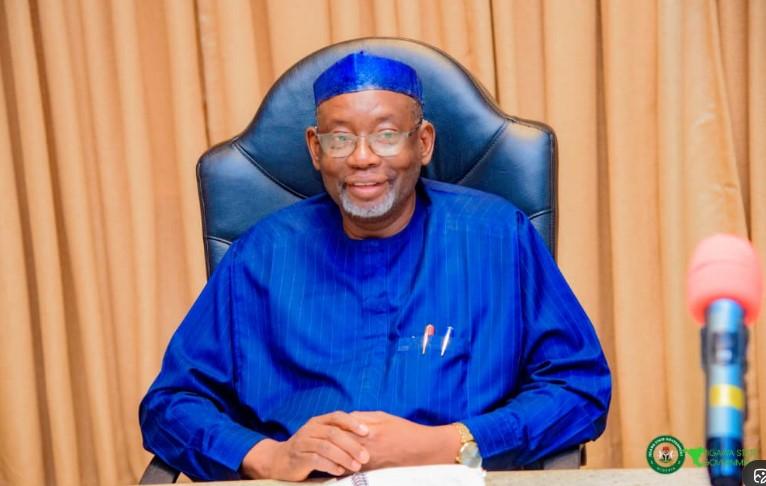
Umar Namadi @ 63: Stewardship defined by integrity and service, By Nasiru Nasiru
Today marks the 63rd birthday of the Governor of Jigawa State, Umar Namadi, a leader widely regarded as emblematic of humility, accountability, transparency and a deep commitment to public service.
Today marks the 63rd birthday of the Governor of Jigawa State, Umar Namadi, a leader widely regarded as emblematic of humility, accountability, transparency and a deep commitment to public service.
Born on 7 April 1963 in Kafin-Hausa, Jigawa State, Namadi popularly known as Mallam or Danmodi, represents a distinctive model of leadership shaped by modesty and discipline.
His worldview was profoundly influenced by his family’s scholarly and religious background. His grandfather, the Chief Imam of Kafin-Hausa town, laid the foundation for his moral and spiritual upbringing.
He began his early education at Kafin-Hausa Central Primary School, alongside Qur’anic and Islamiyya studies. He later attended Mallam Madori Teachers’ College, where he obtained his Teachers’ Grade II Certificate in 1982. In 1984, he earned his Advanced Level Certificate with distinction, securing admission into Bayero University Kano, where he graduated with a BSc in Accounting in 1987 and subsequently obtained an MBA.
Following his graduation, Namadi undertook the mandatory National Youth Service Corps (NYSC) in Makurdi, Benue State, serving as an Audit Assistant with Egwu Oga & Co. He went on to build a solid professional career between 1988 and 1994 at Abdu Abdurrahim & Co. Chartered Accountants in Kano, where he handled audit management and consultancy services.
He later worked briefly with the National Board for Community Banks as a Principal Inspection Officer, and subsequently at Kaduna Textiles Limited in various capacities. His career trajectory took a significant leap when he joined the Dangote Group, where he rose from Assistant General Manager (Finance) to Financial Controller, serving both Dangote Sugar Refinery and the wider group.
Transitioning from the private sector, Mr Namadi brought his expertise into public service. Between 2006 and 2013, he served at the National Health Insurance Scheme (NHIS) as General Manager of Finance & Accounts and later as General Manager of the Contribution Management Department.
He subsequently ventured into private enterprise, serving as Managing Partner of Namadi, Umar & Co. Chartered Accountants, and as Chairman/CEO of Danmodi Food Processing Limited and Danmodi Farms Limited.
Before becoming Deputy Governor of Jigawa State in 2019, Namadi served as Commissioner for Finance and Economic Planning from 2015 to 2019. In that role, he championed reforms that enhanced fiscal efficiency and transparency.
His career across public and private sectors has been marked by discipline, ethical consistency and a steadfast commitment to due process—qualities that have earned him a reputation as a principled and incorruptible professional.
Among his defining attributes are his philanthropic disposition, grassroots orientation, and unwavering dedication to the welfare of the people. His investment in Danmodi Food Processing Limited—the first private rice milling company in Jigawa State—has created employment opportunities for many youths.
Since assuming office as governor on 29 May 2023, Namadi has introduced a renewed sense of purpose and direction in Jigawa State. His leadership reflects the confidence reposed in him by the electorate, and within a relatively short period, he has delivered a governance record that continues to inspire optimism.
His administration has prioritised infrastructure development, education reform, healthcare improvement, agricultural advancement, human capital development and job creation. These priorities are anchored in a comprehensive 12-point agenda aimed at fostering economic growth and improving living standards. Among the key sectors of focus are:
Agriculture remains central to the state’s development strategy. Through the Jigawa Agricultural Revitalisation Programme (JARP), over 60,000 farmers have benefited from subsidised inputs, modern equipment and mechanised services. The rehabilitation of irrigation schemes in Hadejia, Birnin Kudu and Kazaure has transformed seasonal farming into year-round agricultural activity, significantly boosting food production.
The state has also promoted export-oriented initiatives in rice, sesame and hibiscus, linking local farmers to international markets and increasing incomes.
Education has received significant attention, with over 700 classrooms renovated and 1,500 qualified teachers recruited. The Girl-Child Support Programme—offering free uniforms, meals and scholarships—has improved school enrolment and retention rates.
In healthcare, the Jigawa Health Access Programme (J-HAP) provides free maternal and child healthcare services across all 287 wards. New primary healthcare centres have been constructed, while existing ones have been upgraded with modern facilities and personnel.
The administration has embarked on extensive infrastructure development, including the construction of over 500 kilometres of rural roads. These projects have improved connectivity, facilitated trade and enhanced access to economic opportunities.
Through the Jigawa Micro Enterprise Initiative, more than ₦2.5 billion has been disbursed to small and medium-scale enterprises, particularly those owned by youth and women. Vocational training centres have been revitalised through partnerships with private sector stakeholders, equipping young people with digital and technical skills.
These efforts have positioned Jigawa among the more proactive states in job creation and SME development, with youth unemployment steadily declining.
The administration has earned commendation from civil society for its transparent budgeting processes and firm anti-corruption stance. By adopting the Open Government Partnership (OGP) model, the state has enhanced public access to financial records and project tracking.
Security has also improved through stronger collaboration between local vigilante groups and national security agencies, alongside sustained peacebuilding initiatives across communities.
In 2024, Governor Namadi received the Nigeria Governors’ Forum Award for Good Governance and Innovation, reflecting the impact of his policies. Jigawa State also ranked among the top-performing states in budget transparency and fiscal discipline.
Looking ahead, the administration has outlined plans for green energy development, agro-processing zones and expanded digital infrastructure.
At 63, Umar Namadi stands as one of Jigawa’s most consequential leaders in recent history. With the prospect of a second term on the horizon, the state appears poised to witness even greater strides under his stewardship.
Happy birthday to the People’s Mallam and servant leader.
*Nasiru M. Nasiru writes from Abuja.