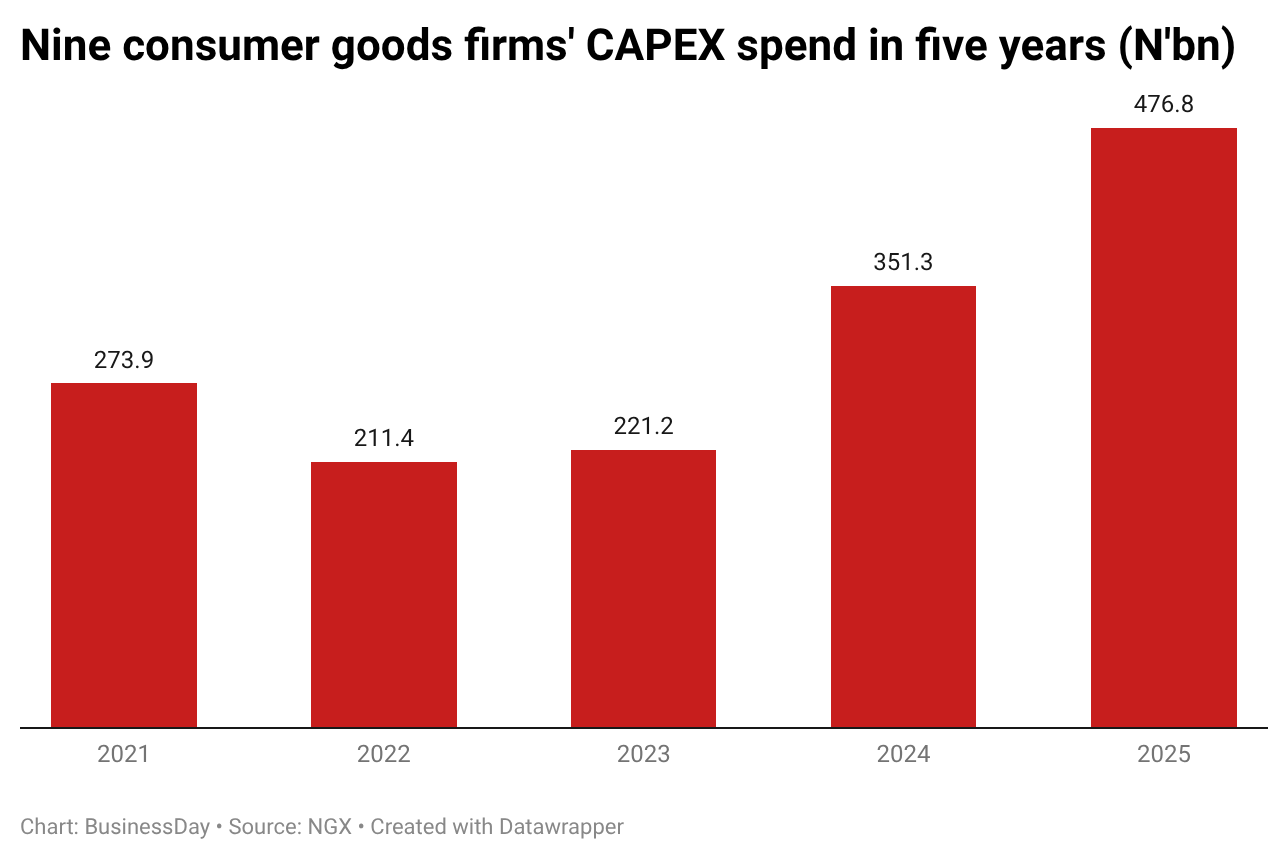
After years of holding back, consumer goods firms are opening up their wallets, deploying as much as N476.7 billion in 2025 toward factories, equipment, and supply chain expansion.
- +FMCG firms deepen expansion as capital spending hits five-year high
- +Expansion bets in a stabilising economy
According to data tracked by BusinessDay using the 2025 audited cash flow financial statements of consumer goods manufacturers listed on the Nigerian Exchange (NGX), capital expenditure (CAPEX) spending of nine manufacturers rose from N221.19 billion in 2023 to N351.32 billion in 2024, before rising further to N476.76 billion in 2025, the highest level in five years.
According to data tracked by BusinessDay using the 2025 audited cash flow financial statements of consumer goods manufacturers listed on the Nigerian Exchange (NGX), capital expenditure (CAPEX) spending of nine manufacturers rose from N221.19 billion in 2023 to N351.32 billion in 2024, before rising further to N476.76 billion in 2025, the highest level in five years.
The firms surveyed include Nestle Nigeria, Unilever Nigeria, Cadbury Nigeria, BUA Foods, Nascon Allied Industries Plc, Dangote Sugar Refinery, Nigerian Breweries, International Breweries, and Champion Breweries.
Kemi Abiodun, consumer goods analyst at CardinalStone Research, said capex spend among consumer goods firms increased due to ongoing investments in operational efficiency, asset replacement, and supply chain improvements, indicating that they are no longer in survival mode.
“The trend also reflects higher replacement costs driven by inflationary pressures and foreign exchange volatility, as well as periodic catch-up spending on previously deferred maintenance. For example, Nestle expanded its Golden Morn plant and also upgraded some of its vehicles and trade assets at Agbara,” she added.
Similarly, Modupe Arinde, research analyst at Meristem Securities, said the increase in capital expenditure was supported by an improving macroeconomic environment in 2025FY, with easing inflation and reduced FX volatility compared to prior years.
“These conditions made it easier for consumer goods companies to plan and commit to longer-term investments, including the acquisition of property, plant, and equipment. As a result, spending was increasingly directed toward efficiency-enhancing assets. For example, NASCON invested in CNG trucks in 2025 to lower operating expenses and improve distribution efficiency. This led to an increase in NASCON’s capex spending in 2025 FY,” Arinde said.
A deep dive into the financial statement shows that these manufacturers’ capital expenditure margins increased 0.83 percentage points year over year, from 6.84 percent in 2024 to 7.67 percent in 2025.
Capital expenditure margin (capex margin) is a metric that measures how much a company is spending on capital expenditure, essentially, the acquisition of new fixed assets, relative to its revenue.
That optimism was largely absent just a few years ago. Between 2021 and 2023, total capex declined from N273.93 billion to N211.43 billion, before rising to N221.19 billion. The period was characterised by severe FX shortages, currency misalignment, and rising operating costs, which eroded margins and forced companies to prioritise liquidity over expansion.
At the company level, the pullback was pronounced. BUA Foods, one of the sector’s biggest investors in 2021 with N107.2 billion in capex, reduced spending to N15.5 billion in 2022 as it paused expansion projects. Although it recovered to N37.1 billion in 2023, investment remained well below earlier levels.
Similarly, Nestlé Nigeria reduced capex to N4.77 billion in 2022 and N5.69 billion in 2023, reflecting a defensive posture in response to rising input costs and exchange rate pressures. Dangote Sugar also cut back, with capex falling from N51.3 billion in 2021 to N19.5 billion in 2023.
Even in the brewing segment, where investment levels remained relatively elevated, growth stalled. Nigerian Breweries maintained capex at just under N100 billion between 2022 and 2023, while International Breweries saw spending decline from N58.5 billion to N45.7 billion over the same period.
The shift in 2024, therefore, represents more than a cyclical uptick; it signals a structural change in how companies are approaching growth.
The most dramatic increase came from Nestlé Nigeria, whose capex jumped from N5.69 billion in 2023 to N62.6 billion in 2024, before more than doubling to N131.4 billion in 2025.
“The increase reflects the ongoing CAPEX initiatives related to strategic capacity expansion plans, which bode well for future earnings growth and manufacturing efficiency,” analysts at Cardinal Stone said in a notice.
A similar trend is evident in the brewing industry, where competition is intensifying. International Breweries increased capex from N45.7 billion in 2023 to N71.8 billion in 2024 and further to N111.4 billion in 2025, while Nigerian Breweries sustained high investment levels, reaching N140.4 billion in 2024 before easing slightly to N123.8 billion in 2025.
“Brewers typically account for a larger capex spend due to the capital-intensive nature of their operations, which require continuous investment in production facilities, bottling infrastructure, and logistics networks,” Abiodun, a CardinalStone analyst, noted.
“What we are seeing is capacity expansion, distribution strengthening, and likely innovation in product offerings, all aimed at defending or growing market share,” she added.
Elsewhere, Dangote Sugar is ramping up spending again, with capex rising to N44.7 billion in 2025, reflecting continued investment in backward integration projects. Nascon Allied Industries Plc also recorded a sharp increase, with capex jumping from N2.29 billion in 2024 to N23.7 billion in 2025, indicating a shift toward more aggressive expansion.
More measured spending patterns were observed in Unilever Nigeria and Cadbury Nigeria, where capex remained relatively stable at around N6 billion in 2024 and 2025.
Expansion bets in a stabilising economy
The drivers of the current capex surge are both structural and cyclical. Improved macroeconomic visibility has played a key role, as companies gain more clarity on exchange rates and policy direction. Although the operating environment remains challenging, it is less unpredictable than in previous years, allowing firms to plan and execute long-term investments.
Muyiwa Oni, head of equity research, West Africa at Stanbic IBTC Bank, stated that Nigeria’s GDP is estimated to grow by 3.99 percent in the first quarter and 4.22 percent in 2026, up from 3.87 percent in 2025.
Inflation, which has eased to 15.06 percent in February from 23.18 percent reported in February 2025, has also supported the rise in capex. However, the cost of machinery, construction, and imported inputs remains elevated, meaning that part of the growth in capex is nominal rather than purely volume-driven.
At the same time, companies are investing to address structural vulnerabilities exposed during the FX crisis. Localisation of inputs and backward integration have become central strategies, particularly for firms in food processing and manufacturing. By reducing reliance on imported raw materials, companies aim to protect margins and improve supply chain resilience.