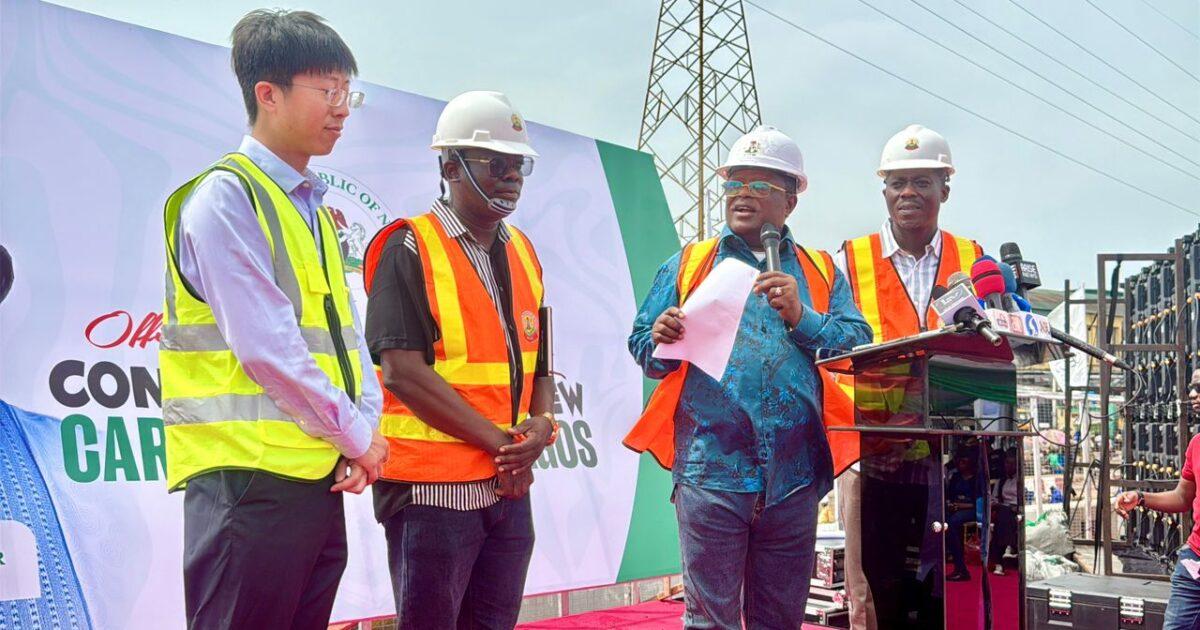
The Federal Government has approved the construction of a new Carter Bridge in Lagos at a project cost of about N545bn, as part of efforts to rebuild critical infrastructure and address long-standing structural defects affecting major bridges in the state.
- +FG hands over construction of N545bn Carter Bridge project to CCECC
The contract for the new bridge has been awarded to China Civil Engineering Construction Corporation, following what officials described as a competitive procurement process involving several international and local firms.
The contract for the new bridge has been awarded to China Civil Engineering Construction Corporation, following what officials described as a competitive procurement process involving several international and local firms.
The handover ceremony took place on Wednesday at the Carter Bridge site in Lagos Island, where the Minister of Works, Senator David Umahi, said the decision followed years of technical investigations that confirmed severe underwater structural damage to both Carter Bridge and Third Mainland Bridge.
A statement issued by the minister’s Senior Special Assistant on Media, Francis Nwaze, said the project is expected to run for 36 months, with funding structured through 30 per cent Federal Government counterpart financing and 70 per cent external borrowing.
The statement read, “The Federal Government has officially handed over the construction of a brand-new Carter Bridge in Lagos to China Civil Engineering Construction Corporation, as part of President Bola Ahmed Tinubu’s commitment to protecting critical infrastructure and ensuring the safety of Nigerians. The event took place at Carter Bridge, Lagos Island, Lagos State, on Wednesday, May 6, 2026.”
Speaking during the handover ceremony, the Minister of Works, Senator David Umahi, said the decision to reconstruct the bridge became necessary after years of structural investigations revealed worsening defects beneath both Carter Bridge and the Third Mainland Bridge.
According to the minister, earlier assessments dating back to 2013 and 2019 had already raised concerns, but fresh investigations conducted under the current administration showed that the situation had worsened significantly.
The reports, he said, indicated that the defects were increasing at what experts described as “geometrical progression.”
“The past administration commissioned investigation of what was happening with the structural elements below the water, and that was in 2013. And very disturbing defects were noticed in Carter Bridge and Third Mainland Bridge,” Umahi said.
The minister explained that further underwater inspections conducted after he assumed office confirmed that some of the supporting piles had become displaced from their pile caps.
He said, “When we went deeper with specialist divers and geologists, we discovered that some of the piles had moved away from their pile caps. It’s just like the hip of the leg is cut off. That is the level of damage we are dealing with.”
According to him, after consultations with local and international experts, the Federal Government concluded that repairing the bridge would cost almost as much as constructing a new one.
He said, “Experts advised us that the cost of rehabilitation was almost double the cost of a new structure. So we took a decision to build a brand-new Carter Bridge that will serve Lagos better and safer.”
Umahi disclosed that the new design will include a modern cable-stayed section to improve both aesthetics and navigation along the waterway.
He said, “Part of this new Carter Bridge will be a cable-stayed structure. You see those beautiful bridges overseas. This will enhance navigation and also give Lagos a world-class infrastructure.”
“The project is expected to be completed within 36 months, with funding structured through a combination of federal counterpart contributions and external financing. The Federal Government will provide about 30 per cent of the funding, while 70 per cent will be sourced externally.”
Umahi said due process was followed in selecting the contractor, adding that six firms participated in the bidding process.
He said, “The CCECC was technically and commercially the most viable. That is why the Bureau of Public Procurement recommended them and the Federal Executive Council approved the award.”
The minister formally handed over the site to the contractor and directed immediate mobilisation, stressing that the project would be closely monitored by the ministry.
In a related development, Umahi also announced the emergency closure of one carriageway of Eko Bridge following what he described as severe structural damage caused by illegal dredging activities.
He said illegal sand mining around the bridge had weakened key structural components after barges struck pile caps supporting the bridge.
He said, “When they knocked the pile cap, they broke three piles. When they were trying to remove the barge, they broke another two. That section is now dangerously weak.”
As a precaution, he ordered that one carriageway of Eko Bridge be shut down from midnight on Sunday, May 10, 2026, while the other side remains open to traffic.
He said, “We will not allow people to endanger lives. This is a responsible government, and we are taking emergency action to prevent disaster.”
Umahi added that emergency engineering interventions, including lifting sections of the bridge for underwater repairs, have already been activated, with specialist contractors engaged.
He assured Lagos residents that President Bola Tinubu had directed that the situation be treated as an emergency, with immediate technical response.
The minister appealed for patience from commuters, saying the interventions, though disruptive, are necessary to secure the long-term safety of critical infrastructure.
“We are solving problems we didn’t create, but that’s why you voted for us, and that we are going to be working day and night,” he said.
The PUNCH reports that Carter Bridge is one of Lagos’ oldest and most strategic road links, connecting Lagos Island to the mainland through Iddo. The original structure dates back to the colonial era, when it was first constructed in the early 1900s and later rebuilt and expanded in the 1970s to accommodate rising traffic demand.
The bridge plays a critical role in Lagos’ transport network, serving as a major corridor for commuters, traders, and commercial vehicles entering the island business districts. However, over the years, it has suffered from ageing infrastructure, heavy traffic load, and environmental stress from its coastal location.
Repeated engineering assessments have raised concerns about its underwater foundations, particularly its piles and pile caps, which support the bridge across the lagoon. These structural vulnerabilities have prompted renewed federal intervention, culminating in the decision to fully reconstruct the bridge with a modern design.