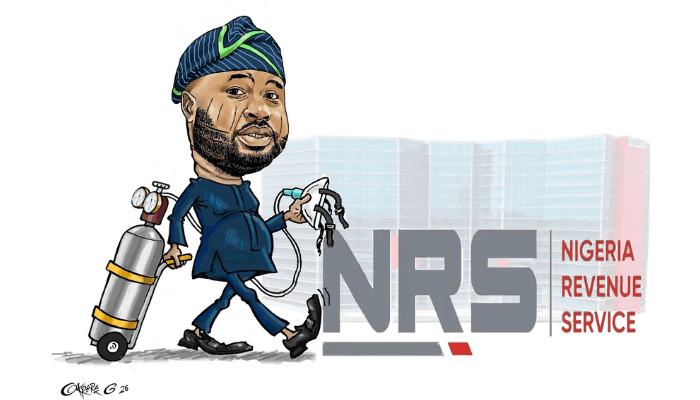
…As NRS moves from traditional tax authority to digitised, data-driven institution
- +Zacch Adedeji: Giving oxygen to Nigeria Revenue Service
- +…President Tinubu gives agency’s chair thumbs up
When President Bola Ahmed Tinubu appointed Zacch Adedeji as chairman of the Federal Inland Revenue Service (FIRS) in September 2023, the assignment before him was daunting.
…President Tinubu gives agency’s chair thumbs up
When President Bola Ahmed Tinubu appointed Zacch Adedeji as chairman of the Federal Inland Revenue Service (FIRS) in September 2023, the assignment before him was daunting.
Nigeria’s tax system was widely seen as inefficient, burdened by leakages, weak compliance, bureaucratic bottlenecks, and an overdependence on oil revenues. Government revenues consistently struggled to match the growing demands of a country seeking economic stability, infrastructure expansion, and fiscal sustainability.
Less than three years later, the story has changed dramatically.
Today, the Nigeria Revenue Service (NRS), formerly known as the FIRS, is at the centre of one of the most ambitious fiscal reform efforts in Nigeria’s recent history. At the heart of that transformation is Adedeji, the accountant, technocrat and reform-driven administrator whose leadership has reshaped the country’s revenue collection architecture.
The numbers tell part of the story. In 2024, the FIRS recorded a historic N21.66 trillion in revenue collection, representing 111.6 percent of its target for the year. Non-oil taxes exceeded projections by 28 percent and accounted for 73.4 percent of total collections, a major shift for a country long dependent on crude oil earnings.
The momentum continued in 2025, and the agency surpassed its annual target by generating N28.3 trillion against a projected N25.2 trillion.
For many observers, the figures reflected more than aggressive tax collection. They signalled a restructuring of the country’s fiscal culture.
The reforms were driven by a clear objective: to widen the tax net, improve compliance, block leakages, and modernise tax administration without overburdening ordinary Nigerians.
That vision aligned closely with President Tinubu’s broader economic agenda.
Speaking during the commissioning of the NRS headquarters in Abuja in April 2026, Tinubu described revenue reform as central to his administration’s “Renewed Hope” programme.
“Our goal is to widen the tax net without overburdening the hardworking citizens of this country,” the president said.
He noted that the newly commissioned headquarters, a 16-floor complex built to accommodate over 3,000 workers, would strengthen technology-driven tax administration and improve accountability in revenue collection.
The new headquarters also symbolised the evolution of the agency itself.
From a traditional tax authority, the NRS is gradually becoming a digitised and data-driven institution. Automation of tax systems, electronic filing platforms, Tax Identification Number verification processes, and integrated digital operations have become key pillars of the agency’s strategy.
Under Adedeji’s leadership, the agency intensified investments in technology to reduce manual processes and improve efficiency.
Those familiar with his leadership style say the reforms are consistent with his long-standing approach to public service, one driven by technical expertise, speed, and institutional restructuring.
An Abuja-based financial analyst, Anthony Anana, described Adedeji as “a brilliant mind” whose commitment to public service distinguishes him from many public officials.
“In a country where many people see public service as an unserious job that should not demand anybody’s commitment, there are some Nigerians who take their jobs seriously. Zacch Adedeji, executive chairman of the Nigeria Revenue Service (NRS) is an example of a brilliant mind in Nigeria. I am very proud of him,” the analyst said.
Others point to his professional background as a major advantage.
“Adedeji’s pedigree, knowledge and scholarship lent him to the job. He is a proper and prime fit. He didn’t have to learn the ropes because as an A-grade chartered accountant, tax collection and management were no strangers to him. He found a natural and professional habitat at NRS. This is global best practice; get the right personnel with the requisite skills set to critical positions,” another analyst said.
Before joining the government, Adedeji built a career in finance and corporate management at Procter & Gamble, where he rose to become Corporate Finance Manager for West Africa. He later served as Commissioner for Finance in Oyo State between 2011 and 2015, where he gained experience in public finance management.
He also served as Executive Secretary of the National Sugar Development Council before becoming Special Adviser to the President on Revenue and subsequently chairman of the FIRS.
His academic credentials equally reflect his grounding in finance and taxation. Adedeji studied Accountancy at the Federal Polytechnic, Ede, before earning a First-Class degree in Management and Accounting from Obafemi Awolowo University, Ile-Ife. He later obtained both a master’s degree and a PhD in Accounting from the institution and completed an executive programme at the Harvard Kennedy School in the United States.
But beyond qualifications, supporters argue that his greatest contribution has been execution.
Under his watch, the agency has pursued reforms aimed at making tax administration less opaque and more predictable. The transition from FIRS to NRS, backed by sweeping tax reforms signed into law in 2025, expanded the agency’s responsibilities to include petroleum royalties and mineral revenues, consolidating several revenue streams under one structure.
The reforms also came with an ambitious mandate. For 2026 alone, the NRS is targeting over N40 trillion in revenue generation as Nigeria seeks to strengthen domestic revenues and reduce fiscal vulnerabilities.
President Tinubu, in a birthday tribute to Adedeji earlier this year, credited him with helping to restructure the country’s revenue profile and supporting broader economic reforms, including the implementation of the National Single Window project designed to streamline import and export processes.
“He recorded a historic achievement, meeting the budget targets in the third quarter of 2025 and stimulating the economy for prosperity,” Tinubu said.
For many economic analysts, the significance of the reforms extends beyond revenue figures.
A stronger non-oil tax base is increasingly viewed as critical to Nigeria’s long-term economic stability, particularly at a time of global oil market uncertainty and rising fiscal pressures.
The growth in non-oil tax revenues under Adedeji’s leadership is therefore being interpreted as an early indication that Nigeria may finally be making progress toward sustainable revenue diversification.
Challenges remain. Tax compliance levels are still relatively low, the informal sector remains largely untapped, and businesses continue to raise concerns about multiple taxation and the cost of compliance.