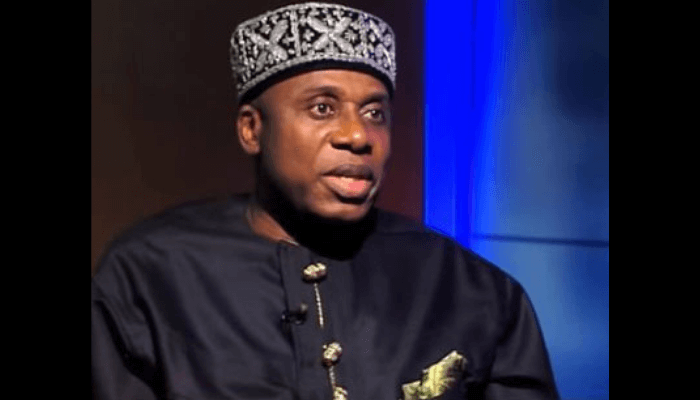
Amaechi Rejects Tinubu’s Claim on Buhari’s 2015 Victory, Says Opposition Coalition Decided Election Outcome
Rotimi Amaechi, Former Minister of Transportation, has dismissed claims that President Bola Tinubu was solely responsible for the emergence and 2015 electoral victory of late former President Muhammadu Buhari, insisting instead that the outcome was driven by a broad coalition of political actors.
Rotimi Amaechi, Former Minister of Transportation, has dismissed claims that President Bola Tinubu was solely responsible for the emergence and 2015 electoral victory of late former President Muhammadu Buhari, insisting instead that the outcome was driven by a broad coalition of political actors.
Amaechi argued that Buhari’s victory in the 2015 presidential election was the product of collective mobilisation efforts across opposition ranks, not the influence of any single political figure. He said the historic defeat of the Peoples Democratic Party (PDP), which had governed Nigeria for 16 years, was made possible through coordinated efforts, strategic alliances, and widespread grassroots engagement by several key stakeholders within the then-opposition movement.
Speaking during an interview on Friday on Arise Television, the former Rivers State governor rejected suggestions that Tinubu alone engineered Buhari’s path to victory. He maintained that attributing the outcome to one individual distorted the complex political negotiations and partnerships that culminated in the formation of the All Progressives Congress (APC) and its eventual success at the polls.
Amaechi further stated that he played a central role in Buhari’s electoral breakthrough, noting that he led significant mobilisation efforts that helped consolidate support for the opposition candidate across key regions of the country. According to him, these coordinated activities were critical in building the momentum that ultimately unseated the ruling party at the time.
The comments come amid renewed political debate over the credit for the 2015 opposition victory, widely regarded as a turning point in Nigeria’s democratic history. The election marked the first time an incumbent president was defeated in Nigeria’s history, following a rare coalition of opposition parties that rallied behind Buhari’s candidacy.
Tinubu, a prominent figure in the formation of the APC, has previously been associated with the strategic alliance-building that merged opposition blocs ahead of the election. However, Amaechi’s remarks challenge the narrative that credits any single leader with determining the outcome.
Since 2015, competing accounts have persisted within political circles over the relative contributions of key actors in the APC’s formation and electoral success. Amaechi’s latest comments are expected to further intensify those debates as stakeholders continue to revisit the party’s founding history and leadership dynamics.